BREAKTHROUGH REVIEW

Breakthrough review

Submissions that exceed a published record enter the Pending queue first. Passing the arena verifier is only the first step; an entry moves to Verified only after source, metric convention, rounding precision, and construction checks are complete.

Verified breakthroughs190
Pending candidates21
Problem families15
CLAIM POLICY

Certification standards

  1. 01Traceable external benchmarkThere must be a public source and an explicit comparison value. An internal baseline generated by this site does not count as an external record.
  2. 02Verified complete constructionThe complete answer is rescored by the submission verifier. Each certification snapshot is pinned to that exact score and contributor and does not transfer when the record changes hands.
  3. 03Rule out precision artefactsTruncated and rounded literature values are expanded to their most conservative interval, accounting for coordinate precision, solver tolerances, and reconstruction error. Last-digit tweaks within uncertainty bounds remain candidates; certification requires either a proof or a margin beyond all identified uncertainties.

Certifications permanently record historical achievements. For live standings, holding the current site #1 earns 1 point and a certified world #1 adds +3 points; an internal takeover removes both, while an external advance removes the world #1 bonus. Historical certifications do not stack points.

VERIFIED ACHIEVEMENTS

Verified breakthroughs

Newest certifications first; same-day results are ordered by improvement. Each sub-problem shows its strongest certified result. World #1 points depend on current records.

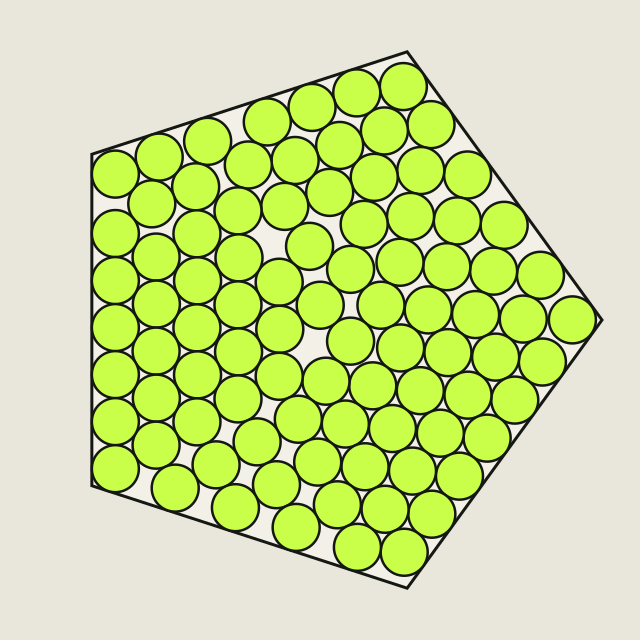
Current verifiable construction for Equal circles in regular polygons, m = 5 · n = 89Left: the sub-problem's current record construction. Right: the pinned score and contributor from the certified breakthrough.
97 · P82Historical honour · no current points

Equal circles in regular polygons · m = 5 · n = 89

Published best known[0.083373984545, 0.083373984547]
→
Verified here0.083377346
Relative improvement+0.004032%
Verified contributor
condor#338
Solution method
AI · OpenAI: GPT-6.1 Sol
Verified

Review: The exact certificate 0.083377346 clears the conservative published upper endpoint 0.083373984547. Two source-only local starts were checked against all pairs and walls; the best numerically feasible refined radius is about 0.083373991729064. Matching container symmetries and circle permutations leaves maximum displacement 0.01669, with 10 near-contact pairs removed and 26 added, supporting a changed arrangement. Local search is a diagnostic against simple polishing, not a global optimality proof.

Packomania (compiled by Eckard Specht), m=5, n=89. Eckard Specht, program cpt , 2023. The site cites the table's value and author; the configuration is not imported. The table does not mark this row proved.
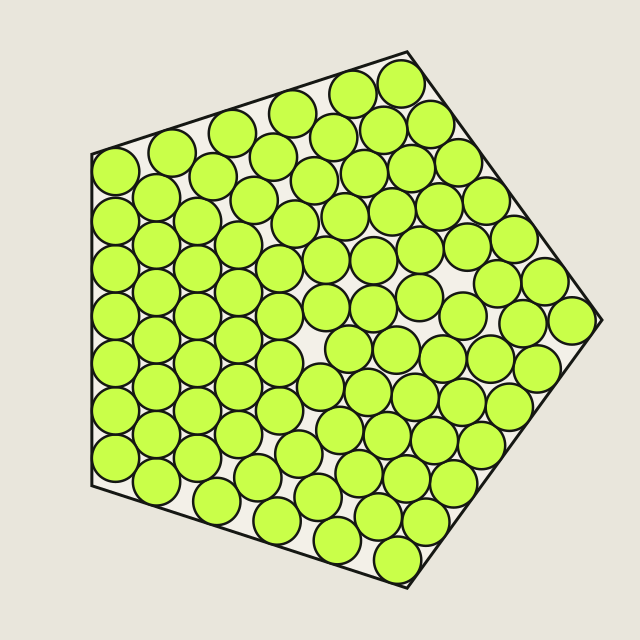
Current verifiable construction for Equal circles in regular polygons, m = 5 · n = 88Left: the sub-problem's current record construction. Right: the pinned score and contributor from the certified breakthrough.
98 · P82Historical honour · no current points

Equal circles in regular polygons · m = 5 · n = 88

Published best known[0.083957834536, 0.083957834538]
→
Verified here0.083960843
Relative improvement+0.003583%
Verified contributor
condor#338
Solution method
AI · OpenAI: GPT-6.1 Sol
Verified

Review: The exact certificate 0.083960843 clears the conservative published upper endpoint 0.083957834538. Two source-only local starts were checked against all pairs and walls; the best numerically feasible refined radius is about 0.0839578345365. Matching container symmetries and circle permutations leaves maximum displacement 0.02526, with 11 near-contact pairs removed and 25 added, supporting a changed arrangement. Local search is a diagnostic against simple polishing, not a global optimality proof.

Packomania (compiled by Eckard Specht), m=5, n=88. Eckard Specht, program cpt , 2023. The site cites the table's value and author; the configuration is not imported. The table does not mark this row proved.

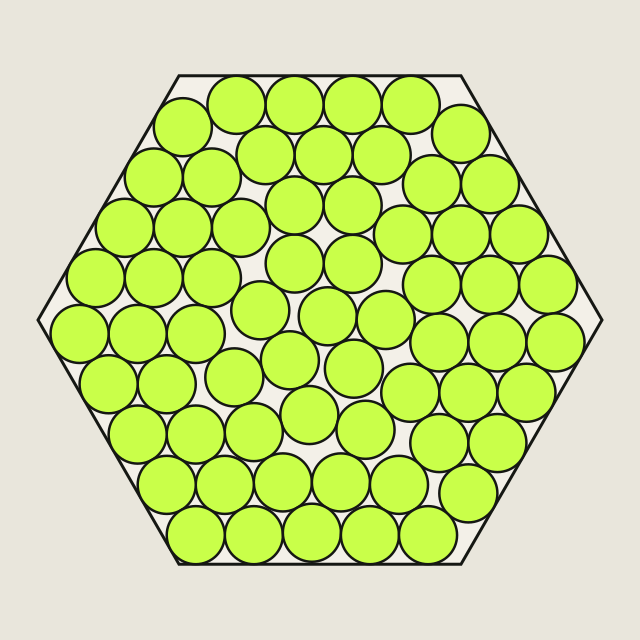
Current verifiable construction for Equal circles in regular polygons, m = 6 · n = 64Left: the sub-problem's current record construction. Right: the pinned score and contributor from the certified breakthrough.
99 · P82World #1 · currently +3

Equal circles in regular polygons · m = 6 · n = 64

Published best known[0.102994077926, 0.102994077928]
→
Verified here0.102997653
Relative improvement+0.003471%
Verified contributor
condor#338
Solution method
AI · OpenAI: GPT-6.1 Sol
Verified

Review: The exact certificate 0.102997653 clears the conservative published upper endpoint 0.102994077928. Two source-only local starts were checked against all pairs and walls; the best numerically feasible refined radius is about 0.10299407792728. Matching container symmetries and circle permutations leaves maximum displacement 0.06862, with 12 near-contact pairs removed and 13 added, supporting a changed arrangement. Local search is a diagnostic against simple polishing, not a global optimality proof.

Packomania (compiled by Eckard Specht), m=6, n=64. Eckard Specht, program chx , 2020. The site cites the table's value and author; the configuration is not imported. The table does not mark this row proved.

Earlier certifications (1)

These snapshots preserve the original scores, benchmark sources, and contributors. Historical honours remain permanently; live points apply only to an eligible current holder and do not stack across multiple reviews.

Joost de Winter #338

[0.102994077926, 0.102994077928]→0.102996845+0.002687%

AI · OpenAI: GPT-6.1 Sol

Review: The original submission re-verifies exactly. The source table and coordinates were downloaded again. Two source-only local refinements (original radius and an inward-relaxed radius) give a best diagnostic value about 0.102994077927285, versus this submission's 0.102996845. Symmetry-aware point matching shows changed contacts and improvement beyond publication precision, rather than repair of a rounded site exhibit. Optimisation results are diagnostic, not an upper bound or a global optimality proof.

Packomania (compiled by Eckard Specht), m=6, n=64. Eckard Specht, program chx , 2020. The site cites the table's value and author; the configuration is not imported. The table does not mark this row proved. ↗
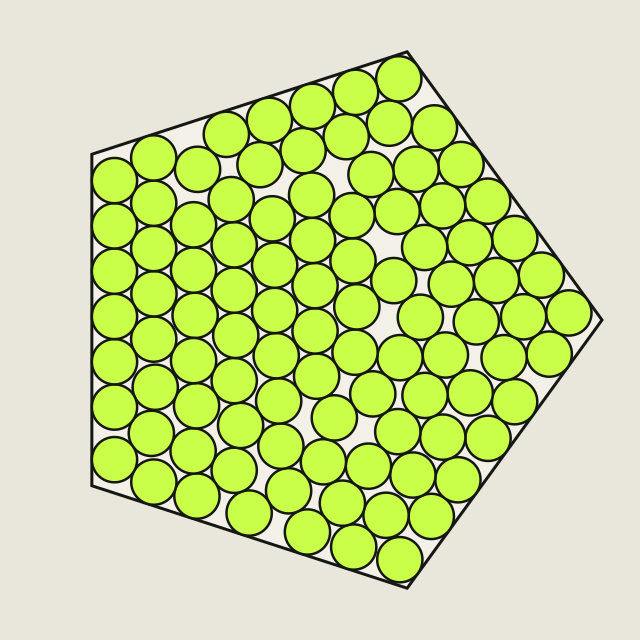
Current verifiable construction for Equal circles in regular polygons, m = 5 · n = 96Left: the sub-problem's current record construction. Right: the pinned score and contributor from the certified breakthrough.
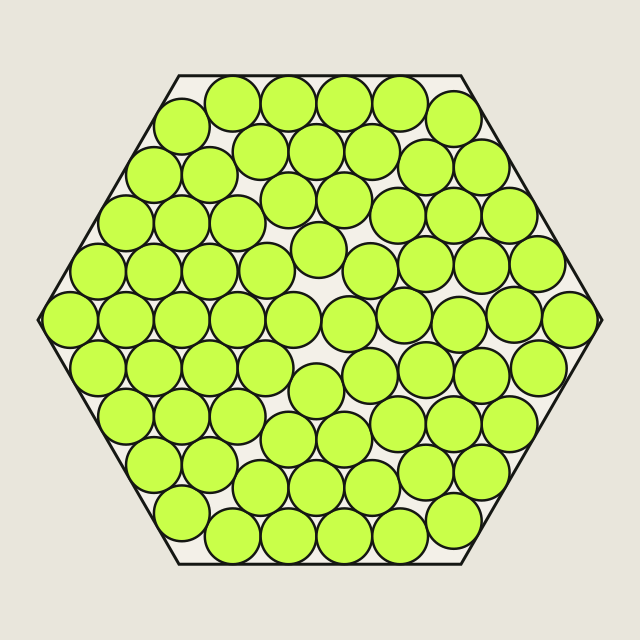
100 · P82Historical honour · no current points

Equal circles in regular polygons · m = 5 · n = 96

Published best known[0.080301040265, 0.080301040267]
→
Verified here0.080303164
Relative improvement+0.002645%
Verified contributor
condor#338
Solution method
AI · OpenAI: GPT-6.1 Sol
Verified

Review: The exact certificate 0.080303164 clears the conservative published upper endpoint 0.080301040267. Two source-only local starts were checked against all pairs and walls; the best numerically feasible refined radius is about 0.080301040266327. Matching container symmetries and circle permutations leaves maximum displacement 0.00508, with 8 near-contact pairs removed and 6 added, supporting a changed arrangement. Local search is a diagnostic against simple polishing, not a global optimality proof.

Packomania (compiled by Eckard Specht), m=5, n=96. Paolo Amore, Circle packing in regular polygons , Phys. Fluids 35 , 027130 (2023). The site cites the table's value and author; the configuration is not imported. The table does not mark this row proved.

Current verifiable construction for Equal circles in regular polygons, m = 6 · n = 70Left: the sub-problem's current record construction. Right: the pinned score and contributor from the certified breakthrough.
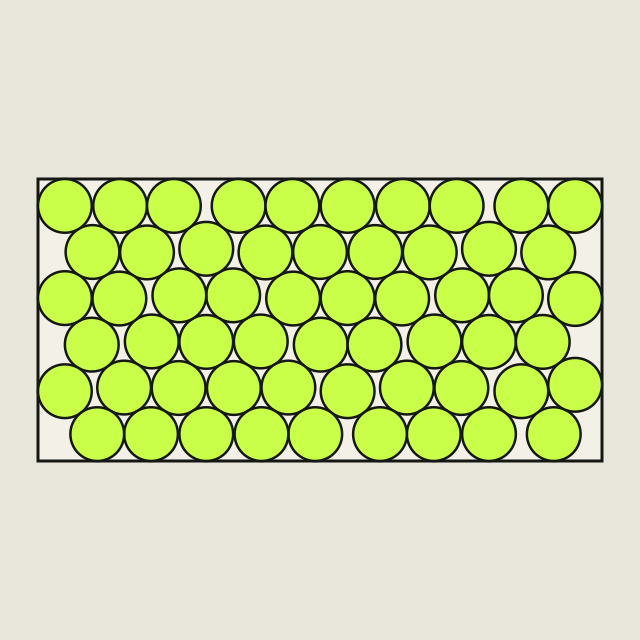
101 · P82World #1 · currently +3

Equal circles in regular polygons · m = 6 · n = 70

Published best known[0.098953578374, 0.098953578376]
→
Verified here0.098955726
Relative improvement+0.00217%
Verified contributor
condor#338
Solution method
AI · OpenAI: GPT-6.1 Sol
Verified

Review: The exact certificate 0.098955726 clears the conservative published upper endpoint 0.098953578376. Two source-only local starts were checked against all pairs and walls; the best numerically feasible refined radius is about 0.098953578374921. Matching container symmetries and circle permutations leaves maximum displacement 0.01841, with 2 near-contact pairs removed and 8 added, supporting a changed arrangement. Local search is a diagnostic against simple polishing, not a global optimality proof.

Packomania (compiled by Eckard Specht), m=6, n=70. Paolo Amore, Circle packing in regular polygons , Phys. Fluids 35 , 027130 (2023). The site cites the table's value and author; the configuration is not imported. The table does not mark this row proved.

Current verifiable construction for Equal-circle packing in a 2:1 rectangle, n = 57Left: the sub-problem's current record construction. Right: the pinned score and contributor from the certified breakthrough.
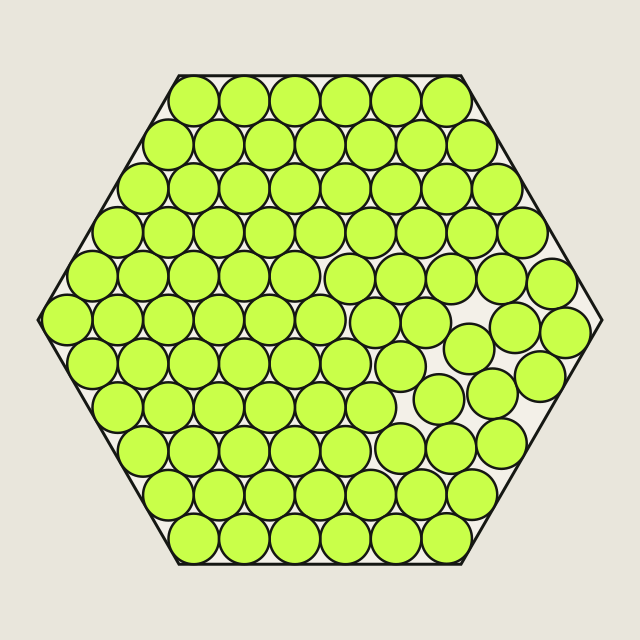
102 · P12World #1 · currently +3

Equal-circle packing in a 2:1 rectangle · n = 57

Published best known[0.095307426822987297251292693015, 0.095307426822987297251292693017]
→
Verified here0.095308884
Relative improvement+0.001529%
Verified contributor
condor#338
Solution method
AI · OpenAI: GPT-6.1 Sol
Verified

Review: The exact certificate 0.095308884 clears the conservative published upper endpoint 0.095307426822987297251292693017. Two source-only local starts were checked against all pairs and walls; the best numerically feasible refined radius is about 0.095307426822988. Matching container symmetries and circle permutations leaves maximum displacement 0.007882, with 18 near-contact pairs removed and 7 added, supporting a changed arrangement. Local search is a diagnostic against simple polishing, not a global optimality proof.

Packomania's crc table, compiled by Eckard Specht, keeps the best known packings of equal circles in a 1 × 0.5 rectangle; this problem's 2 × 1 rectangle is that one doubled, so the radius is twice the table's. The table cites David W. Cantrell (2010-08-30) for this row. It does not mark this row proved

Earlier certifications (1)

These snapshots preserve the original scores, benchmark sources, and contributors. Historical honours remain permanently; live points apply only to an eligible current holder and do not stack across multiple reviews.

condor #338

[0.095307426822987297251292693015, 0.095307426822987297251292693017]→0.095307613+0.000195%

AI · OpenAI: GPT-6.1 Sol

Review: The original submission re-verifies exactly. The source table and coordinates were downloaded again. Two source-only local refinements (original radius and an inward-relaxed radius) give a best diagnostic value about 0.0953074268229878, versus this submission's 0.095307613. Symmetry-aware point matching shows changed contacts and improvement beyond publication precision, rather than repair of a rounded site exhibit. Optimisation results are diagnostic, not an upper bound or a global optimality proof.

Packomania's crc table, compiled by Eckard Specht, keeps the best known packings of equal circles in a 1 × 0.5 rectangle; this problem's 2 × 1 rectangle is that one doubled, so the radius is twice the table's. The table cites David W. Cantrell (2010-08-30) for this row. It does not mark this row proved ↗
Current verifiable construction for Equal circles in regular polygons, m = 6 · n = 88Left: the sub-problem's current record construction. Right: the pinned score and contributor from the certified breakthrough.
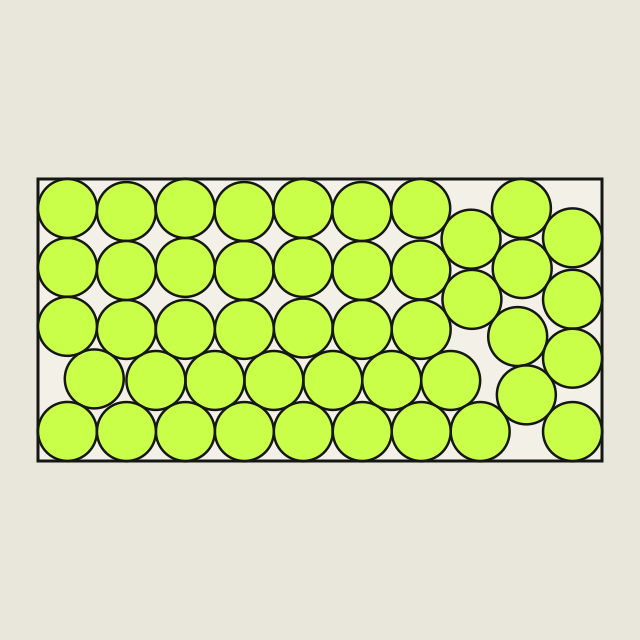
103 · P82World #1 · currently +3

Equal circles in regular polygons · m = 6 · n = 88

Published best known[0.089674476084, 0.089674476086]
→
Verified here0.089675701
Relative improvement+0.001366%
Verified contributor
condor#338
Solution method
AI · OpenAI: GPT-6.1 Sol
Verified

Review: The exact certificate 0.089675701 clears the conservative published upper endpoint 0.089674476086. Two source-only local starts were checked against all pairs and walls; the best numerically feasible refined radius is about 0.089674476085118. Matching container symmetries and circle permutations leaves maximum displacement 0.02921, with 8 near-contact pairs removed and 9 added, supporting a changed arrangement. Local search is a diagnostic against simple polishing, not a global optimality proof.

Packomania (compiled by Eckard Specht), m=6, n=88. Paolo Amore, Circle packing in regular polygons , Phys. Fluids 35 , 027130 (2023). The site cites the table's value and author; the configuration is not imported. The table does not mark this row proved.

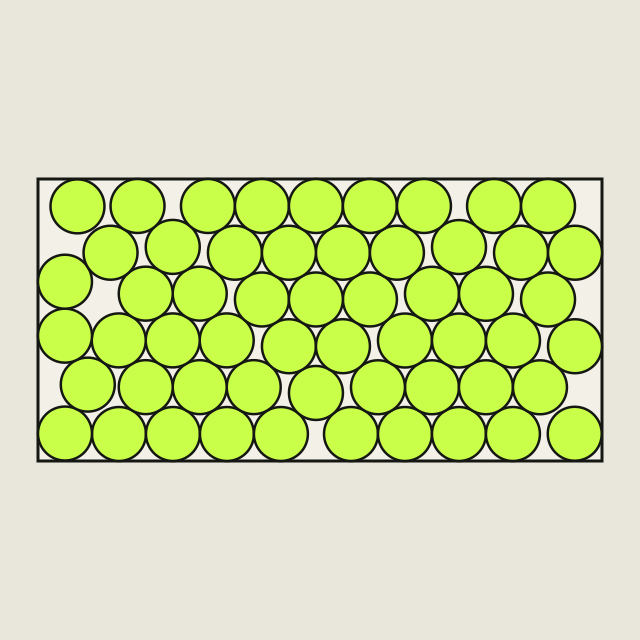
Current verifiable construction for Equal-circle packing in a 2:1 rectangle, n = 46Left: the sub-problem's current record construction. Right: the pinned score and contributor from the certified breakthrough.
104 · P12World #1 · currently +3

Equal-circle packing in a 2:1 rectangle · n = 46

Published best known[0.104530388091175692588349823739, 0.104530388091175692588349823741]
→
Verified here0.104531506
Relative improvement+0.001069%
Verified contributor
condor#338
Solution method
AI · OpenAI: GPT-6.1 Sol
Verified

Review: The exact certificate 0.104531506 clears the conservative published upper endpoint 0.104530388091175692588349823741. Two source-only local starts were checked against all pairs and walls; the best numerically feasible refined radius is about 0.10453038809118. Matching container symmetries and circle permutations leaves maximum displacement 0.0372, with 7 near-contact pairs removed and 18 added, supporting a changed arrangement. Local search is a diagnostic against simple polishing, not a global optimality proof.

Packomania's crc table, compiled by Eckard Specht, keeps the best known packings of equal circles in a 1 × 0.5 rectangle; this problem's 2 × 1 rectangle is that one doubled, so the radius is twice the table's. The table cites Eckard Specht (2010-08-10) for this row. It does not mark this row proved

Current verifiable construction for Equal circles in regular polygons, m = 6 · n = 95Left: the sub-problem's current record construction. Right: the pinned score and contributor from the certified breakthrough.
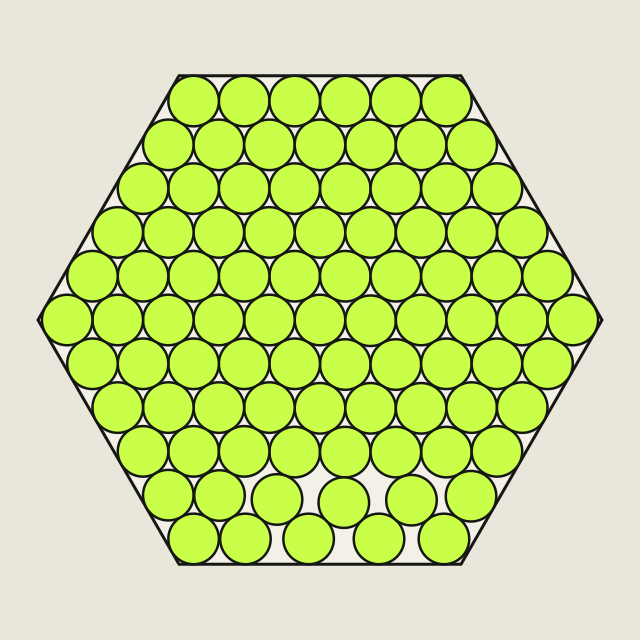
105 · P82Historical honour · no current points

Equal circles in regular polygons · m = 6 · n = 95

Published best known[0.085401704333, 0.085401704342]
→
Verified here0.085402533
Relative improvement+0.00097%
Verified contributor
condor#338
Solution method
AI · OpenAI: GPT-6.1 Sol
Verified

Review: The exact certificate 0.085402533 clears the conservative published upper endpoint 0.085401704342. Two source-only local starts were checked against all pairs and walls; the best numerically feasible refined radius is about 0.085401706328934. Matching container symmetries and circle permutations leaves maximum displacement 0.02227, with 6 near-contact pairs removed and 19 added, supporting a changed arrangement. Local search is a diagnostic against simple polishing, not a global optimality proof.

Packomania (compiled by Eckard Specht), m=6, n=95. Eckard Specht, program chx , 2020. The site cites the table's value and author; the configuration is not imported. The table does not mark this row proved. The table prints 0.085401704341 and its radius.txt 0.085401704334; they agree to nine decimals, and the comparison window covers both.

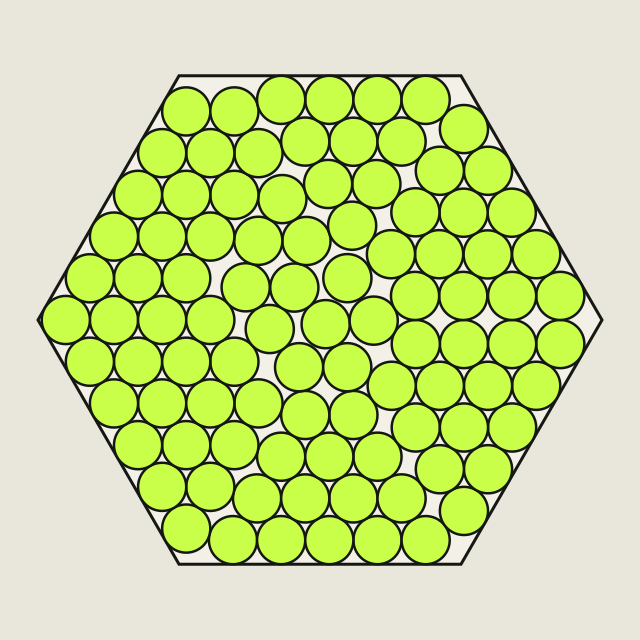
Current verifiable construction for Equal circles in regular polygons, m = 6 · n = 89Left: the sub-problem's current record construction. Right: the pinned score and contributor from the certified breakthrough.
106 · P82Historical honour · no current points

Equal circles in regular polygons · m = 6 · n = 89

Published best known[0.089648390876, 0.08964839094]
→
Verified here0.089648861
Relative improvement+0.000524%
Verified contributor
condor#338
Solution method
AI · OpenAI: GPT-6.1 Sol
Verified

Review: The exact certificate 0.089648861 clears the conservative published upper endpoint 0.08964839094. Two source-only local starts were checked against all pairs and walls; the best numerically feasible refined radius is about 0.089648452428751. Matching container symmetries and circle permutations leaves maximum displacement 0.09398, with 7 near-contact pairs removed and 18 added, supporting a changed arrangement. Local search is a diagnostic against simple polishing, not a global optimality proof.

Packomania (compiled by Eckard Specht), m=6, n=89. Eckard Specht, program chx , 2020. The site cites the table's value and author; the configuration is not imported. The table does not mark this row proved. The table prints 0.089648390877 and its radius.txt 0.089648390939; they agree to nine decimals, and the comparison window covers both.

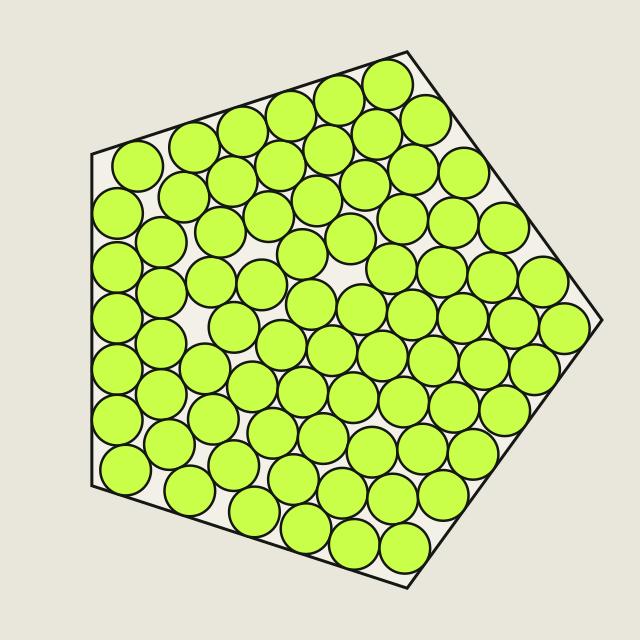
Current verifiable construction for Equal circles in regular polygons, m = 5 · n = 76Left: the sub-problem's current record construction. Right: the pinned score and contributor from the certified breakthrough.
107 · P82Historical honour · no current points

Equal circles in regular polygons · m = 5 · n = 76

Published best known[0.089885244873, 0.089885244875]
→
Verified here0.089885662
Relative improvement+0.000464%
Verified contributor
condor#338
Solution method
AI · OpenAI: GPT-6.1 Sol
Verified

Review: The exact certificate 0.089885662 clears the conservative published upper endpoint 0.089885244875. Two source-only local starts were checked against all pairs and walls; the best numerically feasible refined radius is about 0.089885247114276. Matching container symmetries and circle permutations leaves maximum displacement 0.02417, with 2 near-contact pairs removed and 8 added, supporting a changed arrangement. Local search is a diagnostic against simple polishing, not a global optimality proof.

Packomania (compiled by Eckard Specht), m=5, n=76. Eckard Specht, program cpt , 2023. The site cites the table's value and author; the configuration is not imported. The table does not mark this row proved.

Current verifiable construction for Equal-circle packing in a 2:1 rectangle, n = 56Left: the sub-problem's current record construction. Right: the pinned score and contributor from the certified breakthrough.
108 · P12World #1 · currently +3

Equal-circle packing in a 2:1 rectangle · n = 56

Published best known[0.095707426403254254068587403303, 0.095707426403254254068587403305]
→
Verified here0.095707714
Relative improvement+0.0003%
Verified contributor
condor#338
Solution method
AI · OpenAI: GPT-6.1 Sol
Verified

Review: The exact certificate 0.095707714 clears the conservative published upper endpoint 0.095707426403254254068587403305. Two source-only local starts were checked against all pairs and walls; the best numerically feasible refined radius is about 0.095707426403254. Matching container symmetries and circle permutations leaves maximum displacement 0.01759, with 10 near-contact pairs removed and 9 added, supporting a changed arrangement. Local search is a diagnostic against simple polishing, not a global optimality proof.

Packomania's crc table, compiled by Eckard Specht, keeps the best known packings of equal circles in a 1 × 0.5 rectangle; this problem's 2 × 1 rectangle is that one doubled, so the radius is twice the table's. The table cites Eckard Specht (1999–2010) for this row. It does not mark this row proved

Earlier certifications (1)

These snapshots preserve the original scores, benchmark sources, and contributors. Historical honours remain permanently; live points apply only to an eligible current holder and do not stack across multiple reviews.

Joost de Winter #338

[0.095707426403254254068587403303, 0.095707426403254254068587403305]→0.09570761+0.000192%

AI · OpenAI: GPT-6.1 Sol

Review: The original submission re-verifies exactly. The source table and coordinates were downloaded again. Two source-only local refinements (original radius and an inward-relaxed radius) give a best diagnostic value about 0.0957074264032557, versus this submission's 0.09570761. Symmetry-aware point matching shows changed contacts and improvement beyond publication precision, rather than repair of a rounded site exhibit. Optimisation results are diagnostic, not an upper bound or a global optimality proof.

Packomania's crc table, compiled by Eckard Specht, keeps the best known packings of equal circles in a 1 × 0.5 rectangle; this problem's 2 × 1 rectangle is that one doubled, so the radius is twice the table's. The table cites Eckard Specht (1999–2010) for this row. It does not mark this row proved ↗