BREAKTHROUGH REVIEW

Breakthrough review

Submissions that exceed a published record enter the Pending queue first. Passing the arena verifier is only the first step; an entry moves to Verified only after source, metric convention, rounding precision, and construction checks are complete.

Verified breakthroughs131
Pending candidates112
Problem families16
CLAIM POLICY

Certification standards

  1. 01Traceable external benchmarkThere must be a public source and an explicit comparison value. An internal baseline generated by this site does not count as an external record.
  2. 02Verified complete constructionThe complete answer is rescored by the submission verifier. Each certification snapshot is pinned to that exact score and contributor and does not transfer when the record changes hands.
  3. 03Rule out precision artefactsTruncated and rounded literature values are expanded to their most conservative interval, accounting for coordinate precision, solver tolerances, and reconstruction error. Last-digit tweaks within uncertainty bounds remain candidates; certification requires either a proof or a margin beyond all identified uncertainties.

Certifications permanently record historical achievements. For live standings, holding the current site #1 earns 1 point and a certified world #1 adds +3 points; an internal takeover removes both, while an external advance removes the world #1 bonus. Historical certifications do not stack points.

VERIFIED ACHIEVEMENTS

Verified breakthroughs

Newest certifications first; same-day results are ordered by improvement. Each sub-problem shows its strongest certified result. World #1 points depend on current records.

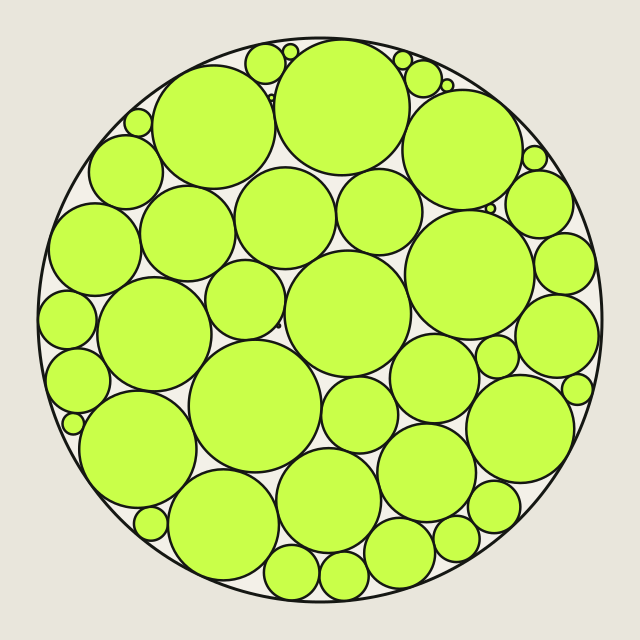
Current verifiable construction for Packing circles of radius 1,2,…,n into a circle, n = 44Left: the sub-problem's current record construction. Right: the pinned score and contributor from the certified breakthrough.
61 · P06World #1 · currently +3

Packing circles of radius 1,2,…,n into a circle · n = 44

Published best known[182.77261935255, 182.77261935265]
→
Verified here182.772617816
Relative improvement+0.000001%
Verified contributor
condor#338
Solution method
AI · OpenAI: GPT-6.1 Sol
Verified

Review: The exact certificate 182.772617816 is below the conservative published lower endpoint 182.77261935255. Two local refinements from Packomania's public coordinates remain near 182.7726193526, with every pair and boundary rechecked. Matching the distinct radii and container symmetries leaves maximum displacement 0.03779 in normalized container units, supporting a changed arrangement rather than coordinate rounding. Public record chronology identifies the initial site construction; later last-digit variants are not separately certified. No global optimality is claimed.

Packomania's ccin ratio table and public coordinates (Eckard Specht); the source precision is preserved and the coordinates are conservatively repaired to the site's nine-place grid
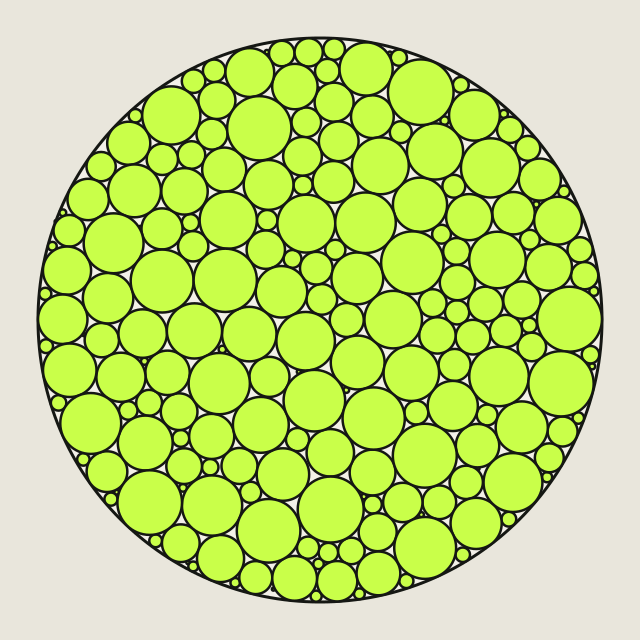
Current verifiable construction for Packing circles of radius 1,2,…,n into a circle, n = 196Left: the sub-problem's current record construction. Right: the pinned score and contributor from the certified breakthrough.
62 · P06Historical honour · no current points

Packing circles of radius 1,2,…,n into a circle · n = 196

Published best known[1675.59978151565, 1675.59978151575]
→
Verified here1675.59976942
Relative improvement+0.000001%
Verified contributor
condor#338
Solution method
AI · OpenAI: GPT-6.1 Sol
Verified

Review: The exact certificate 1675.59976942 is below the conservative published lower endpoint 1675.59978151565. Two local refinements from Packomania's public coordinates remain near 1675.5997815168, with every pair and boundary rechecked. Matching the distinct radii and container symmetries leaves maximum displacement 0.1127 in normalized container units, supporting a changed arrangement rather than coordinate rounding. Public record chronology identifies the initial site construction; later last-digit variants are not separately certified. No global optimality is claimed.

Packomania's ccin ratio table and public coordinates (Eckard Specht); the source precision is preserved and the coordinates are conservatively repaired to the site's nine-place grid

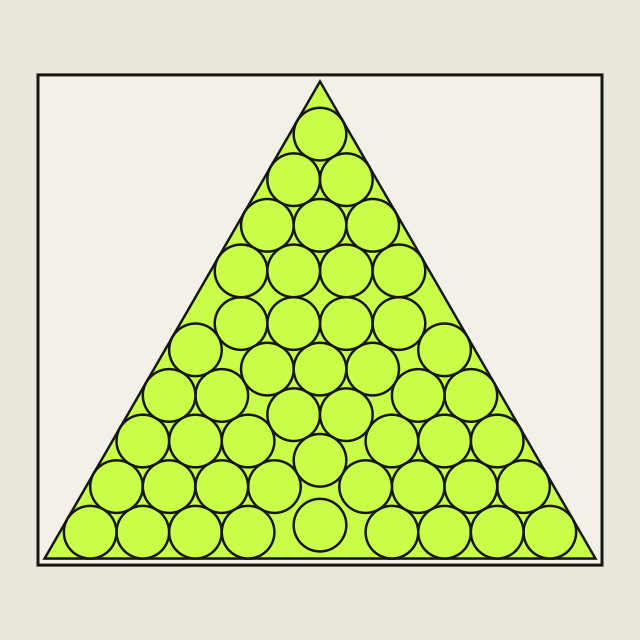
Current verifiable construction for Unit circles in a minimum-area triangle, n = 49Left: the sub-problem's current record construction. Right: the pinned score and contributor from the certified breakthrough.
63 · P66World #1 · currently +3

Unit circles in a minimum-area triangle · n = 49

Published best known[189.655099261701514905174226831805, 189.655099261701514905174226831866]
→
Verified here187.956369504086608742
Relative improvement+0.895694%
Verified contributor
condor#338
Solution method
AI · OpenAI: GPT-6.1 Sol
Verified

Review: Exact integer verification checks all unit-circle distances, triangle containment and area, obtaining 187.956369504086608742. The triangle shape and layout differ from the external source and earlier public site construction, and the gain exceeds source precision. Submission UUID and construction hash are pinned. Global optimality is not claimed.

Graham–Lubachevsky equilateral-triangle construction, still listed by Friedman's current table as best known among arbitrary triangles; public numerical data was recovered algebraically and quantized to the nine-decimal grid here. External comparisons use a rigorous rational enclosure of the continuous area 84 + 61√3, not the outward-repaired site certificate. Improving that grid certificate is not by itself a literature breakthrough

Earlier certifications (1)

These snapshots preserve the original scores, benchmark sources, and contributors. Historical honours remain permanently; live points apply only to an eligible current holder and do not stack across multiple reviews.

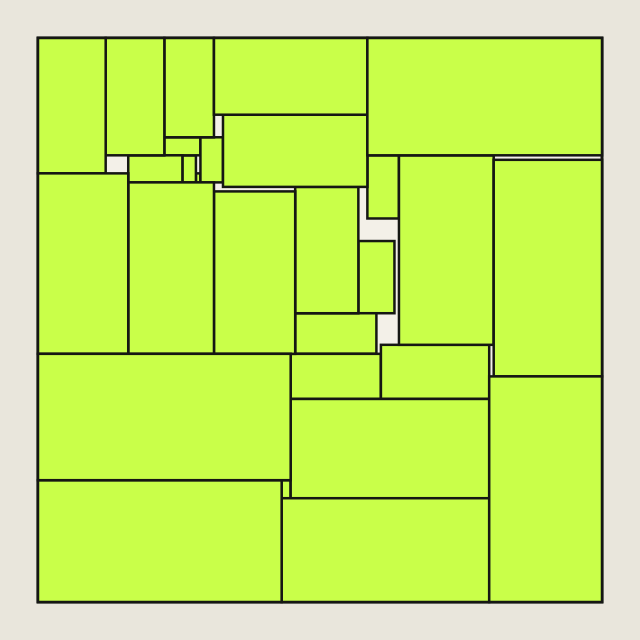
Current verifiable construction for Consecutive dominoes in a square, n = 28Left: the sub-problem's current record construction. Right: the pinned score and contributor from the certified breakthrough.
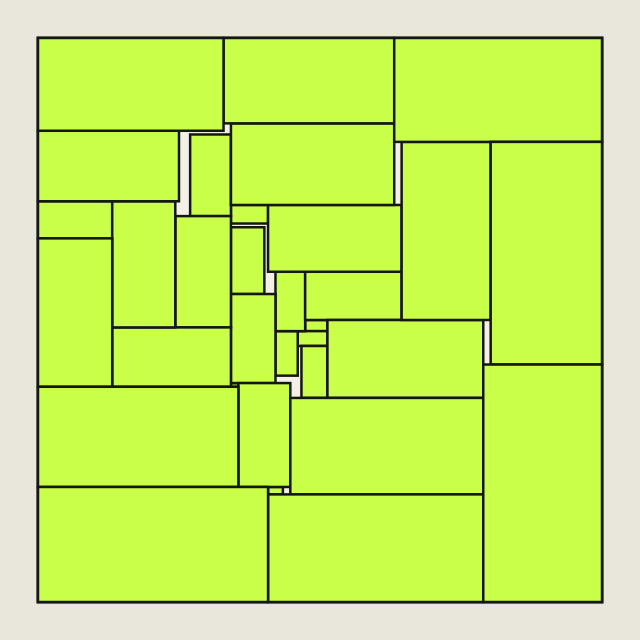
64 · P95World #1 · currently +3

Consecutive dominoes in a square · n = 28

Published best known126
→
Verified here125
Relative improvement+0.793651%
Verified contributor
condor#338
Solution method
AI · OpenAI: GPT-6.1 Sol
Verified

Review: Exact verification checks all consecutive-size dominoes for n = 28: the k-th piece is k by 2k, every integer-coordinate axis-aligned rectangle lies in a square of side 125, and all interiors are disjoint. Matthew Sun's construction in Friedman's table has exact integer side 126; the page was retrieved again on 2026-10-27 and its SHA-256 agrees with revision b788af5. This improves the side by one full unit, independently checked with integer rectangle tests, not decimal truncation or a container-unit conversion. This certifies improvement over that external source, not global optimality.

Matthew Sun (June 2026), Friedman's consecutive dominoes table at b788af5ef087b3a32259684155d5d7116c5160e9.

Current verifiable construction for Consecutive dominoes in a square, n = 32Left: the sub-problem's current record construction. Right: the pinned score and contributor from the certified breakthrough.
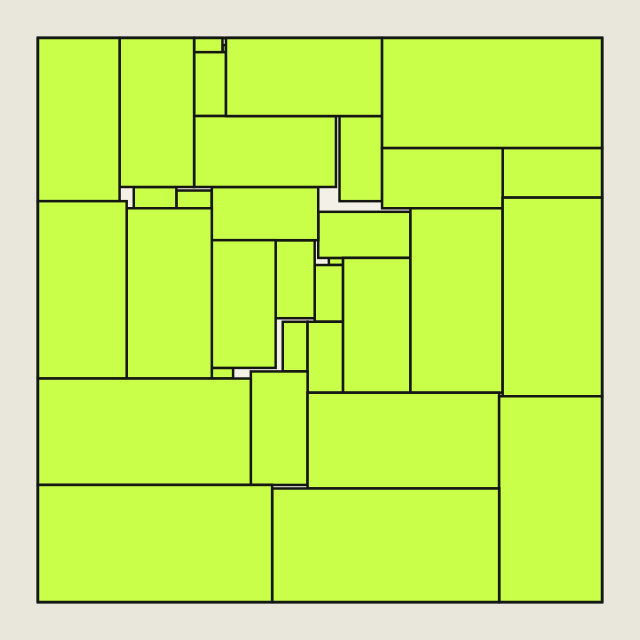
65 · P95World #1 · currently +3

Consecutive dominoes in a square · n = 32

Published best known153
→
Verified here152
Relative improvement+0.653595%
Verified contributor
condor#338
Solution method
AI · OpenAI: GPT-6.1 Sol
Verified

Review: Exact verification checks all consecutive-size dominoes for n = 32: the k-th piece is k by 2k, every integer-coordinate axis-aligned rectangle lies in a square of side 152, and all interiors are disjoint. Matthew Sun's construction in Friedman's table has exact integer side 153; the page was retrieved again on 2026-10-27 and its SHA-256 agrees with revision b788af5. This improves the side by one full unit, independently checked with integer rectangle tests, not decimal truncation or a container-unit conversion. This certifies improvement over that external source, not global optimality.

Matthew Sun (June 2026), Friedman's consecutive dominoes table at b788af5ef087b3a32259684155d5d7116c5160e9.

Current verifiable construction for Consecutive dominoes in a square, n = 33Left: the sub-problem's current record construction. Right: the pinned score and contributor from the certified breakthrough.
66 · P95World #1 · currently +3

Consecutive dominoes in a square · n = 33

Published best known160
→
Verified here159
Relative improvement+0.625%
Verified contributor
condor#338
Solution method
AI · OpenAI: GPT-6.1 Sol
Verified

Review: Exact verification checks all consecutive-size dominoes for n = 33: the k-th piece is k by 2k, every integer-coordinate axis-aligned rectangle lies in a square of side 159, and all interiors are disjoint. Matthew Sun's construction in Friedman's table has exact integer side 160; the page was retrieved again on 2026-10-27 and its SHA-256 agrees with revision b788af5. This improves the side by one full unit, independently checked with integer rectangle tests, not decimal truncation or a container-unit conversion. This certifies improvement over that external source, not global optimality.

Matthew Sun (June 2026), Friedman's consecutive dominoes table at b788af5ef087b3a32259684155d5d7116c5160e9.

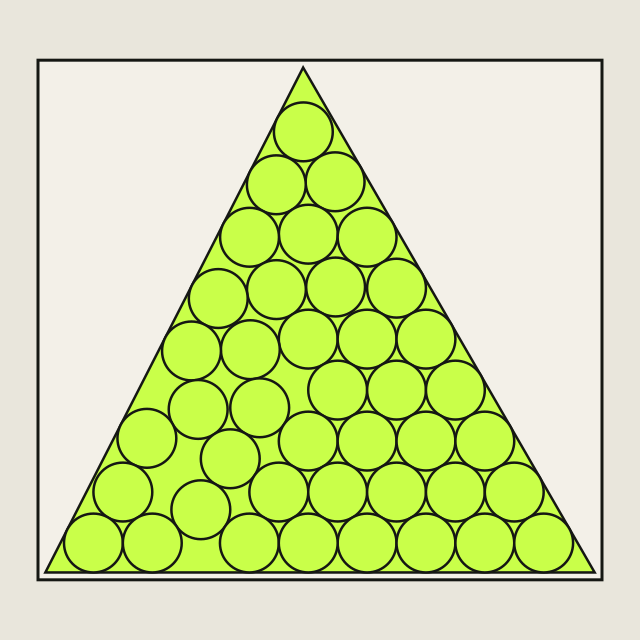
Current verifiable construction for Unit circles in a minimum-area triangle, n = 41Left: the sub-problem's current record construction. Right: the pinned score and contributor from the certified breakthrough.
67 · P66Historical honour · no current points

Unit circles in a minimum-area triangle · n = 41

Published best known[160.08329, 160.08330)
→
Verified here159.4407489094115075765
Relative improvement+0.401379%
Verified contributor
condor#338
Solution method
AI · OpenAI: GPT-6.1 Sol
Verified

Review: Exact integer verification checks all unit-circle distances, triangle containment and area, obtaining 159.4407489094115075765. The triangle shape and layout differ from the external source and earlier public site construction, and the gain exceeds source precision. Submission UUID and construction hash are pinned. Global optimality is not claimed.

Yanis Gomes (October 2026), Friedman revision e68d36c dated 2026-10-18.

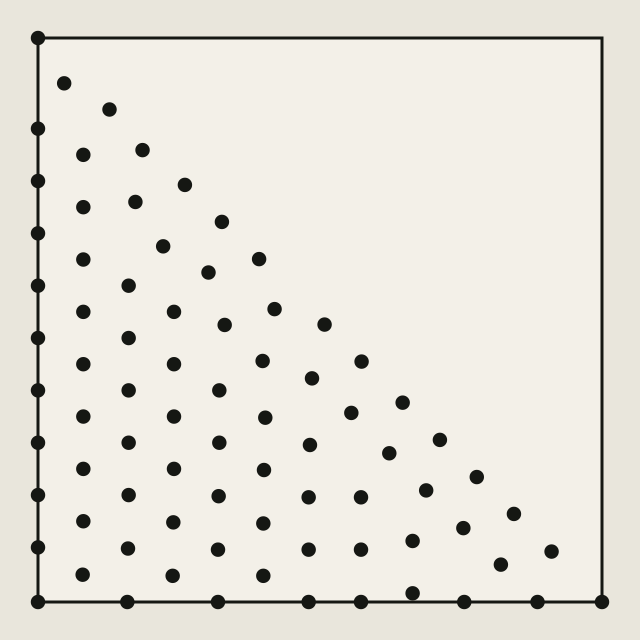
Current verifiable construction for Spreading points in a right triangle, n = 79Left: the sub-problem's current record construction. Right: the pinned score and contributor from the certified breakthrough.
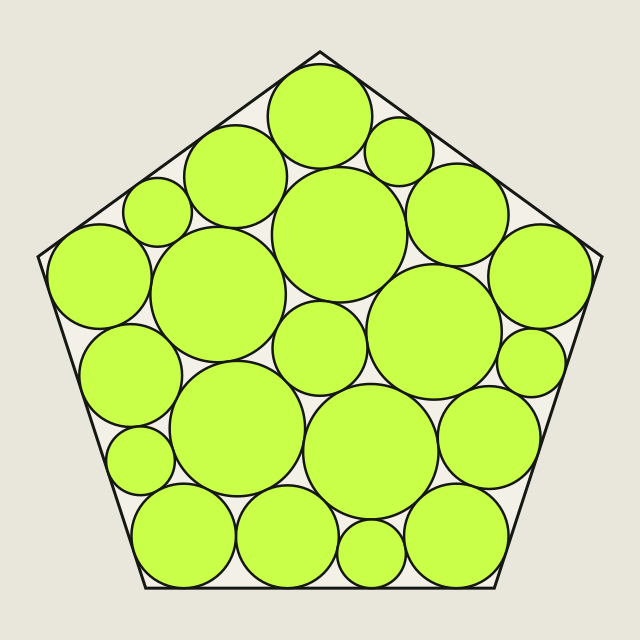
68 · P16World #1 · currently +3

Spreading points in a right triangle · n = 79

Published best known[0.092749672, 0.092749676]
→
Verified here0.092808874
Relative improvement+0.063826%
Verified contributor
matrixfang#330
Solution method
AI · OpenAI: GPT-6.1 Sol
Verified

Review: The original submission re-verifies exactly. The source table and coordinates were downloaded again. Two source-only local refinements (original radius and an inward-relaxed radius) give a best diagnostic value about 0.092749675936786, versus this submission's 0.092808874. Symmetry-aware point matching shows changed contacts and improvement beyond publication precision, rather than repair of a rounded site exhibit. Optimisation results are diagnostic, not an upper bound or a global optimality proof.

Spreading n points here is packing n equal circles in the triangle (the points are the centres, d = 2r/(1 − (2+√2)r)); Packomania's crt table, compiled by Eckard Specht, keeps the best known packings and their coordinates, and cites Eckard Specht (2009–2010) for this row. The table does not mark it proved. The equivalence was pointed out by Tmrg, a user of this site, in a discussion

Current verifiable construction for Sum of radii in the regular pentagon, n = 21Left: the sub-problem's current record construction. Right: the pinned score and contributor from the certified breakthrough.
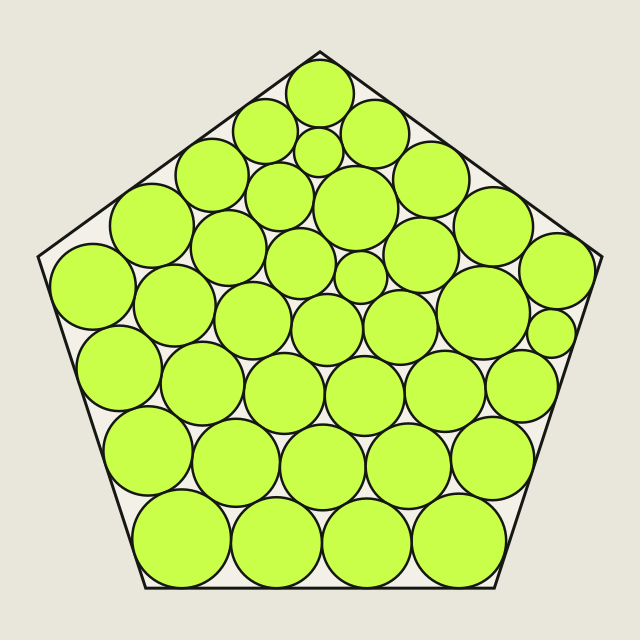
69 · P94Historical honour · no current points

Sum of radii in the regular pentagon · n = 21

Published best known[3.08715, 3.08716)
→
Verified here3.088531256
Relative improvement+0.044418%
Verified contributor
qiboqi#280
Solution method
AI · OpenAI: GPT-6 Luna
Verified

Review: Exact verification checks containment and every circle pair. The score 3.088531256 exceeds the source interval's upper edge 3.08716. Symmetry matching and local refinement of the source figure give a different, weaker layout. This construction first appears in the site's public record history under this author at 2026-10-18T06:34:43.161Z (944f92e3-80d0-4f39-a85e-80f44f431856); this review pins their later strongest reviewed submission. Other last-digit variants do not receive duplicate certification. Local optimisation is diagnostic, not an optimality proof.

Richard Wang, Friedman's cirRpen table at c20fd4e865e7e88eabbec63c4ce74b988a3a9d8f (2026-10-16).

Current verifiable construction for Sum of radii in the regular pentagon, n = 37Left: the sub-problem's current record construction. Right: the pinned score and contributor from the certified breakthrough.
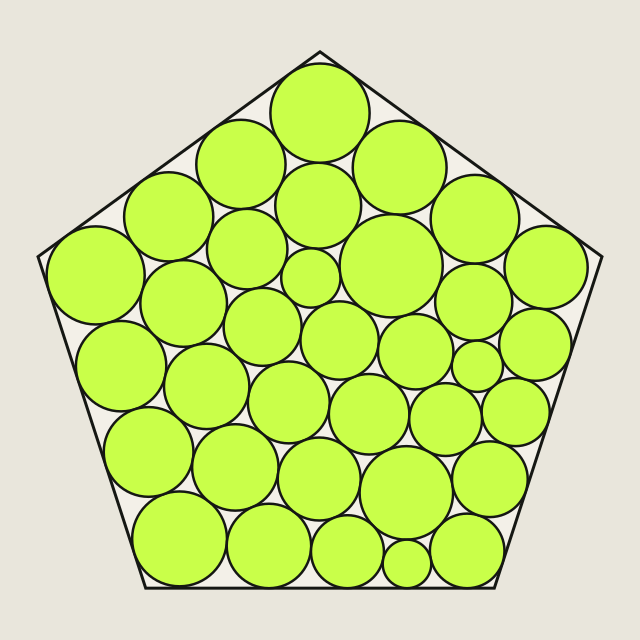
70 · P94Historical honour · no current points

Sum of radii in the regular pentagon · n = 37

Published best known[4.14946, 4.14947)
→
Verified here4.150872849
Relative improvement+0.033808%
Verified contributor
qiboqi#280
Solution method
AI · DeepSeek: DeepSeek V4.1 Flash 1017
Verified

Review: Exact verification checks containment and every circle pair. The score 4.150872849 exceeds the source interval's upper edge 4.14947. Symmetry matching and local refinement of the source figure give a different, weaker layout. This construction first appears in the site's public record history under this author at 2026-10-18T13:31:04.592Z (35e90a39-abcf-4d07-9c91-8eb4c3046d9c); this review pins their later strongest reviewed submission. Other last-digit variants do not receive duplicate certification. Local optimisation is diagnostic, not an optimality proof.

Joost de Winter, Friedman's cirRpen table at c20fd4e865e7e88eabbec63c4ce74b988a3a9d8f (2026-10-16).

Current verifiable construction for Sum of radii in the regular pentagon, n = 34Left: the sub-problem's current record construction. Right: the pinned score and contributor from the certified breakthrough.
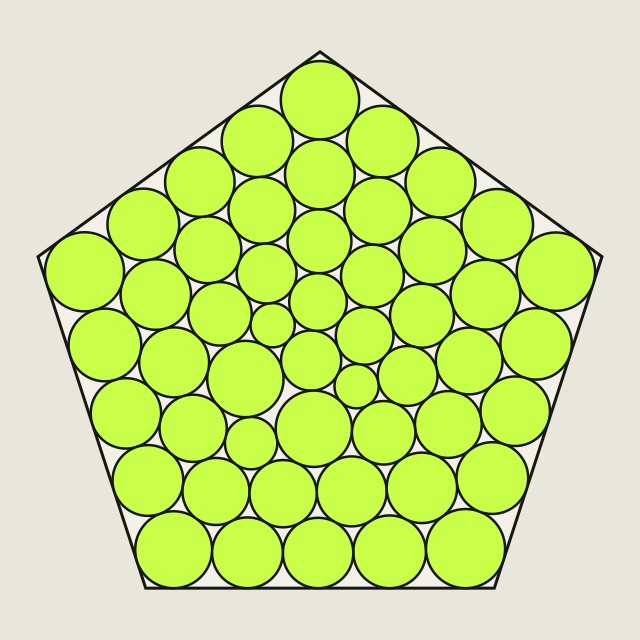
71 · P94World #1 · currently +3

Sum of radii in the regular pentagon · n = 34

Published best known[3.97647, 3.97648)
→
Verified here3.977640276
Relative improvement+0.029178%
Verified contributor
zzzcy#308
Solution method
AI · OpenAI: GPT-6 Astra
Verified

Review: Exact verification checks containment and every circle pair. The score 3.977640276 exceeds the source interval's upper edge 3.97648. Symmetry matching and local refinement of the source figure give a different, weaker layout. This construction first appears in the site's public record history under this author at 2026-10-18T13:10:33.738Z (18e9a7e5-7c96-48ef-8be8-e5d9436ca515); this review pins their later strongest reviewed submission. Other last-digit variants do not receive duplicate certification. Local optimisation is diagnostic, not an optimality proof.

Richard Wang, Friedman's cirRpen table at c20fd4e865e7e88eabbec63c4ce74b988a3a9d8f (2026-10-16).

Current verifiable construction for Sum of radii in the regular pentagon, n = 50Left: the sub-problem's current record construction. Right: the pinned score and contributor from the certified breakthrough.
72 · P94World #1 · currently +3

Sum of radii in the regular pentagon · n = 50

Published best known[4.86154, 4.86155)
→
Verified here4.862887127
Relative improvement+0.027504%
Verified contributor
zzzcy#308
Solution method
AI · OpenAI: GPT-6 Astra
Verified

Review: Exact verification checks containment and every circle pair. The score 4.862887127 exceeds the source interval's upper edge 4.86155. Symmetry matching and local refinement of the source figure give a different, weaker layout. This construction first appears in the site's public record history under this author at 2026-10-18T13:08:59.353Z (06486ef7-bf72-45f8-94ed-af9cd59cafe8); this review pins their later strongest reviewed submission. Other last-digit variants do not receive duplicate certification. Local optimisation is diagnostic, not an optimality proof.

Jonathan Viquerat, Friedman's cirRpen table at c20fd4e865e7e88eabbec63c4ce74b988a3a9d8f (2026-10-16).