P74 · Extremal configurations · Classic · Applied frontier

Covering an equilateral triangle with n equal discs · n = 9

Place n centres in a unit equilateral triangle. Every centre has the same covering radius; every point of the triangle must lie in at least one disc, and that radius is minimised.

Instancen = 9
ObjectiveMinimize the covering radius
Proven floor√(A(K)/(π·9))no arrangement can go below 0.123752541563016 · the record stands 34.7% above itHere K is the verifier's fixed-grid equilateral triangle and A(K) is its area. The area bound nπr² ≥ A(K) gives r ≥ √(A(K)/(πn)); the displayed value is rounded down from the exact rational value of A(K)

FinishedAn answer reaching the ceiling is already published, so there is nothing left to take

Formal definition

  • ContainerThe closed convex polygon with vertices (0,0), (1,0), and (0.5,0.866025404), the site's unambiguous nine-decimal representative of an equilateral triangle
  • SubmissionExactly n distinct points inside the container
  • ScoreTake the distance to the nearest centre at every place in the container, then the largest of those distances; rational Voronoi polygons make the verifier exactr(P)=maxxKminixpi
  • ObjectiveMake the covering radius as small as possibleminPr(P)
Open the editor and look
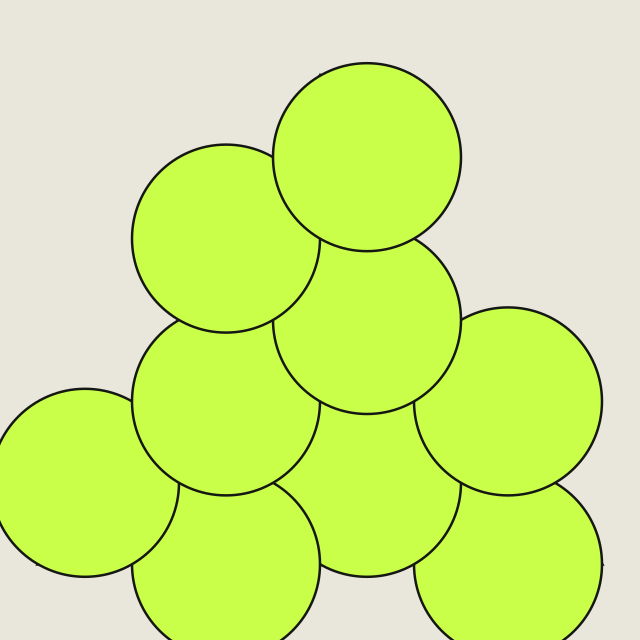
VERIFIED CONSTRUCTION9 equal discs of shared radius 0.166667; the marked place is the hardest to reach, and it is what sets the radius

Getting a feel for it

Corners and interior compete for centres

The three sharp corners demand attention, but pushing every centre outward leaves a hole in the middle. The best configurations are usually not a simple equally spaced triangular grid.

Published records and verifiable constructions are included

Nurmela (2000) collected and extended high-precision constructions for n=2–36. The site reconstructs n=7–36 from the contact graphs in Figures 2–4, showing both the paper's continuous value and the verifier-exact nine-decimal certificate. The n=9 and n=10 rows are proved optimal; the other n≤36 rows remain challengeable known bests. The paper explicitly reports no searches beyond n=36, so n=37–40 ship only transparent site starts obtained by filling successive farthest holes of n=36, without invented external records.

Source
The record-holding arrangement for Covering an equilateral triangle with n equal discs n = 9, 0.166666667608464
Current leader

0.166666667608464

the covering radius

OptimalThe optimum is proven; there is nothing left to gain
Answer sourceHans Melissen
Solution methodPublished reference construction
The optimum is proven; there is nothing left to gain
ANSWER FORMAT

How to write your answer

The base runs from (0,0) to (1,0), with apex (0.5, 0.866025404). This explicitly defined nine-decimal representative of the equilateral triangle is the boundary the verifier actually uses.

Submit points: exactly n centres, with each coordinate a decimal string of at most nine places. The verifier computes the shared radius; smaller is better.

The current leader's answer

{
  "points": [
    [
      "0.833333333",
      "0"
    ],
    [
      "0.583333328",
      "0.144337564"
    ],
    [
      "0.333333333",
      "0"
    ],
    [
      "0.833333328",
      "0.288675132"
    ],
    [
      "0.083333334",
      "0.144337568"
    ],
    [
      "0.333333333",
      "0.288675131"
    ],
    [
      "0.583333333",
      "0.433012702"
    ],
    [
      "0.333333331",
      "0.577350263"
    ],
    [
      "0.583333328",
      "0.721687834"
    ]
  ]
}
Submission format and technical detailsOpen this when you are ready to prepare a JSON answer

Instance parameters

{
  "n": 9
}

The current leader's answer

{
  "points": [
    [
      "0.833333333",
      "0"
    ],
    [
      "0.583333328",
      "0.144337564"
    ],
    [
      "0.333333333",
      "0"
    ],
    [
      "0.833333328",
      "0.288675132"
    ],
    [
      "0.083333334",
      "0.144337568"
    ],
    [
      "0.333333333",
      "0.288675131"
    ],
    [
      "0.583333333",
      "0.433012702"
    ],
    [
      "0.333333331",
      "0.577350263"
    ],
    [
      "0.583333328",
      "0.721687834"
    ]
  ]
}

Submit points: exactly n centres, with each coordinate a decimal string of at most nine places. The verifier computes the shared radius; smaller is better. · Verifier v1.0.0

DISCUSSION

Discussion

Talk strategy, share methods, ask why you are stuck. Posts carry your public byline, the same name your records use; the #number after it is the account's signup ordinal, so a name cannot be worn by someone else. The floor is earned: break a record once, anywhere, and it is yours for good. New posts appear after an automated review.

No threads yet. Be the first to talk about this problem?