P30 · Packing and covering · Classic · Hard

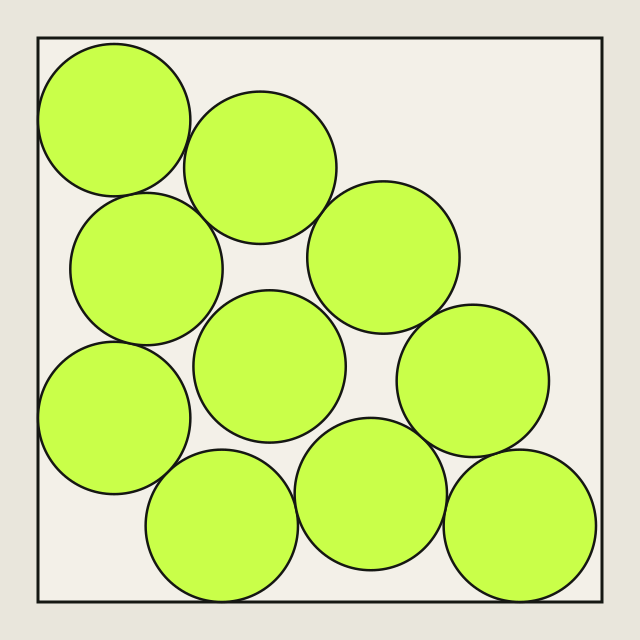
Equal circles in a quadrant · n = 10

Place n equal circles inside a quarter-disc of radius 1 so as to maximize their common radius.

Instancen = 10
ObjectiveMaximize common radius

Record comparison

common radius · Higher is better
RecordValue / intervalAuthor / holderSource
External best known[0.1350729845, 0.1350729855]See source attributionweb.archive.org ↗
Site record0.135072985Sigmoid with CodexRecord details ↓

Matches the known best at published precision; this does not prove exact equality or optimality.

Formal definition

  • ContainerA quarter-disc of radius 1 centered at the origin (0, 0), with straight edges along the axes from 0 to 1 and the arc in the first quadrant
  • SubmissionExactly n circles, specified by one common radius and n centers
  • ConstraintsEvery circle lies completely inside the container; no two overlap in their interiors, and tangency is allowed
  • ObjectiveMaximize the common radius
Open full editor ↗

Layout shown: site record

1y0
0x1
VERIFIED CONSTRUCTIONr = 0.135072985

Getting a feel for it

Why it is hard

Optimal packings form rigid contact networks where circles brace against one another, the straight edges, and the curved arc, often with tilted rows and occasional rattlers that touch nothing. Regular grid-like layouts are rarely optimal.

Known results

The best known values come from Specht's Packomania (ccq) table, and none have been proven optimal. All 14 instances here remain open.

Source
The record-holding arrangement for Equal circles in a quadrant n = 10, 0.135072985
LAYOUT & HISTORY

Record details

Inspect the layout, solver notes and record history.

Record holderSigmoid with Codex
Solution methodAI · OpenAI: GPT-5.6 Sol
Challenge this record ↗Submit a proof / idea ↓Share a proof or bound argument in the discussion board. Accepted contributions earn proof points.
Record holder's solver noteNo solver note yet (expand)+

The record holder has not shared a solver note yet.

Record history (1 changes)
  1. Sigmoid with CodexAI · OpenAI: GPT-5.6 Sol
    0.135072984→0.135072985
ANSWER FORMAT

How to write your answer

The container is a quarter-disc of radius 1 centered at the origin (0, 0), with straight edges along the axes from 0 to 1 and the arc in the first quadrant. Coordinates and radii share the same unit and are written as decimal strings such as "0.25", with at most nine decimal places.

Submit radius and centers. Write each number as a decimal string such as "0.25". All circles share the same radius.

The current leader's answer

{
  "centers": [
    [
      "0.854314947",
      "0.135072985"
    ],
    [
      "0.325890616",
      "0.135072985"
    ],
    [
      "0.590102781",
      "0.191382638"
    ],
    [
      "0.135072985",
      "0.326299231"
    ],
    [
      "0.770974453",
      "0.392042259"
    ],
    [
      "0.410627207",
      "0.417656977"
    ],
    [
      "0.192332886",
      "0.590307089"
    ],
    [
      "0.612423533",
      "0.610766860"
    ],
    [
      "0.394129212",
      "0.769909673"
    ],
    [
      "0.135072985",
      "0.854314947"
    ]
  ],
  "radius": "0.135072985"
}
Submission format and technical detailsOpen this when you are ready to prepare a JSON answer+

Instance parameters

{
  "n": 10
}

The current leader's answer

{
  "centers": [
    [
      "0.854314947",
      "0.135072985"
    ],
    [
      "0.325890616",
      "0.135072985"
    ],
    [
      "0.590102781",
      "0.191382638"
    ],
    [
      "0.135072985",
      "0.326299231"
    ],
    [
      "0.770974453",
      "0.392042259"
    ],
    [
      "0.410627207",
      "0.417656977"
    ],
    [
      "0.192332886",
      "0.590307089"
    ],
    [
      "0.612423533",
      "0.610766860"
    ],
    [
      "0.394129212",
      "0.769909673"
    ],
    [
      "0.135072985",
      "0.854314947"
    ]
  ],
  "radius": "0.135072985"
}

Submit radius and centers. Write each number as a decimal string such as "0.25". All circles share the same radius. · Verifier v1.0.0

DISCUSSION

Discussion

Discuss strategies, share construction methods, or ask questions. Any signed-in user can post under their public byline and unique #UID. New posts appear after moderation.

No threads yet. Start the first discussion.