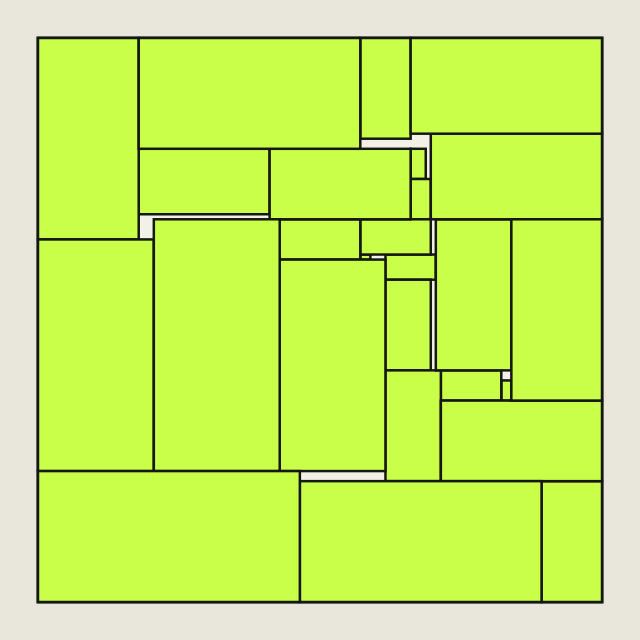
Consecutive dominoes in a square · n = 26
Place n dominoes, the k-th a k × 2k rectangle (k = 1, …, n), without overlap in a square, moved and turned freely, so as to minimise the square's side.
Instancen = 26
ObjectiveMinimize the square's side
Record comparison
the square's side · Lower is better| Record | Value / interval | Author / holder | Source |
|---|---|---|---|
| External best known | 112 | Ryan Chi and d/dx2026-09 | Erich Friedman ↗ |
| Site record | 112 | condor | Record details ↓ |
Matches the known best at published precision; this does not prove exact equality or optimality.
Formal definition
- ContainerThe closed square [0, side] × [0, side] with its lower-left corner at the origin, in units of the smallest domino's short side; dominoes may touch its sides
- SubmissionThe square's side, side > 0, and the placement of exactly n dominoes: the k-th (k = 1, …, n) is the closed k × 2k rectangle, each used exactly once; every value has at most nine decimal places
- PlacementEach piece may be moved and turned freely: rotated lays it flat (2k × k) or stands it up (k × 2k), then it turns counter-clockwise by θ about its lower-left corner (x, y), with tan(θ/2) = turn. cos θ and sin θ are rational, so every corner is rational and any orientation can be written
- ConstraintsEvery piece's four corners lie in the square; no two pieces' interiors intersect (touching is allowed), decided by the separating-axis test on both pieces' edge normals. Everything is decided exactly in integers, never approximately
- ScoreThe square's side, displayed to at most nine decimal places; smaller is better
- ObjectiveMinimise the square's side over all valid arrangements