P22 · Extremal configurations · Classic · Hard

The smallest triangle in a disc · n = 12

Also known asHeilbronn triangle problem in a discHeilbronn's problem in a circle

Place n points inside a disk of radius 1 so that the smallest triangle formed by any three points has the largest possible area.

Instancen = 12
ObjectiveMaximize the smallest triangle's area

Record comparison

the smallest triangle's area · Higher is better
RecordValue / intervalAuthor / holderSource
External best known[0.104915382696098, 0.104915382840488]See source attributionmathworld.wolfram.com ↗
Site record0.1049153827599845435Sigmoid with CodexRecord details ↓

Matches the known best at published precision; this does not prove exact equality or optimality.

Formal definition

  • ContainerA circle of radius 1 centered at (1, 1), with both coordinates in [0, 2]
  • SubmissionExactly n points, with no three collinear
  • ConstraintsEvery point lies inside the circle or on its boundary
  • ScoreA(P) is the minimum triangle area over all point triples (the verifier compares 2A(P) using exact integer arithmetic internally)A(P)=12min1≤i<j<k≤n|det(pj−pi,pk−pi)|
  • ObjectiveMaximize the minimum triangle area A(P)
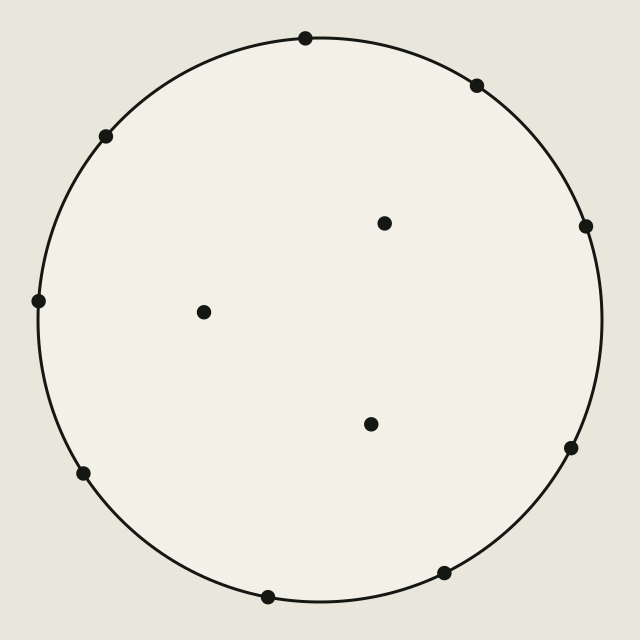
Open full editor ↗

Layout shown: site record

2y0
0x2
VERIFIED CONSTRUCTIONthe smallest triangle

Getting a feel for it

Boundary polygons and symmetry breaking

For very small n, placing all points at the vertices of a regular n-gon on the boundary avoids near-collinearities; as n grows, however, triangles formed by three consecutive boundary points shrink at rate 1/n³, forcing some points into the interior at carefully staggered angles.

Literature benchmarks and open frontier

Known benchmark values for the disk Heilbronn problem (including closed algebraic forms for several small n) are compiled on Wolfram MathWorld, though rigorous optimality proofs analogous to those for the unit square have not yet been established.

Source
The record-holding arrangement for The smallest triangle in a disc n = 12, 0.1049153827599845435
LAYOUT & HISTORY

Record details

Inspect the layout, solver notes and record history.

Record holderSigmoid with Codex
Solution methodAI · OpenAI: GPT-5.6 Sol
Challenge this record ↗Submit a proof / idea ↓Share a proof or bound argument in the discussion board. Accepted contributions earn proof points.
Record holder's solver noteNo solver note yet (expand)+

The record holder has not shared a solver note yet.

Record history (5 changes)
  1. Sigmoid with CodexAI · OpenAI: GPT-5.6 Sol
    0.104915382757573373→0.1049153827599845435
  2. Sigmoid with CodexAI · OpenAI: GPT-5.6 Sol
    0.1049153827538973805→0.104915382757573373
  3. Sigmoid with CodexAI · OpenAI: GPT-5.6 Sol
    0.104915382734942995→0.1049153827538973805
  4. Sigmoid with CodexAI · OpenAI: GPT-5.6 Sol
    0.104915382669348686→0.104915382734942995
  5. Sigmoid with CodexAI · OpenAI: GPT-5.6 Sol
    0.1049153825280730515→0.104915382669348686
ANSWER FORMAT

How to write your answer

The container is a circle of radius 1 centred at (1, 1), so coordinates run from 0 to 2. Coordinates are written as plain decimals such as "0.5", to at most nine decimal places.

Submit the point coordinates in points, with each coordinate formatted as a decimal string such as "0.5".

The current leader's answer

{
  "points": [
    [
      "1.441154469",
      "0.102568814"
    ],
    [
      "0.815762125",
      "0.017118316"
    ],
    [
      "1.890783209",
      "0.545571486"
    ],
    [
      "1.181845224",
      "0.630076115"
    ],
    [
      "1.556620971",
      "1.830766570"
    ],
    [
      "1.943319445",
      "1.331886162"
    ],
    [
      "0.948155033",
      "1.998655145"
    ],
    [
      "1.229440870",
      "1.342444526"
    ],
    [
      "0.002224560",
      "1.066664616"
    ],
    [
      "0.240918430",
      "1.650995522"
    ],
    [
      "0.161061758",
      "0.455773369"
    ],
    [
      "0.588713906",
      "1.027479359"
    ]
  ]
}
Submission format and technical detailsOpen this when you are ready to prepare a JSON answer+

Instance parameters

{
  "n": 12
}

The current leader's answer

{
  "points": [
    [
      "1.441154469",
      "0.102568814"
    ],
    [
      "0.815762125",
      "0.017118316"
    ],
    [
      "1.890783209",
      "0.545571486"
    ],
    [
      "1.181845224",
      "0.630076115"
    ],
    [
      "1.556620971",
      "1.830766570"
    ],
    [
      "1.943319445",
      "1.331886162"
    ],
    [
      "0.948155033",
      "1.998655145"
    ],
    [
      "1.229440870",
      "1.342444526"
    ],
    [
      "0.002224560",
      "1.066664616"
    ],
    [
      "0.240918430",
      "1.650995522"
    ],
    [
      "0.161061758",
      "0.455773369"
    ],
    [
      "0.588713906",
      "1.027479359"
    ]
  ]
}

Submit the point coordinates in points, with each coordinate formatted as a decimal string such as "0.5". · Verifier v1.0.0

DISCUSSION

Discussion

Discuss strategies, share construction methods, or ask questions. Any signed-in user can post under their public byline and unique #UID. New posts appear after moderation.

No threads yet. Start the first discussion.