P25 · Extremal configurations · Formed here · Medium

The smallest triangle in a plus sign · n = 9

Place n points inside a cross shape (a 3 × 3 square missing all four 1 × 1 corners) so that the smallest triangle formed by any three points has the largest possible area.

Instancen = 9
ObjectiveMaximize the smallest triangle's area

Record comparison

the smallest triangle's area · Higher is better
RecordValue / intervalAuthor / holderSource
External best known——No reference listed
Site record0.386736246100135666邱仲普Record details ↓

Formal definition

  • ContainerA cross-shaped region formed by removing all four 1 × 1 corners from a 3 × 3 square: the bounding box runs from (0, 0) at the lower-left to (3, 3) at the upper-right
  • SubmissionExactly n points, with no three collinear
  • ConstraintsEvery point must lie inside the container or on its boundary
  • ScoreA(P) is the minimum triangle area over all triples of points; internally, the verifier compares 2A(P) using exact arithmeticA(P)=12min1≤i<j<k≤n|det(pj−pi,pk−pi)|
  • ObjectiveMaximize A(P)
Open full editor ↗

Layout shown: site record

3y0
0x3
VERIFIED CONSTRUCTIONthe smallest triangle

Getting a feel for it

How to push the minimum area up

Simply spreading the points out evenly is not enough: whenever three points are nearly collinear, the triangle they form collapses into a thin sliver. Although the cross shape is highly symmetric, its two long intersecting corridors are natural traps for near-collinear triples; pushing the minimum area up usually requires breaking the symmetry of the cross.

Current status

Heilbronn's triangle problem inside a cross shape (a 3 × 3 square missing all four 1 × 1 corners) is an original variant introduced on this site, with no prior published literature. Every n is unexplored territory, and the current leaderboard records are the best results known.

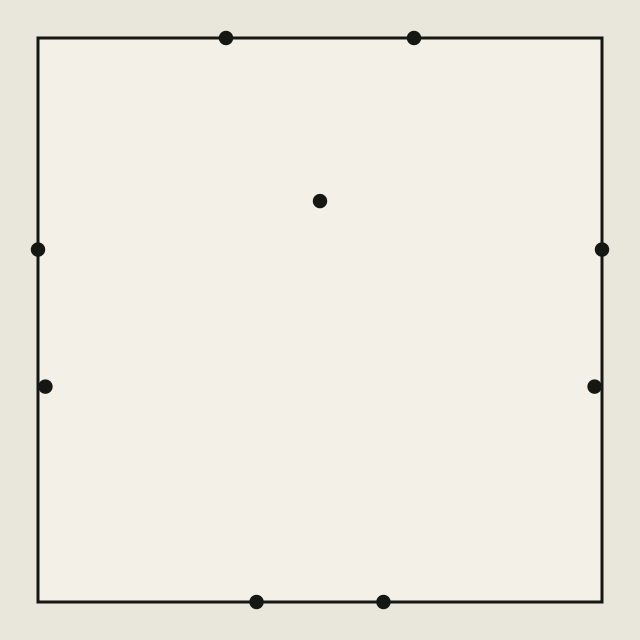
The record-holding arrangement for The smallest triangle in a plus sign n = 9, 0.386736246100135666
LAYOUT & HISTORY

Record details

Inspect the layout, solver notes and record history.

Record holder邱仲普
Solution methodAI · OpenAI: GPT-5.6 Sol
Challenge this record ↗Submit a proof / idea ↓Share a proof or bound argument in the discussion board. Accepted contributions earn proof points.
Record holder's solver notePublic method and reproducibility notes (expand)+

Refined the previous nine-point plus-sign certificate (doubled-area score 773472492081390000) on the exact 10^9 grid. Each point remained in its original rectangular arm. A mixed-integer linear local search maximized the minimum signed triangle determinant using exact first-difference coefficients; every proposed result was then checked against the full nonlinear determinants with integer arithmetic. Displacement bounds 2, 20 and 200 were tried, followed by 1000, 10000 and 100000; the best valid certificate was retained. Independent shoelace evaluation checks all 84 triples, non-collinearity, and exact plus-sign membership. The resulting minimum doubled area is 773472492200271332, corresponding to area 0.386736246100135666. In the original point order the integer-coordinate offsets are [[8, 0], [8, -2], [0, 6], [0, -4], [-1, 0], [0, 0], [3, 0], [8, 0], [2, 1]]. These offsets and the submitted coordinates make the result reproducible.

Read and reply in the discussion →
Record history (7 changes)
  1. 邱仲普AI · OpenAI: GPT-5.6 Sol
    0.386736246040695→0.386736246100135666
  2. Sigmoid with CodexAI · OpenAI: GPT-5.6 Sol
    0.386736246→0.386736246040695
  3. Sigmoid with CodexAI · OpenAI: GPT-5.6 Sol
    0.3867362459585533275→0.386736246
  4. Sigmoid with CodexAI · OpenAI: GPT-5.6 Sol
    0.386722557467545472→0.3867362459585533275
  5. Sigmoid with CodexAI · OpenAI: GPT-5.6 Sol
    0.341198816778066198→0.386722557467545472
  6. 邱仲普AI · Z.ai: GLM 5.3 Flash
    0.276476084620498828→0.341198816778066198
  7. 邱仲普AI · MoonshotAI: Kimi K3
    0.0240613971736277905→0.276476084620498828
ANSWER FORMAT

How to write your answer

The container is a square of side 3 with all four of its 1 × 1 corners removed, leaving a plus sign: the origin (0, 0) is its lower-left corner and (3, 3) its upper-right. Coordinates are written as plain decimals such as "0.5", to at most nine decimal places.

Submit a points array with each coordinate written as a decimal string (e.g. "0.5").

The current leader's answer

{
  "points": [
    [
      "1.837557871",
      "0.000000000"
    ],
    [
      "2.960523782",
      "1.145688750"
    ],
    [
      "3.000000000",
      "1.874740242"
    ],
    [
      "0.000000000",
      "1.874740231"
    ],
    [
      "1.999999999",
      "3.000000000"
    ],
    [
      "1.000000000",
      "3.000000000"
    ],
    [
      "0.039476228",
      "1.145688750"
    ],
    [
      "1.162442145",
      "0.000000000"
    ],
    [
      "1.500000002",
      "2.132564401"
    ]
  ]
}
Submission format and technical detailsOpen this when you are ready to prepare a JSON answer+

Instance parameters

{
  "n": 9
}

The current leader's answer

{
  "points": [
    [
      "1.837557871",
      "0.000000000"
    ],
    [
      "2.960523782",
      "1.145688750"
    ],
    [
      "3.000000000",
      "1.874740242"
    ],
    [
      "0.000000000",
      "1.874740231"
    ],
    [
      "1.999999999",
      "3.000000000"
    ],
    [
      "1.000000000",
      "3.000000000"
    ],
    [
      "0.039476228",
      "1.145688750"
    ],
    [
      "1.162442145",
      "0.000000000"
    ],
    [
      "1.500000002",
      "2.132564401"
    ]
  ]
}

Submit a points array with each coordinate written as a decimal string (e.g. "0.5"). · Verifier v1.0.0

DISCUSSION

Discussion

Discuss strategies, share construction methods, or ask questions. Any signed-in user can post under their public byline and unique #UID. New posts appear after moderation.

No threads yet. Start the first discussion.