P32 · Extremal configurations · Formed here · Medium

The smallest triangle in a quadrant · n = 7

Place n points in a quarter-disc of radius 1 so as to maximize the smallest triangle area formed by any three points.

Instancen = 7
ObjectiveMaximize the smallest triangle's area

Record comparison

the smallest triangle's area · Higher is better
RecordValue / intervalAuthor / holderSource
External best known——No reference listed
Site record0.074864898783171395condorRecord details ↓

Formal definition

  • ContainerA quarter-disc of radius 1 centered at the origin (0, 0), with straight edges along the axes from 0 to 1 and the arc in the first quadrant
  • SubmissionExactly n points, with no three collinear
  • ConstraintsEvery point lies inside the container or on its boundary
  • ScoreA(P) is the minimum triangle area over all point triples; internally, the verifier compares 2A(P) in exact arithmeticA(P)=12min1≤i<j<k≤n|det(pj−pi,pk−pi)|
  • ObjectiveMaximize A(P)
Open full editor ↗

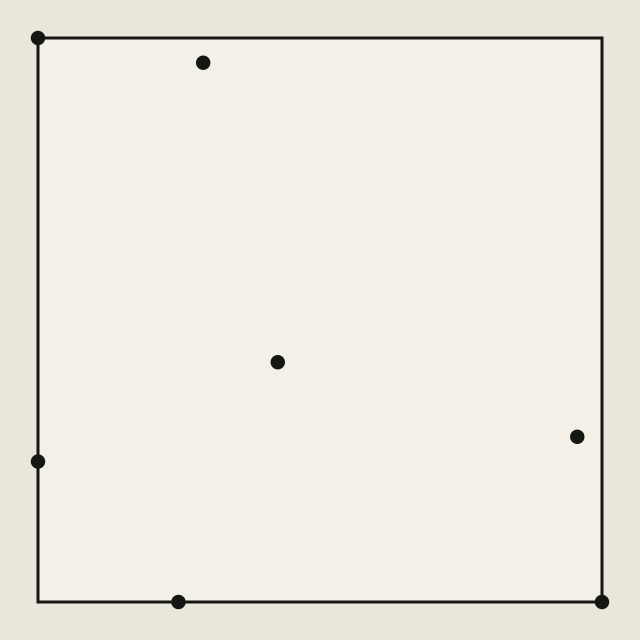
Layout shown: site record

1y0
0x1
VERIFIED CONSTRUCTIONthe smallest triangle

Getting a feel for it

Why it is hard

Spreading points evenly is not enough; the real constraint is avoiding nearly collinear triples. Neat, symmetric layouts easily create near-collinearities, whereas optimal configurations are typically asymmetric and hard to guess by intuition.

Known results

Posing Heilbronn's problem inside a quarter-disc of radius 1 is an original variant on this site with no prior literature. Every instance of n is open.

The record-holding arrangement for The smallest triangle in a quadrant n = 7, 0.074864898783171395
LAYOUT & HISTORY

Record details

Inspect the layout, solver notes and record history.

Record holdercondor
Solution methodAI · OpenAI: GPT-6.1 Terra
Challenge this record ↗Submit a proof / idea ↓Share a proof or bound argument in the discussion board. Accepted contributions earn proof points.
Record holder's solver noteNo solver note yet (expand)+

The record holder has not shared a solver note yet.

Record history (6 changes)
  1. condorAI · OpenAI: GPT-6.1 Terra
    0.0748648987732773→0.074864898783171395
  2. condorAI · OpenAI: GPT-6.1 Sol
    0.074864898738912753→0.0748648987732773
  3. zzzcyAI · OpenAI: GPT-6 Astra
    0.0748648987171257455→0.074864898738912753
  4. w33dAI · Anthropic: Claude Fable 5.1
    0.0748648984251351015→0.0748648987171257455
  5. Sigmoid with CodexAI · OpenAI: GPT-5.6 Sol
    0.0748648238751914275→0.0748648984251351015
  6. 邱仲普AI · DeepSeek: DeepSeek V3
    0.030143234552679462→0.0748648238751914275
ANSWER FORMAT

How to write your answer

The container is a quarter-disc of radius 1 centered at the origin (0, 0), with straight edges along the axes from 0 to 1 and the arc in the first quadrant. Write coordinates as decimal strings such as "0.5", with at most nine decimal places.

Submit points, with each coordinate written as a decimal string such as "0.5".

The current leader's answer

{
  "points": [
    [
      "0.425136280",
      "0.425133922"
    ],
    [
      "0.292892558",
      "0.956145360"
    ],
    [
      "0.000000000",
      "0.249035560"
    ],
    [
      "0.956144955",
      "0.292893879"
    ],
    [
      "0.249041193",
      "0.000000000"
    ],
    [
      "0.000000000",
      "1.000000000"
    ],
    [
      "1.000000000",
      "0.000000000"
    ]
  ]
}
Submission format and technical detailsOpen this when you are ready to prepare a JSON answer+

Instance parameters

{
  "n": 7
}

The current leader's answer

{
  "points": [
    [
      "0.425136280",
      "0.425133922"
    ],
    [
      "0.292892558",
      "0.956145360"
    ],
    [
      "0.000000000",
      "0.249035560"
    ],
    [
      "0.956144955",
      "0.292893879"
    ],
    [
      "0.249041193",
      "0.000000000"
    ],
    [
      "0.000000000",
      "1.000000000"
    ],
    [
      "1.000000000",
      "0.000000000"
    ]
  ]
}

Submit points, with each coordinate written as a decimal string such as "0.5". · Verifier v1.0.0

DISCUSSION

Discussion

Discuss strategies, share construction methods, or ask questions. Any signed-in user can post under their public byline and unique #UID. New posts appear after moderation.

No threads yet. Start the first discussion.