P100 · Extremal configurations · Classic

Rectangle-free binary matrices · n = 22

Place as many ones as possible in an n × n grid. No two rows and two columns may meet at four ones.

Instancen = 22
ObjectiveMaximize number of ones

Record comparison

number of ones · Higher is better
RecordValue / intervalAuthor / holderSource
Proven optimum108Narjess Afzaly & Brendan McKayExtremal Graphs and Turan Numbers ↗
Site recordNo player record yet——

Formal definition

  • GridFill each cell of an n-row, n-column grid with zero or one.
  • RectangleChoose any two distinct rows and any two distinct columns. At most three of the four corners may contain ones, regardless of the entries inside.
  • ConstructionSupply the entire matrix, including any all-zero rows or columns.
  • ObjectiveScore one point for each one. Maximize the total.
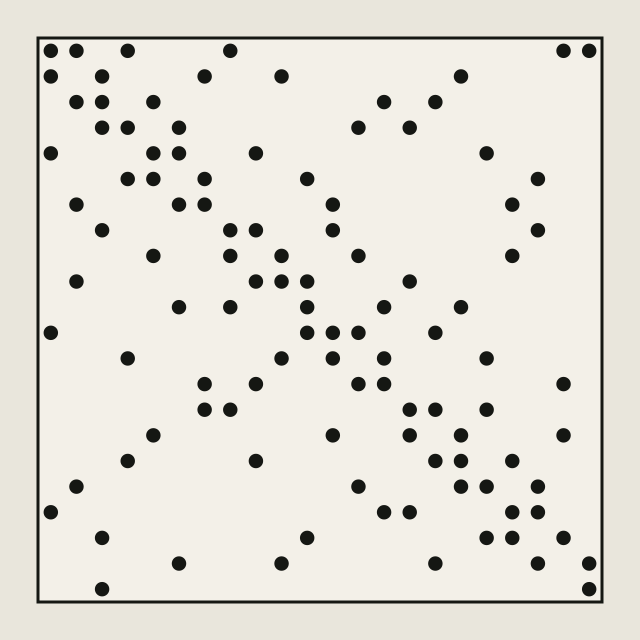
Inspect in editor ↗

Layout shown: starter layout

VERIFIED CONSTRUCTION108 ones

Getting a feel for it

How often can a column pair occur?

Three ones in one row use three pairs of columns. If another row uses even one of those pairs, the four ones form a rectangle.

The current arrangement for Rectangle-free binary matrices n = 22
LAYOUT & HISTORY

Starter layout

Inspect the layout, solver notes and record history.

The optimum is proven; no further improvement is possibleSubmit a proof / idea ↓Share a proof or bound argument in the discussion board. Accepted contributions earn proof points.
ANSWER FORMAT

How to write your answer

Submit an array named rows containing n strings of length n, using only 0 and 1.

Starter answer

{
  "rows": [
    "1101000100000000000011",
    "1010001001000000100000",
    "0110100000000101000000",
    "0011010000001010000000",
    "1000110010000000010000",
    "0001101000100000000100",
    "0100011000010000001000",
    "0010000110010000000100",
    "0000100101001000001000",
    "0100000011100010000000",
    "0000010100100100100000",
    "1000000000111001000000",
    "0001000001010100010000",
    "0000001010001100000010",
    "0000001100000011010000",
    "0000100000010010100010",
    "0001000010000001101000",
    "0100000000001000110100",
    "1000000000000110001100",
    "0010000000100000011010",
    "0000010001000001000101",
    "0010000000000000000001"
  ]
}
Submission format and technical detailsOpen this when you are ready to prepare a JSON answer+

Instance parameters

{
  "n": 22
}

Starter answer

{
  "rows": [
    "1101000100000000000011",
    "1010001001000000100000",
    "0110100000000101000000",
    "0011010000001010000000",
    "1000110010000000010000",
    "0001101000100000000100",
    "0100011000010000001000",
    "0010000110010000000100",
    "0000100101001000001000",
    "0100000011100010000000",
    "0000010100100100100000",
    "1000000000111001000000",
    "0001000001010100010000",
    "0000001010001100000010",
    "0000001100000011010000",
    "0000100000010010100010",
    "0001000010000001101000",
    "0100000000001000110100",
    "1000000000000110001100",
    "0010000000100000011010",
    "0000010001000001000101",
    "0010000000000000000001"
  ]
}

Submit an array named rows containing n strings of length n, using only 0 and 1. · Verifier v1.0.0

DISCUSSION

Discussion

Discuss strategies, share construction methods, or ask questions. Any signed-in user can post under their public byline and unique #UID. New posts appear after moderation.

No threads yet. Start the first discussion.