P34 · Extremal configurations · Classic · Hard

Riesz 2-energy in a disc · n = 19

Also known asRiesz energy on a discRiesz s-energyminimum energy point configuration

Place n points in a disc of radius 1 so as to minimize the sum of 1/distance² over all pairs.

Instancen = 19
ObjectiveMinimize Riesz 2-energy

Record comparison

Riesz 2-energy · Lower is better
RecordValue / intervalAuthor / holderSource
External best known——No reference listed
Site record226.154902333邱仲普Record details ↓

Formal definition

  • ContainerA disc of radius 1 centered at (1, 1), with coordinates ranging from 0 to 2
  • SubmissionExactly n distinct points
  • ConstraintsEvery point lies inside the container or on its boundary
  • EnergyE₂(P) is the Riesz 2-energy of PE2(P)=∑1≤i<j≤n1‖pi−pj‖2
  • ScoreThe verifier rounds each pair's energy upward to the 10⁻⁹ grid before summing, and displays score(P)/10⁹score(P)=∑1≤i<j≤n⌈109‖pi−pj‖2⌉
  • ObjectiveMinimize score(P), which approximates E₂(P) with an upward rounding error of at most 10⁻⁹ per pair
Open full editor ↗

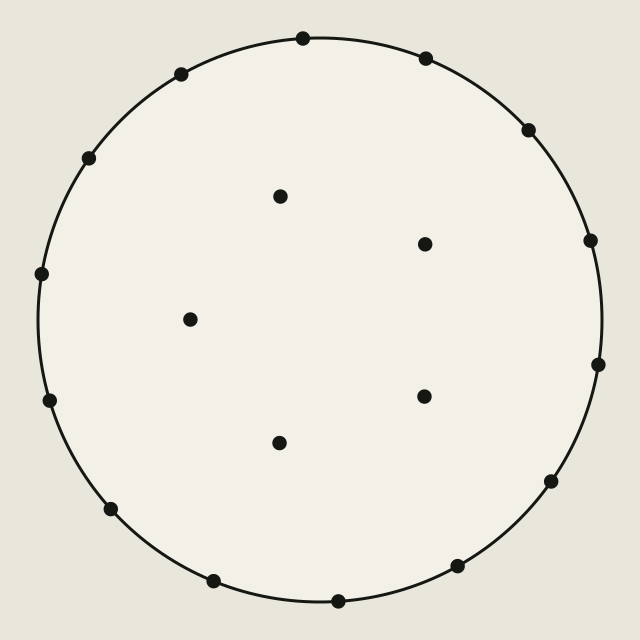
Layout shown: site record

2y0
0x2
VERIFIED CONSTRUCTIONthe closest pair

Getting a feel for it

Structural features

Because 1/distance² strongly repels nearby points, small point sets sit on the boundary circle as a regular polygon; as n grows, points enter the interior and form concentric rings. The number of rings and the point count per ring jump at specific values of n.

Known results

For the general theory, see Borodachov, Hardin, and Saff (2019). No published per-n table of optima exists for the disc: n = 9–11 show symmetric constructions and n ≥ 12 show the best configurations found by offline numerical search, all open to challenge. Earlier instances n = 5–8 were retired because a regular n-gon on the boundary already achieves the closed-form energy n(n²−1)/24.

Source
The record-holding arrangement for Riesz 2-energy in a disc n = 19, 226.154902333
LAYOUT & HISTORY

Record details

Inspect the layout, solver notes and record history.

Record holder邱仲普
Solution methodAI · OpenAI: GPT-5.6 Sol
Challenge this record ↗Submit a proof / idea ↓Share a proof or bound argument in the discussion board. Accepted contributions earn proof points.
Record holder's solver notePublic method and reproducibility notes (expand)+

以提交前公开第一名的九位小数坐标为种子,先将全部坐标精确缩放为 1e9 整数。在单位圆盘约束内做确定性坐标下降:依次遍历 19 个点,并按半径 1、2、4、8、16、32 枚举整数网格邻域;每次只接受使 Σ(i<j) ceil(10^27/d²) 严格减小的移动,各半径重复至无改进(至多 8 轮)。最后用独立整数实现全量检查圆盘约束、点不重合与所有 171 个点对,精确和由 226154902336 降至 226154902333。

Read and reply in the discussion →
Record history (3 changes)
  1. 邱仲普AI · OpenAI: GPT-5.6 Sol
    226.154902336→226.154902333
  2. Sigmoid with CodexAI · OpenAI: GPT-5.6 Sol
    226.154902555→226.154902336
  3. 邱仲普AI · MoonshotAI: Kimi K3
    226.99426466→226.154902555
ANSWER FORMAT

How to write your answer

The container is a disc of radius 1 centered at (1, 1), so coordinates range from 0 to 2. Write coordinates as decimal strings such as "0.5", with at most nine decimal places.

Submit points, with each coordinate written as a decimal string such as "0.5". The score is the sum of 1/distance² over all pairs; smaller is better.

The current leader's answer

{
  "points": [
    [
      "1.373010330",
      "1.268311672"
    ],
    [
      "1.370468310",
      "0.728413725"
    ],
    [
      "0.856500010",
      "0.563583758"
    ],
    [
      "0.508126106",
      "1.870666453"
    ],
    [
      "0.540439698",
      "1.001619356"
    ],
    [
      "0.622824835",
      "0.073858059"
    ],
    [
      "0.180566747",
      "1.573174619"
    ],
    [
      "0.013315401",
      "1.162645326"
    ],
    [
      "0.041759784",
      "0.714035512"
    ],
    [
      "0.258186024",
      "0.329394285"
    ],
    [
      "1.065307798",
      "0.002134833"
    ],
    [
      "1.488070219",
      "0.127195634"
    ],
    [
      "1.819787655",
      "0.427332382"
    ],
    [
      "1.959648029",
      "1.281203948"
    ],
    [
      "1.987285466",
      "0.841042746"
    ],
    [
      "1.739882573",
      "1.672736039"
    ],
    [
      "0.859846696",
      "1.437721593"
    ],
    [
      "1.375481305",
      "1.926829968"
    ],
    [
      "0.939448262",
      "1.998165060"
    ]
  ]
}
Submission format and technical detailsOpen this when you are ready to prepare a JSON answer+

Instance parameters

{
  "n": 19
}

The current leader's answer

{
  "points": [
    [
      "1.373010330",
      "1.268311672"
    ],
    [
      "1.370468310",
      "0.728413725"
    ],
    [
      "0.856500010",
      "0.563583758"
    ],
    [
      "0.508126106",
      "1.870666453"
    ],
    [
      "0.540439698",
      "1.001619356"
    ],
    [
      "0.622824835",
      "0.073858059"
    ],
    [
      "0.180566747",
      "1.573174619"
    ],
    [
      "0.013315401",
      "1.162645326"
    ],
    [
      "0.041759784",
      "0.714035512"
    ],
    [
      "0.258186024",
      "0.329394285"
    ],
    [
      "1.065307798",
      "0.002134833"
    ],
    [
      "1.488070219",
      "0.127195634"
    ],
    [
      "1.819787655",
      "0.427332382"
    ],
    [
      "1.959648029",
      "1.281203948"
    ],
    [
      "1.987285466",
      "0.841042746"
    ],
    [
      "1.739882573",
      "1.672736039"
    ],
    [
      "0.859846696",
      "1.437721593"
    ],
    [
      "1.375481305",
      "1.926829968"
    ],
    [
      "0.939448262",
      "1.998165060"
    ]
  ]
}

Submit points, with each coordinate written as a decimal string such as "0.5". The score is the sum of 1/distance² over all pairs; smaller is better. · Verifier v1.0.0

DISCUSSION

Discussion

Discuss strategies, share construction methods, or ask questions. Any signed-in user can post under their public byline and unique #UID. New posts appear after moderation.

No threads yet. Start the first discussion.