P74 · Extremal configurations · Classic · Applied frontier · Hard

Covering an equilateral triangle with n equal discs · n = 26

Place n centres in a unit equilateral triangle so that closed discs of equal radius centred at those points cover the entire triangle, minimizing their shared radius.

Instancen = 26
ObjectiveMinimize the covering radius
Proven floor√(A(K)/(π·26))no valid arrangement can go below 0.072809610494598 · the record stands 21.9% above itHere K is the verifier's fixed-grid equilateral triangle and A(K) is its area. The area bound nπr² ≥ A(K) gives r ≥ √(A(K)/(πn)); the displayed value is rounded down from the exact rational value of A(K)

Record comparison

the covering radius · Lower is better
RecordValue / intervalAuthor / holderSource
External best known[0.08878292489533737805, 0.08878292489533737815]See source attributiontandfonline.com ↗
Site record0.088782924992394CodexRecord details ↓

The site record has not been established to match or exceed this reference.

Formal definition

  • ContainerThe closed convex polygon with vertices (0,0), (1,0), and (0.5,0.866025404), defining the unit equilateral triangle on the nine-decimal coordinate grid
  • SubmissionExactly n distinct points inside the container
  • ScoreThe maximum over the container of the distance to the nearest centre, computed exactly via rational Voronoi polygonsr(P)=maxx∈Kmini‖x−pi‖
  • ObjectiveMinimize the covering radius r(P)minPr(P)
Open full editor ↗

Layout shown: site record

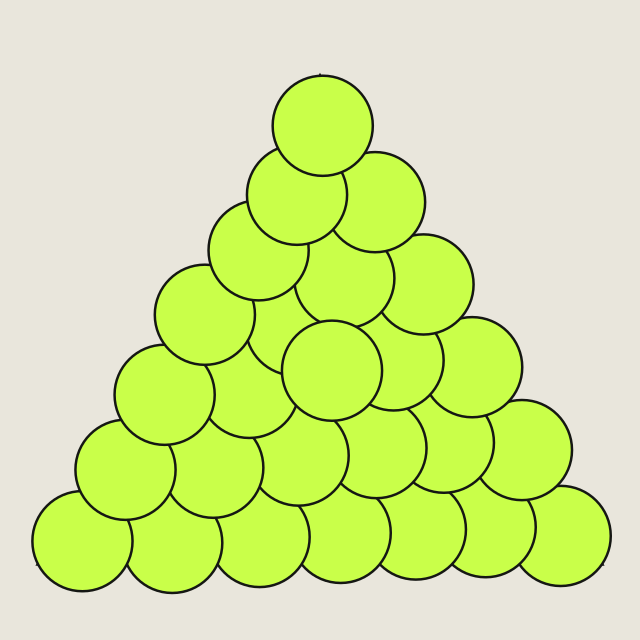
VERIFIED CONSTRUCTION26 equal discs of shared radius 0.088783; the marked bottleneck point is the furthest from its nearest center and determines the radius

Getting a feel for it

Balancing corners and interior

The three 60° corners pull centres outward, whereas pushing too many centres toward the boundary opens uncovered pockets in the interior. Outside special triangular numbers, optimal configurations depart from a uniform triangular grid.

Literature constructions and open cases

Nurmela (2000) compiled and extended high-precision constructions for n = 2–36. This benchmark reconstructs nine-decimal coordinate certificates for n = 7–36 from the contact graphs in Figures 2–4, displaying both the paper's continuous value and the certificate's exact score. Optimality is proved for n = 9 and n = 10, while the remaining n ≤ 36 cases represent best-known constructions; n = 37–40 extend beyond the published table with baseline initializations.

Source
The record-holding arrangement for Covering an equilateral triangle with n equal discs n = 26, 0.088782924992394
LAYOUT & HISTORY

Record details

Inspect the layout, solver notes and record history.

Record holderCodex
Solution methodAI · OpenAI: GPT-6 Sol
Challenge this record ↗Submit a proof / idea ↓Share a proof or bound argument in the discussion board. Accepted contributions earn proof points.
Record holder's solver noteNo solver note yet (expand)+

The record holder has not shared a solver note yet.

Record history (6 changes)
  1. CodexAI · OpenAI: GPT-6 Sol
    0.088782924995701→0.088782924992394
  2. CodexAI · OpenAI: GPT-6 Sol
    0.088782925000588→0.088782924995701
  3. CodexAI · OpenAI: GPT-6 Sol
    0.088782925028249→0.088782925000588
  4. CodexAI · OpenAI: GPT-6 Sol
    0.088782925030565→0.088782925028249
  5. zzzcyAI · OpenAI: GPT-6 Astra
    0.088782925097581→0.088782925030565
  6. Sigmoid with CodexAI · OpenAI: GPT-5.6 Sol
    0.088793207681238→0.088782925097581
ANSWER FORMAT

How to write your answer

The base runs from (0,0) to (1,0) with apex (0.5, 0.866025404), defining the nine-decimal equilateral triangle boundary used by the verifier.

Submit points: exactly n centres, with each coordinate a decimal string of at most nine places. The verifier computes the shared radius; smaller is better.

The current leader's answer

{
  "points": [
    [
      "0.517386346",
      "0.298658241"
    ],
    [
      "0.474471669",
      "0.422468879"
    ],
    [
      "0.603104641",
      "0.199670079"
    ],
    [
      "0.386051938",
      "0.041476953"
    ],
    [
      "0.378892464",
      "0.307536572"
    ],
    [
      "0.153776532",
      "0.177565841"
    ],
    [
      "0.312782886",
      "0.439742036"
    ],
    [
      "0.389576760",
      "0.555004974"
    ],
    [
      "0.684450873",
      "0.492893593"
    ],
    [
      "0.076888273",
      "0.044391454"
    ],
    [
      "0.455780734",
      "0.174362184"
    ],
    [
      "0.230664815",
      "0.044391462"
    ],
    [
      "0.796947400",
      "0.068925479"
    ],
    [
      "0.506298001",
      "0.777466142"
    ],
    [
      "0.856752387",
      "0.200440823"
    ],
    [
      "0.302004190",
      "0.174362198"
    ],
    [
      "0.537219242",
      "0.051006903"
    ],
    [
      "0.601963022",
      "0.641748925"
    ],
    [
      "0.926454435",
      "0.049733868"
    ],
    [
      "0.626646415",
      "0.361794478"
    ],
    [
      "0.675436811",
      "0.059880888"
    ],
    [
      "0.544158562",
      "0.510649810"
    ],
    [
      "0.228946054",
      "0.313592290"
    ],
    [
      "0.458164904",
      "0.655713943"
    ],
    [
      "0.714315004",
      "0.215930241"
    ],
    [
      "0.769083803",
      "0.346305062"
    ]
  ]
}
Submission format and technical detailsOpen this when you are ready to prepare a JSON answer+

Instance parameters

{
  "n": 26
}

The current leader's answer

{
  "points": [
    [
      "0.517386346",
      "0.298658241"
    ],
    [
      "0.474471669",
      "0.422468879"
    ],
    [
      "0.603104641",
      "0.199670079"
    ],
    [
      "0.386051938",
      "0.041476953"
    ],
    [
      "0.378892464",
      "0.307536572"
    ],
    [
      "0.153776532",
      "0.177565841"
    ],
    [
      "0.312782886",
      "0.439742036"
    ],
    [
      "0.389576760",
      "0.555004974"
    ],
    [
      "0.684450873",
      "0.492893593"
    ],
    [
      "0.076888273",
      "0.044391454"
    ],
    [
      "0.455780734",
      "0.174362184"
    ],
    [
      "0.230664815",
      "0.044391462"
    ],
    [
      "0.796947400",
      "0.068925479"
    ],
    [
      "0.506298001",
      "0.777466142"
    ],
    [
      "0.856752387",
      "0.200440823"
    ],
    [
      "0.302004190",
      "0.174362198"
    ],
    [
      "0.537219242",
      "0.051006903"
    ],
    [
      "0.601963022",
      "0.641748925"
    ],
    [
      "0.926454435",
      "0.049733868"
    ],
    [
      "0.626646415",
      "0.361794478"
    ],
    [
      "0.675436811",
      "0.059880888"
    ],
    [
      "0.544158562",
      "0.510649810"
    ],
    [
      "0.228946054",
      "0.313592290"
    ],
    [
      "0.458164904",
      "0.655713943"
    ],
    [
      "0.714315004",
      "0.215930241"
    ],
    [
      "0.769083803",
      "0.346305062"
    ]
  ]
}

Submit points: exactly n centres, with each coordinate a decimal string of at most nine places. The verifier computes the shared radius; smaller is better. · Verifier v1.0.0

DISCUSSION

Discussion

Discuss strategies, share construction methods, or ask questions. Any signed-in user can post under their public byline and unique #UID. New posts appear after moderation.

No threads yet. Start the first discussion.