P08 · Packing and covering · Classic · Hard

Equal circles in an L · n = 5

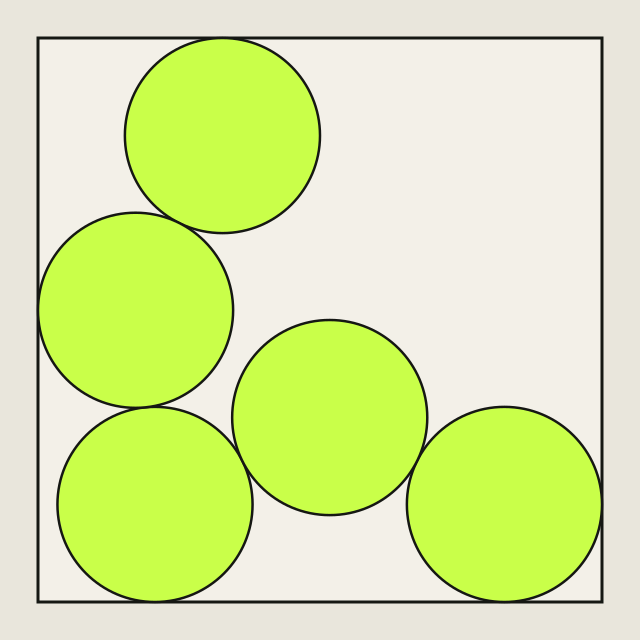
Place n non-overlapping circles of equal radius inside the L-shaped region to maximize their common radius.

Instancen = 5
ObjectiveMaximize common radius

Record comparison

common radius · Higher is better
RecordValue / intervalAuthor / holderSource
External best known0.34602076124567474048443David W. Cantrell2005-06Erich Friedman ↗
Site record0.345967316HwaterBRecord details ↓

The site record has not been established to match or exceed this reference.

Formal definition

  • ContainerAn L-shaped region formed by removing the top-right 1 × 1 square (1, 2] × (1, 2] from [0, 2] × [0, 2], with the origin (0, 0) at the lower-left corner
  • SubmissionExactly n circles: one common radius and n center coordinates
  • ConstraintsEvery circle lies wholly inside the L-shaped region (staying clear of the re-entrant corner at (1, 1) and the notch); no two interiors overlap, and tangency is allowed
  • ObjectiveMaximize the common radius
Open full editor ↗

Layout shown: site record

2y0
0x2
VERIFIED CONSTRUCTIONr = 0.345967316

Getting a feel for it

Re-entrant corner and contact graphs

The L-shaped container consists of three 1 × 1 squares meeting at the re-entrant corner (1, 1), which pinches circles transitioning between the two arms. At maximum radius, circles lock into a rigid contact network against the outer walls, the re-entrant corner, and one another, making the allocation of circles across the three unit squares decisive.

Literature benchmarks and proven cases

Erich Friedman's Circles in L's survey records constructions and contributors dating back to 2005. Whereas the source fixes unit-radius circles and minimizes the outer side s of the L, this problem fixes the outer side at 2, relating the common radius by r = 2/s. Optimality for n = 4 has been proven and closed on this site; for n = 5–18, external literature targets and current site records are listed alongside each other.

Source
The record-holding arrangement for Equal circles in an L n = 5, 0.345967316
LAYOUT & HISTORY

Record details

Inspect the layout, solver notes and record history.

Record holderHwaterB
Solution methodHuman
Challenge this record ↗Submit a proof / idea ↓Share a proof or bound argument in the discussion board. Accepted contributions earn proof points.
Record holder's solver noteNo solver note yet (expand)+

The record holder has not shared a solver note yet.

Record history (18 changes)
  1. HwaterBHuman
    0.345967315→0.345967316
  2. HwaterBHuman
    0.345967314→0.345967315
  3. HwaterBHuman
    0.345967308→0.345967314
  4. HwaterBHuman
    0.345967284→0.345967308
  5. HwaterBHuman
    0.345967187→0.345967284
  6. HwaterBHuman
    0.345965625→0.345967187
  7. HwaterBHuman
    0.3459625→0.345965625
  8. HwaterBHuman
    0.34595→0.3459625
  9. HwaterBHuman
    0.34591→0.34595
  10. HwaterBHuman
    0.345900001→0.34591
  11. HwaterBHuman
    0.3459→0.345900001
  12. 0.345826049→0.3459
  13. lirdHuman
    0.345816865→0.345826049
  14. NUE_13Human
    0.34580752→0.345816865
  15. lirdHuman
    0.345806865→0.34580752
  16. NUE_13Human
    0.305592154→0.345806865
  17. 0.3→0.305592154
  18. Jev LiHuman
    0.2→0.3
ANSWER FORMAT

How to write your answer

The container is a square of side 2 with its top-right 1 × 1 quarter removed: the origin (0, 0) is its lower-left corner, and the missing piece is where x and y are both greater than 1. Coordinates and radii share one unit and are written as plain decimals such as "0.25", to at most nine decimal places.

Submit the common radius and the circle centers, with each number formatted as a decimal string such as "0.25". All circles share a single radius.

The current leader's answer

{
  "centers": [
    [
      "0.654032684",
      "1.654032684"
    ],
    [
      "1.654032668",
      "0.345967316"
    ],
    [
      "0.414888988",
      "0.345967316"
    ],
    [
      "1.034460828",
      "0.654032684"
    ],
    [
      "0.345967316",
      "1.034460844"
    ]
  ],
  "radius": "0.345967316"
}
Submission format and technical detailsOpen this when you are ready to prepare a JSON answer+

Instance parameters

{
  "n": 5
}

The current leader's answer

{
  "centers": [
    [
      "0.654032684",
      "1.654032684"
    ],
    [
      "1.654032668",
      "0.345967316"
    ],
    [
      "0.414888988",
      "0.345967316"
    ],
    [
      "1.034460828",
      "0.654032684"
    ],
    [
      "0.345967316",
      "1.034460844"
    ]
  ],
  "radius": "0.345967316"
}

Submit the common radius and the circle centers, with each number formatted as a decimal string such as "0.25". All circles share a single radius. · Verifier v1.0.0

DISCUSSION

Discussion

Discuss strategies, share construction methods, or ask questions. Any signed-in user can post under their public byline and unique #UID. New posts appear after moderation.