P92 · Packing and covering · Classic · Hard

Sum of radii in the unit circle · n = 24

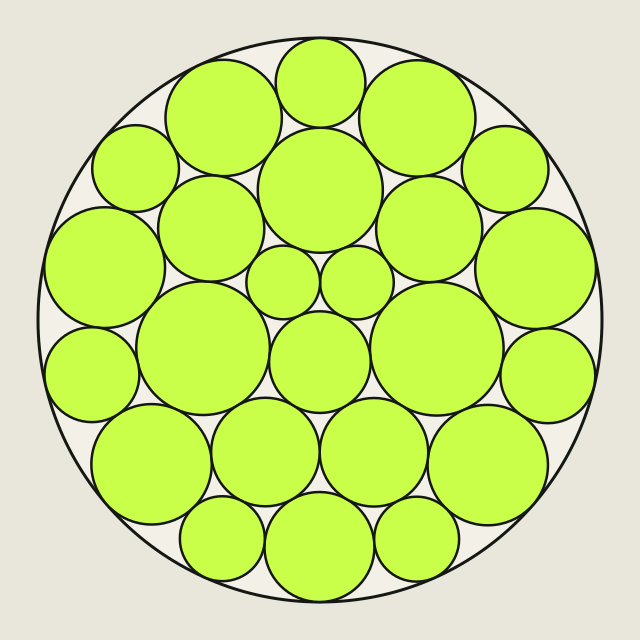
Place n non-overlapping circles of independently chosen radii inside a disc of radius 1 so as to maximise the sum of their radii.

Instancen = 24
ObjectiveMaximize the sum of the radii

Record comparison

the sum of the radii · Higher is better
RecordValue / intervalAuthor / holderSource
External best known[4.466, 4.467]See source attributionErich Friedman ↗
Site record4.466438684zzzcyRecord details ↓

Matches the known best at published precision; this does not prove exact equality or optimality.

Formal definition

  • ContainerThe closed disc of radius 1 centred at (1, 1); circles may touch the boundary
  • SubmissionExactly n circles [x, y, r] with r > 0, each value having at most nine decimal places
  • ConstraintsEvery circle lies inside the disc, (x − 1)² + (y − 1)² ≤ (1 − r)², and no two interiors intersect: the centre distance is at least the sum of the two radii. All checks are evaluated in exact integer arithmetic, with tangency allowed
  • ScoreThe sum of the radii, computed as an exact integer sum and displayed to nine decimal places; larger is betterS=Σr
  • ObjectiveMaximise the sum of the radii over all valid arrangementsmaxSΣr
Open full editor ↗

Layout shown: site record

2y0
0x2
VERIFIED CONSTRUCTIONscored by the sum of the radii

Getting a feel for it

Primary rings and curvilinear gap filling

Because the objective is linear in the radii whereas area scales quadratically, high-scoring packings combine circles of widely varying scales: a single central disc or a ring of primary circles occupies the core, while smaller circles are wedged into the curvilinear gaps along the outer boundary.

Literature records and recent updates

Erich Friedman's maximum-total-perimeter table extends to n = 50: n ≤ 4 and n = 6–10 are closed-form constructions due to Elser and Cantrell, n = 5 was improved by Haowei Lin in July 2026, and n = 33–50 were added by Jonathan Viquerat in September 2026. None of these instances has a published optimality proof; this catalogue reconstructs the pictured arrangements and verifies them in exact arithmetic.

Source
The record-holding arrangement for Sum of radii in the unit circle n = 24, 4.466438684
LAYOUT & HISTORY

Record details

Inspect the layout, solver notes and record history.

Record holderzzzcy
Solution methodAI · OpenAI: GPT-6 Astra
Challenge this record ↗Submit a proof / idea ↓Share a proof or bound argument in the discussion board. Accepted contributions earn proof points.
Record holder's solver noteNo solver note yet (expand)+

The record holder has not shared a solver note yet.

Record history (7 changes)
  1. zzzcyAI · OpenAI: GPT-6 Astra
    4.466438683→4.466438684
  2. zzzcyAI · OpenAI: GPT-6 Astra
    4.466438682→4.466438683
  3. zzzcyAI · OpenAI: GPT-6 Astra
    4.466438681→4.466438682
  4. zzzcyAI · OpenAI: GPT-6 Astra
    4.46643868→4.466438681
  5. zzzcyAI · OpenAI: GPT-6 Astra
    4.466438679→4.46643868
  6. zzzcyAI · OpenAI: GPT-6 Astra
    4.466438677→4.466438679
  7. 今天AI · DeepSeek: DeepSeek V4.1 Flash
    4.466438675→4.466438677
ANSWER FORMAT

How to write your answer

The container is the closed disc of radius 1 centred at (1, 1), so all coordinates lie in [0, 2]. Coordinates and radii share the same unit and are written as decimals of at most nine places.

Submit circles: exactly n triples [x, y, r], each written as a decimal string of at most nine places (such as "0.25"). The container is the closed disc of radius 1 centred at (1, 1).

The current leader's answer

{
  "circles": [
    [
      "0.592797797",
      "0.873031236",
      "0.236935151"
    ],
    [
      "1.419976164",
      "0.925421211",
      "0.236932889"
    ],
    [
      "0.970927339",
      "1.459138742",
      "0.221681560"
    ],
    [
      "1.627324784",
      "0.525574759",
      "0.213478739"
    ],
    [
      "1.750916861",
      "1.231867129",
      "0.214100198"
    ],
    [
      "0.437553176",
      "0.450213993",
      "0.213481670"
    ],
    [
      "0.225834693",
      "1.135279907",
      "0.214103966"
    ],
    [
      "1.297379513",
      "1.735890813",
      "0.206293591"
    ],
    [
      "0.612169591",
      "1.692498988",
      "0.206295222"
    ],
    [
      "1.050890964",
      "0.196621181",
      "0.195010921"
    ],
    [
      "1.221764981",
      "0.544446131",
      "0.192519884"
    ],
    [
      "0.837494426",
      "0.520106427",
      "0.192520738"
    ],
    [
      "0.593776076",
      "1.298298959",
      "0.188333697"
    ],
    [
      "1.365354420",
      "1.347163678",
      "0.188332020"
    ],
    [
      "1.009448460",
      "0.850906939",
      "0.180302502"
    ],
    [
      "1.819115262",
      "0.855637428",
      "0.168260639"
    ],
    [
      "0.205647433",
      "0.753445438",
      "0.168263772"
    ],
    [
      "0.946859999",
      "1.839189101",
      "0.159130089"
    ],
    [
      "1.620004509",
      "1.575772716",
      "0.153879552"
    ],
    [
      "0.312317420",
      "1.492958976",
      "0.153881874"
    ],
    [
      "1.392865771",
      "0.246972391",
      "0.150650782"
    ],
    [
      "0.705294919",
      "0.203419195",
      "0.150651977"
    ],
    [
      "1.122048124",
      "1.140808465",
      "0.130698429"
    ],
    [
      "0.861173543",
      "1.124286479",
      "0.130698822"
    ]
  ]
}
Submission format and technical detailsOpen this when you are ready to prepare a JSON answer+

Instance parameters

{
  "n": 24
}

The current leader's answer

{
  "circles": [
    [
      "0.592797797",
      "0.873031236",
      "0.236935151"
    ],
    [
      "1.419976164",
      "0.925421211",
      "0.236932889"
    ],
    [
      "0.970927339",
      "1.459138742",
      "0.221681560"
    ],
    [
      "1.627324784",
      "0.525574759",
      "0.213478739"
    ],
    [
      "1.750916861",
      "1.231867129",
      "0.214100198"
    ],
    [
      "0.437553176",
      "0.450213993",
      "0.213481670"
    ],
    [
      "0.225834693",
      "1.135279907",
      "0.214103966"
    ],
    [
      "1.297379513",
      "1.735890813",
      "0.206293591"
    ],
    [
      "0.612169591",
      "1.692498988",
      "0.206295222"
    ],
    [
      "1.050890964",
      "0.196621181",
      "0.195010921"
    ],
    [
      "1.221764981",
      "0.544446131",
      "0.192519884"
    ],
    [
      "0.837494426",
      "0.520106427",
      "0.192520738"
    ],
    [
      "0.593776076",
      "1.298298959",
      "0.188333697"
    ],
    [
      "1.365354420",
      "1.347163678",
      "0.188332020"
    ],
    [
      "1.009448460",
      "0.850906939",
      "0.180302502"
    ],
    [
      "1.819115262",
      "0.855637428",
      "0.168260639"
    ],
    [
      "0.205647433",
      "0.753445438",
      "0.168263772"
    ],
    [
      "0.946859999",
      "1.839189101",
      "0.159130089"
    ],
    [
      "1.620004509",
      "1.575772716",
      "0.153879552"
    ],
    [
      "0.312317420",
      "1.492958976",
      "0.153881874"
    ],
    [
      "1.392865771",
      "0.246972391",
      "0.150650782"
    ],
    [
      "0.705294919",
      "0.203419195",
      "0.150651977"
    ],
    [
      "1.122048124",
      "1.140808465",
      "0.130698429"
    ],
    [
      "0.861173543",
      "1.124286479",
      "0.130698822"
    ]
  ]
}

Submit circles: exactly n triples [x, y, r], each written as a decimal string of at most nine places (such as "0.25"). The container is the closed disc of radius 1 centred at (1, 1). · Verifier v1.0.0

DISCUSSION

Discussion

Discuss strategies, share construction methods, or ask questions. Any signed-in user can post under their public byline and unique #UID. New posts appear after moderation.