P12 · Packing and covering · Classic

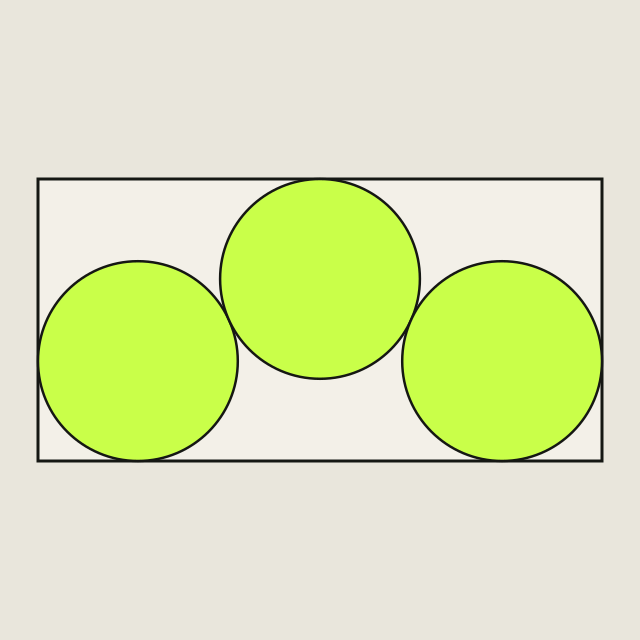
Equal-circle packing in a 2:1 rectangle · n = 3

Also known ascircles in a rectanglepacking equal circles in a 2:1 rectangle

Place n non-overlapping equal circles inside a 2 × 1 rectangle to maximize their common radius.

Instancen = 3
ObjectiveMaximize common radius

Record comparison

common radius · Higher is better
RecordValue / intervalAuthor / holderSource
Proven optimum3 − √7See source attribution
Proof / source

a zigzag of three, r = 3 − √7

Site recordNo player record yet——

FinishedA construction reaching the theoretical ceiling is already published, leaving nothing further to improve

Formal definition

  • ContainerA 2 × 1 rectangle [0, 2] × [0, 1], with lower-left corner (0, 0) and upper-right corner (2, 1)
  • SubmissionExactly n circles: one common radius and n center coordinates
  • ConstraintsEvery circle lies wholly inside the rectangle; no two interiors overlap, and tangency is allowed
  • ObjectiveMaximize the common radius
Inspect in editor ↗

Layout shown: starter layout

1y0
0x2
VERIFIED CONSTRUCTIONr = 0.354248688

Getting a feel for it

Staggered zig-zag chains and row transitions

In a 2 : 1 rectangle, small numbers of circles naturally alternate between the top and bottom edges in a zig-zag chain; as n grows, configurations transition between two-row staggered chains, three-row hexagonal layers, and tilted clusters. Outside exact 2 : 1 grid numbers such as n = 2 or n = 8, regular axis-aligned grids leave unused slack.

Proven optima and open frontier

Optimality for n = 3..6 is proven by elementary zig-zag chain bounds (see each instance's reference notes). Larger n cite Packomania's table for the 1 × 0.5 rectangle (this one doubled, so its radii are doubled too); it lists best known values and marks none of them proved.

The current arrangement for Equal-circle packing in a 2:1 rectangle n = 3
LAYOUT & HISTORY

Starter layout

Inspect the layout, solver notes and record history.

The optimum is proven; no further improvement is possibleSubmit a proof / idea ↓Share a proof or bound argument in the discussion board. Accepted contributions earn proof points.
ANSWER FORMAT

How to write your answer

The container is a rectangle 2 wide and 1 tall. Its lower-left corner is the origin (0, 0) and its upper-right corner is (2, 1). Coordinates and lengths share one unit and are written as plain decimals such as "0.25", to at most nine decimal places.

Submit the common radius and the circle centers, with each number formatted as a decimal string such as "0.25".

Starter answer

{
  "centers": [
    [
      "0.354248688",
      "0.354248688"
    ],
    [
      "1",
      "0.645751312"
    ],
    [
      "1.645751312",
      "0.354248688"
    ]
  ],
  "radius": "0.354248688"
}
Submission format and technical detailsOpen this when you are ready to prepare a JSON answer+

Instance parameters

{
  "n": 3
}

Starter answer

{
  "centers": [
    [
      "0.354248688",
      "0.354248688"
    ],
    [
      "1",
      "0.645751312"
    ],
    [
      "1.645751312",
      "0.354248688"
    ]
  ],
  "radius": "0.354248688"
}

Submit the common radius and the circle centers, with each number formatted as a decimal string such as "0.25". · Verifier v1.0.0

DISCUSSION

Discussion

Discuss strategies, share construction methods, or ask questions. Any signed-in user can post under their public byline and unique #UID. New posts appear after moderation.