P11 · Packing and covering · Classic

Equal-circle packing in a right triangle · n = 2

Also known ascircles in a trianglepacking equal circles in a right triangle

Place n non-overlapping equal circles inside the right triangle with legs 1 and 0.75 to maximize their common radius.

Instancen = 2
ObjectiveMaximize common radius

Record comparison

common radius · Higher is better
RecordValue / intervalAuthor / holderSource
Proven optimum5/28NUE_13 #31MinMax Arena ↗
Site record0.178571428CphysicsRecord details ↓

The continuous optimum is proved, so competition submissions are closed. Historical records and contribution points are retained. Because finite-decimal coordinates cannot attain this value exactly, the current certificate is not claimed optimal on the nine-decimal grid.

Formal definition

  • ContainerA 3-4-5 right triangle with its right angle at the origin (0, 0) and legs along the axes to (1, 0) and (0, 0.75)
  • SubmissionExactly n circles: one common radius and n center coordinates
  • ConstraintsEvery circle lies wholly inside the right triangle; no two interiors overlap, and tangency is allowed
  • ObjectiveMaximize the common radius
Read the optimality proof ↗

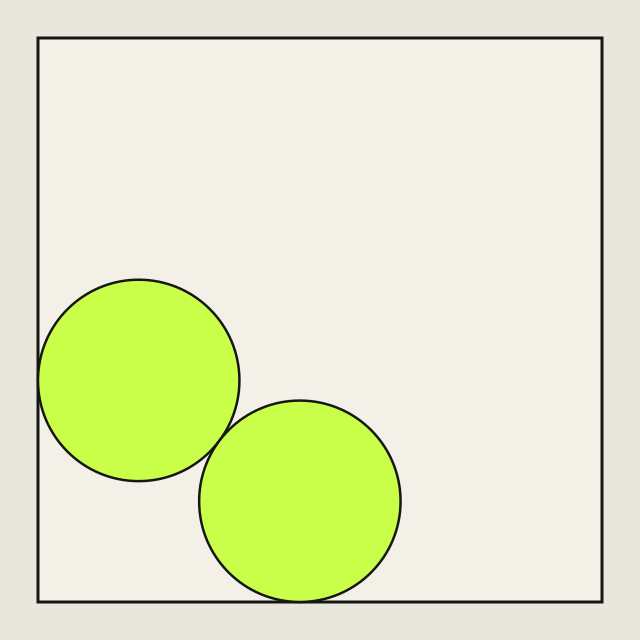
Layout shown: site record

0.75y0
0x1
VERIFIED CONSTRUCTIONr = 0.178571428

Getting a feel for it

Unequal acute angles and asymmetric contact graphs

Because the three angles of a 3-4-5 right triangle are all different, the narrower acute corners force circle centers farther from the vertices and leave unequal dead space. At maximum radius, circles form asymmetric contact networks braced against the three sides, occasionally leaving a rattler in an interior pocket.

Literature context and open status

No dedicated benchmark table has been published for equal-circle packing in the 1 : 0.75 : 1.25 right triangle (closely related containers such as the isosceles right triangle are surveyed on Erich Friedman's Packing Center). NUE_13 #31's proof, completed by the site, settles the continuous optimal radii 5/28, 25/164 and 5/36 for n = 2, 3 and 4; those three cases retain their history and close without claiming nine-decimal grid optimality. From n = 5 on every instance is open.

Source
The record-holding arrangement for Equal-circle packing in a right triangle n = 2, 0.178571428
LAYOUT & HISTORY

Record details

Inspect the layout, solver notes and record history.

Record holderCphysics
Solution methodHuman
Proven optimumSubmit a proof / idea ↓Share a proof or bound argument in the discussion board. Accepted contributions earn proof points.Read the published proof ↗
Record holder's solver noteNo solver note yet (expand)+

The record holder has not shared a solver note yet.

Record history (4 changes)
  1. 0.177597036→0.178571428
  2. NUE_13Human
    0.176197036→0.177597036
  3. DilsesHuman
    0.173342234→0.176197036
  4. jiayaHuman
    0.166666666→0.173342234
ANSWER FORMAT

How to write your answer

The container is a right triangle: the right angle is the origin (0, 0), one leg runs along the x axis to (1, 0), the other along the y axis to (0, 0.75), and the hypotenuse joins those two points. Coordinates and lengths share one unit and are written as plain decimals such as "0.15", to at most nine decimal places.

Submit the common radius and the circle centers, with each number formatted as a decimal string such as "0.15".

The current leader's answer

{
  "centers": [
    [
      "0.178571428",
      "0.392857142"
    ],
    [
      "0.464285714",
      "0.178571428"
    ]
  ],
  "radius": "0.178571428"
}
Submission format and technical detailsOpen this when you are ready to prepare a JSON answer+

Instance parameters

{
  "n": 2
}

The current leader's answer

{
  "centers": [
    [
      "0.178571428",
      "0.392857142"
    ],
    [
      "0.464285714",
      "0.178571428"
    ]
  ],
  "radius": "0.178571428"
}

Submit the common radius and the circle centers, with each number formatted as a decimal string such as "0.15". · Verifier v1.0.0

DISCUSSION

Discussion

Discuss strategies, share construction methods, or ask questions. Any signed-in user can post under their public byline and unique #UID. New posts appear after moderation.