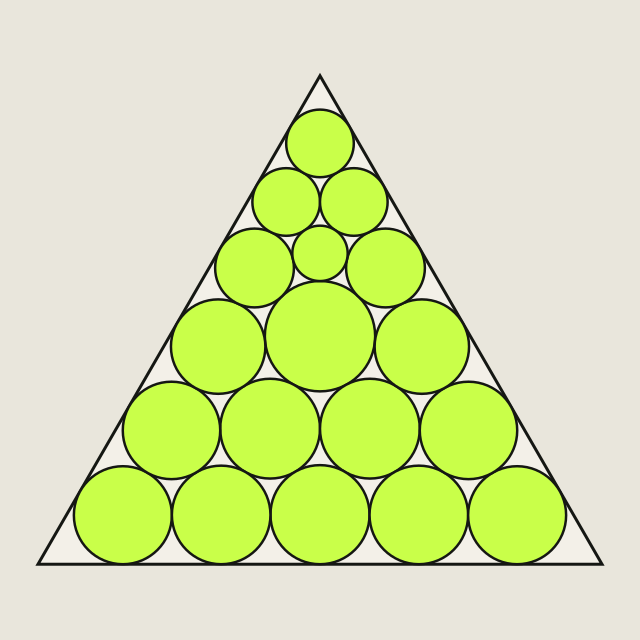
Sum of radii in the equilateral triangle · n = 18
Place n non-overlapping circles inside an equilateral triangle of side 1, each with its own radius, making the sum of the radii as large as possible.
Instancen = 18
ObjectiveMaximize the sum of the radii
Record comparison
the sum of the radii · Higher is better| Record | Value / interval | Author / holder | Source |
|---|---|---|---|
| External best known | [1.420, 1.421) | See source attribution | Erich Friedman ↗ |
| Site record | 1.420030145 | zzzcy | Record details ↓ |
Matches the known best at published precision; this does not prove exact equality or optimality.
Formal definition
- ContainerThe closed equilateral triangle with vertices (0, 0), (1, 0) and (1/2, √3/2); a circle may touch a side
- SubmissionExactly n circles, each [x, y, r] with r > 0, every number to at most nine decimals
- ConstraintsEvery circle lies inside the triangle: y ≥ r, √3·x − y ≥ 2r and √3·(1 − x) − y ≥ 2r; no two interiors meet: the distance between centres is at least the sum of the radii. The slanted sides are compared as squares of integers; everything is exact, and touching is allowed
- ScoreThe sum of the radii, an exact integer sum shown to nine decimals; larger is better
- ObjectiveMaximise the sum of the radii over every legal arrangement