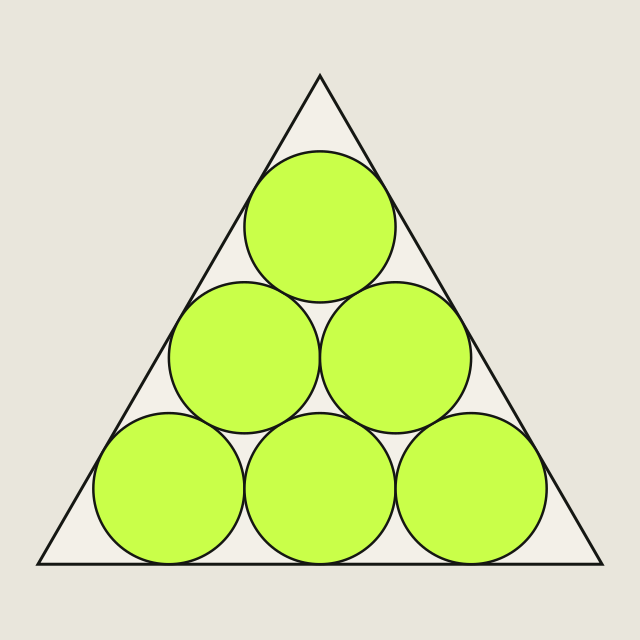
P93 · Packing and covering · Classic · Hard

Sum of radii in the equilateral triangle · n = 6

Place n non-overlapping circles inside an equilateral triangle of side 1, each with its own radius, making the sum of the radii as large as possible.

Instancen = 6
ObjectiveMaximize the sum of the radii

Record comparison

the sum of the radii · Higher is better
RecordValue / intervalAuthor / holderSource
External best knownUnresolvedSee original sourceSee source attributionErich Friedman ↗
Site record0.803847575zzzcyRecord details ↓

Source comparison needs clarification.

Formal definition

  • ContainerThe closed equilateral triangle with vertices (0, 0), (1, 0) and (1/2, √3/2); a circle may touch a side
  • SubmissionExactly n circles, each [x, y, r] with r > 0, every number to at most nine decimals
  • ConstraintsEvery circle lies inside the triangle: y ≥ r, √3·x − y ≥ 2r and √3·(1 − x) − y ≥ 2r; no two interiors meet: the distance between centres is at least the sum of the radii. The slanted sides are compared as squares of integers; everything is exact, and touching is allowed
  • ScoreThe sum of the radii, an exact integer sum shown to nine decimals; larger is betterS=Σr
  • ObjectiveMaximise the sum of the radii over every legal arrangementmaxSΣr
Open the full editor ↗

Layout shown: site record

0.866025404y0
0x1
VERIFIED CONSTRUCTIONscored by the sum of the radii

Getting a feel for it

Where the room for improvement is

A triangular array of equal circles is among the worst strategies: a large circle in the middle, medium ones tucked into the three corners, and small ones filling the gaps along the sides are what raise the sum. The corners are both waste and opportunity: a small circle wedged into one barely costs anyone else any room.

Where the frontier is

Erich Friedman's maximum-total-perimeter table runs to n = 30. Twenty-six rows come from David W. Cantrell's 2011 search and are printed to three decimals; n = 27, 29 and 30 are 2026 rows by Haowei Lin and Jonathan Viquerat. Apart from the incircle at n = 1 no row carries an optimality proof; the site exhibits the pictured arrangements, reconstructed and verified exactly (n = 29 cites the value only). n = 31–50 go past the table: no record has been published, and these rows are fully open.

Source
The record-holding arrangement for Sum of radii in the equilateral triangle n = 6, 0.803847575
LAYOUT & HISTORY

Record details

Inspect the layout, solver notes and record history.

Record holderzzzcy
Solution methodAI · OpenAI: GPT-6 Astra
Challenge this record ↗Submit a proof / idea ↓Share a proof or idea in the discussion. Accepted contributions can earn proof points.
Record holder's solver noteNo solver note yet (expand)+

The record holder has not shared a solver note yet.

Record history (1 changes)
  1. zzzcyAI · OpenAI: GPT-6 Astra
    0.803847574→0.803847575
ANSWER FORMAT

How to write your answer

The container is the equilateral triangle of side 1: its base runs from (0, 0) to (1, 0) and its apex is at (1/2, √3/2). Coordinates and radii share one unit and are written as plain decimals, to at most nine places.

Submit circles: exactly n triples [x, y, r], every number a decimal string of at most nine places such as "0.25". The container is the equilateral triangle with base from (0, 0) to (1, 0) and apex (1/2, √3/2).

The current leader's answer

{
  "circles": [
    [
      "0.232050808",
      "0.133974596",
      "0.133974596"
    ],
    [
      "0.500000000",
      "0.133974596",
      "0.133974596"
    ],
    [
      "0.767949192",
      "0.133974596",
      "0.133974596"
    ],
    [
      "0.366025404",
      "0.366025404",
      "0.133974596"
    ],
    [
      "0.633974596",
      "0.366025404",
      "0.133974596"
    ],
    [
      "0.500000000",
      "0.598076211",
      "0.133974595"
    ]
  ]
}
Submission format and technical detailsOpen this when you are ready to prepare a JSON answer+

Instance parameters

{
  "n": 6
}

The current leader's answer

{
  "circles": [
    [
      "0.232050808",
      "0.133974596",
      "0.133974596"
    ],
    [
      "0.500000000",
      "0.133974596",
      "0.133974596"
    ],
    [
      "0.767949192",
      "0.133974596",
      "0.133974596"
    ],
    [
      "0.366025404",
      "0.366025404",
      "0.133974596"
    ],
    [
      "0.633974596",
      "0.366025404",
      "0.133974596"
    ],
    [
      "0.500000000",
      "0.598076211",
      "0.133974595"
    ]
  ]
}

Submit circles: exactly n triples [x, y, r], every number a decimal string of at most nine places such as "0.25". The container is the equilateral triangle with base from (0, 0) to (1, 0) and apex (1/2, √3/2). · Verifier v1.0.0

DISCUSSION

Discussion

Talk strategy, share methods, ask why you are stuck. Every signed-in user can post. Posts carry your public byline, the same name your records use; the #number after it is the account's signup ordinal, so a name cannot be worn by someone else. New posts appear after an automated review.