P97 · Packing and covering · Classic

Consecutive rectangles in similar rectangles · n = 1

Rectangle k has short side k. All pieces and the container share an aspect ratio r≥1. Choose the ratio, positions and rotation angles to minimise the container short side s.

Instancen = 1
ObjectiveMinimize container short side

Record comparison

container short side · Lower is better
RecordValue / intervalAuthor / holderSource
Proven optimum1See source attributionErich Friedman ↗
Site recordNo player record yet——

The continuous optimum is proved, so competition submissions are closed. Historical records and contribution points are retained. Because finite-decimal coordinates cannot attain this value exactly, the current certificate is not claimed optimal on the nine-decimal grid.

Formal definition

  • Container1≤ratio≤4096, 0<side≤4096. Local vertices are (±k·ratio/2, ±k/2), rotated then translated to centre (x,y). The container long side lies along the x axis.
  • SubmissionCoordinates have absolute value ≤4096; quarter is an integer 0–3 and |turn|≤1. Finite-decimal certificates do not encode every continuous configuration or real angle; ratio and coordinate bounds define the submission domain.
  • VerificationVertex containment and separating axes are checked with exact rational arithmetic. Contact is legal; any positive-area overlap or excursion is rejected. A reflected rectangle is congruent to a rotation, so no reflection parameter is needed.
  • ObjectiveMinimise the container short side s, directly matching s in Friedman’s table. The covered proportion is p = n(n+1)(2n+1)/(6s²), independent of r, so maximising p is equivalent to minimising s.
Inspect in editor ↗

Layout shown: starter layout

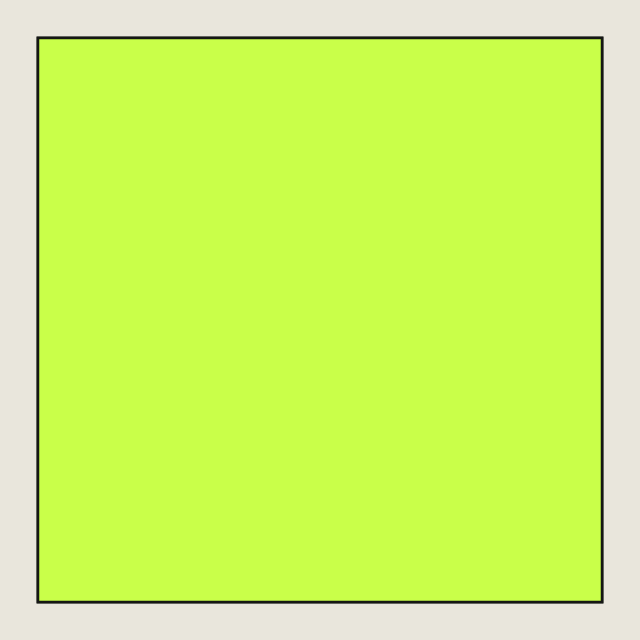
VERIFIED CONSTRUCTIONcontainer short side 1

Getting a feel for it

Choose the aspect ratio

The ratio applies to every piece and the container. Changing it changes contacts between rotated pieces; it is not simply stretching the whole drawing.

Area bound

The pieces have total area r∑k² and the container area is rs². Thus s²≥n(n+1)(2n+1)/6. For n=1, s=1 attains this bound and is proved optimal.

Published records

Friedman’s table supplies exact formulas and attribution for n=1–18. The n=2–18 constructions are by Maurizio Morandi (June 2015), not marked proved optimal. No external record is currently cited for n=19–50. Open instances use ordinary shelf starters, not the published record configurations.

Source
The current arrangement for Consecutive rectangles in similar rectangles n = 1
LAYOUT & HISTORY

Starter layout

Inspect the layout, solver notes and record history.

Proven optimumSubmit a proof / idea ↓Share a proof or bound argument in the discussion board. Accepted contributions earn proof points.
ANSWER FORMAT

How to write your answer

Drag rectangles and edit rotation angles in the coordinate table. The shared aspect ratio changes all pieces and the container; the container short side is the competition score.

Submit side, ratio and placements. Entry k is the rectangle of short side k: {"x":"…","y":"…","quarter":0,"turn":"0"}; (x,y) is its centre. Rotate counterclockwise by quarter×90°, then by θ with turn=tan(θ/2). Except quarter, use decimal strings with at most nine places.

Starter answer

{
  "placements": [
    {
      "quarter": 0,
      "turn": "0",
      "x": "0.5",
      "y": "0.5"
    }
  ],
  "ratio": "1",
  "side": "1"
}
Submission format and technical detailsOpen this when you are ready to prepare a JSON answer+

Instance parameters

{
  "n": 1
}

Starter answer

{
  "placements": [
    {
      "quarter": 0,
      "turn": "0",
      "x": "0.5",
      "y": "0.5"
    }
  ],
  "ratio": "1",
  "side": "1"
}

Submit side, ratio and placements. Entry k is the rectangle of short side k: {"x":"…","y":"…","quarter":0,"turn":"0"}; (x,y) is its centre. Rotate counterclockwise by quarter×90°, then by θ with turn=tan(θ/2). Except quarter, use decimal strings with at most nine places. · Verifier v1.0.0

DISCUSSION

Discussion

Discuss strategies, share construction methods, or ask questions. Any signed-in user can post under their public byline and unique #UID. New posts appear after moderation.