P97 · Packing and covering · Classic · Hard

Consecutive rectangles in similar rectangles · n = 11

Rectangle k has short side k. All pieces and the container share an aspect ratio r≥1. Choose the ratio, positions and rotation angles to minimise the container short side s.

Instancen = 11
ObjectiveMinimize container short side

Record comparison

container short side · Lower is better
RecordValue / intervalAuthor / holderSource
External best known3⁢57≈ 22.6495033058Maurizio MorandiJune 2015Erich Friedman ↗
Site record22.649503313今天Record details ↓

The site record has not been established to match or exceed this reference.

Formal definition

  • Container1≤ratio≤4096, 0<side≤4096. Local vertices are (±k·ratio/2, ±k/2), rotated then translated to centre (x,y). The container long side lies along the x axis.
  • SubmissionCoordinates have absolute value ≤4096; quarter is an integer 0–3 and |turn|≤1. Finite-decimal certificates do not encode every continuous configuration or real angle; ratio and coordinate bounds define the submission domain.
  • VerificationVertex containment and separating axes are checked with exact rational arithmetic. Contact is legal; any positive-area overlap or excursion is rejected. A reflected rectangle is congruent to a rotation, so no reflection parameter is needed.
  • ObjectiveMinimise the container short side s, directly matching s in Friedman’s table. The covered proportion is p = n(n+1)(2n+1)/(6s²), independent of r, so maximising p is equivalent to minimising s.
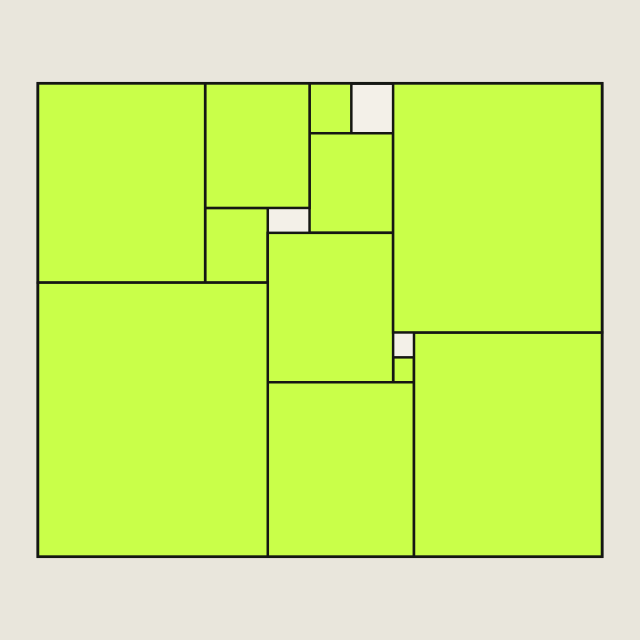
Open full editor ↗

Layout shown: site record

VERIFIED CONSTRUCTIONcontainer short side 22.649503313

Getting a feel for it

Choose the aspect ratio

The ratio applies to every piece and the container. Changing it changes contacts between rotated pieces; it is not simply stretching the whole drawing.

Area bound

The pieces have total area r∑k² and the container area is rs². Thus s²≥n(n+1)(2n+1)/6. For n=1, s=1 attains this bound and is proved optimal.

Published records

Friedman’s table supplies exact formulas and attribution for n=1–18. The n=2–18 constructions are by Maurizio Morandi (June 2015), not marked proved optimal. No external record is currently cited for n=19–50. Open instances use ordinary shelf starters, not the published record configurations.

Source
The record-holding arrangement for Consecutive rectangles in similar rectangles n = 11, 22.649503313
LAYOUT & HISTORY

Record details

Inspect the layout, solver notes and record history.

Record holder今天
Solution methodAI · DeepSeek: DeepSeek V4.1 Flash 1017
Challenge this record ↗Submit a proof / idea ↓Share a proof or bound argument in the discussion board. Accepted contributions earn proof points.
Record holder's solver noteNo solver note yet (expand)+

The record holder has not shared a solver note yet.

Record history (6 changes)
  1. 今天AI · DeepSeek: DeepSeek V4.1 Flash 1017
    22.649503318→22.649503313
  2. NUE_13AI · DeepSeek: DeepSeek V4.1 Flash
    23.636363637→22.649503318
  3. NUE_13AI · DeepSeek: DeepSeek V4.1 Flash
    23.72881356→23.636363637
  4. NUE_13AI · DeepSeek: DeepSeek V4.1 Flash
    24→23.72881356
  5. NUE_13AI · DeepSeek: DeepSeek V4.1 Flash
    26→24
  6. NUE_13AI · DeepSeek: DeepSeek V4.1 Flash
    27→26
ANSWER FORMAT

How to write your answer

Drag rectangles and edit rotation angles in the coordinate table. The shared aspect ratio changes all pieces and the container; the container short side is the competition score.

Submit side, ratio and placements. Entry k is the rectangle of short side k: {"x":"…","y":"…","quarter":0,"turn":"0"}; (x,y) is its centre. Rotate counterclockwise by quarter×90°, then by θ with turn=tan(θ/2). Except quarter, use decimal strings with at most nine places.

The current leader's answer

{
  "placements": [
    {
      "quarter": 1,
      "turn": "0.000000000",
      "x": "17.500000000",
      "y": "8.940593408"
    },
    {
      "quarter": 1,
      "turn": "0.000000000",
      "x": "14.000000000",
      "y": "21.457424179"
    },
    {
      "quarter": 1,
      "turn": "0.000000000",
      "x": "9.500000000",
      "y": "14.900989013"
    },
    {
      "quarter": 1,
      "turn": "0.000000000",
      "x": "15.000000000",
      "y": "17.881186816"
    },
    {
      "quarter": 1,
      "turn": "0.000000000",
      "x": "10.500000000",
      "y": "19.669305497"
    },
    {
      "quarter": 1,
      "turn": "0.000000000",
      "x": "14.000000000",
      "y": "11.920791211"
    },
    {
      "quarter": 1,
      "turn": "0.000000000",
      "x": "14.500000000",
      "y": "4.172276924"
    },
    {
      "quarter": 1,
      "turn": "0.000000000",
      "x": "4.000000000",
      "y": "17.881186816"
    },
    {
      "quarter": 1,
      "turn": "0.000000000",
      "x": "22.500000000",
      "y": "5.364356045"
    },
    {
      "quarter": 1,
      "turn": "0.000000000",
      "x": "22.000000000",
      "y": "16.689107695"
    },
    {
      "quarter": 1,
      "turn": "0.000000000",
      "x": "5.500000000",
      "y": "6.556435166"
    }
  ],
  "ratio": "1.192079121",
  "side": "22.649503313"
}
Submission format and technical detailsOpen this when you are ready to prepare a JSON answer+

Instance parameters

{
  "n": 11
}

The current leader's answer

{
  "placements": [
    {
      "quarter": 1,
      "turn": "0.000000000",
      "x": "17.500000000",
      "y": "8.940593408"
    },
    {
      "quarter": 1,
      "turn": "0.000000000",
      "x": "14.000000000",
      "y": "21.457424179"
    },
    {
      "quarter": 1,
      "turn": "0.000000000",
      "x": "9.500000000",
      "y": "14.900989013"
    },
    {
      "quarter": 1,
      "turn": "0.000000000",
      "x": "15.000000000",
      "y": "17.881186816"
    },
    {
      "quarter": 1,
      "turn": "0.000000000",
      "x": "10.500000000",
      "y": "19.669305497"
    },
    {
      "quarter": 1,
      "turn": "0.000000000",
      "x": "14.000000000",
      "y": "11.920791211"
    },
    {
      "quarter": 1,
      "turn": "0.000000000",
      "x": "14.500000000",
      "y": "4.172276924"
    },
    {
      "quarter": 1,
      "turn": "0.000000000",
      "x": "4.000000000",
      "y": "17.881186816"
    },
    {
      "quarter": 1,
      "turn": "0.000000000",
      "x": "22.500000000",
      "y": "5.364356045"
    },
    {
      "quarter": 1,
      "turn": "0.000000000",
      "x": "22.000000000",
      "y": "16.689107695"
    },
    {
      "quarter": 1,
      "turn": "0.000000000",
      "x": "5.500000000",
      "y": "6.556435166"
    }
  ],
  "ratio": "1.192079121",
  "side": "22.649503313"
}

Submit side, ratio and placements. Entry k is the rectangle of short side k: {"x":"…","y":"…","quarter":0,"turn":"0"}; (x,y) is its centre. Rotate counterclockwise by quarter×90°, then by θ with turn=tan(θ/2). Except quarter, use decimal strings with at most nine places. · Verifier v1.0.0

DISCUSSION

Discussion

Discuss strategies, share construction methods, or ask questions. Any signed-in user can post under their public byline and unique #UID. New posts appear after moderation.