P78 · Extremal configurations · Classic · Hard

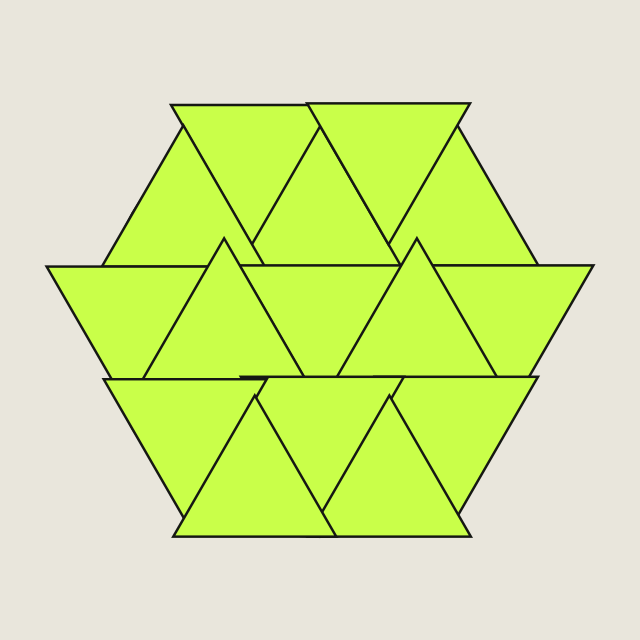
Covering a disc with n equilateral triangles · n = 15

Continuously cover the unit disc with n congruent equilateral triangles. Overlap and protrusion are allowed; minimise the common side.

Formal definition

  • ContainerThe closed disc D = {(x,y) : (x−1)² + (y−1)² ≤ 1}
  • SubmissionA common side s and exactly n {x,y,turn,down} placements, each independently rotatable and flippable
  • CoverEvery point of D belongs to at least one closed covering triangleDT1Tn
  • Exact continuous verificationThe 3n edges are extended to lines; on each face of that arrangement every triangle's membership is constant, so the disc is covered exactly when no face meeting the open disc is empty. Faces are sampled as trapezoids in vertical strips, all arithmetic in Q(√3); the circle enters only as whether a trapezoid meets the open disc, which is a rational comparison. No pixel sampling and no epsilon anywhere
  • ScoreThe side s shared by every covering triangle; smaller is betters(T)=s
  • ObjectiveMinimise s over all legal coversminTs(T)
Open the full editor
VERIFIED CONSTRUCTIONcommon side 0.755638952

Getting a feel for it

Six fit exactly; the problem starts at seven

Six equilateral triangles around the centre make a regular hexagon whose incircle is exactly the unit disc, side 2/√3, with nothing to spare. From the seventh piece on there is no ready answer to where the extra one goes and how the others make room.

Where the frontier is

Friedman's table records n = 1–18 in the reciprocal normalisation: the largest covered-disc radius r for n unit triangles, so the side here is s = 1/r. n = 8–13 have closed forms (Morandi, Cantrell); n = 7 and 14–18 are truncated decimals (Morandi, 2009), and nothing beyond n = 1, 2 and 6 is proved optimal. The source gives only approximately 200-pixel figures and no coordinates. This site reconstructed each pictured set of horizontal and ±60° edges and its contact topology, then used the exact continuous verifier to remove raster-rounding slivers. The literature target and the nine-decimal reconstruction remain separate, so reconstruction error is never presented as the authors' data.

Source
The record-holding arrangement for Covering a disc with n equilateral triangles n = 15, 0.755638952
Current leader

0.755638952

the common side

Answer sourceMaurizio Morandi
Solution methodPublished reference construction
Challenge this record
ANSWER FORMAT

How to write your answer

The container is the closed disc of radius 1 about (1,1), which fills the [0,2]² board. Coordinates mark one reference-edge midpoint; covering pieces may protrude.

Submit side and triangles, each as {x,y,turn,down}. The editor accepts or scrubs θ° and writes turn = tan(θ/2).

The current leader's answer

{
  "side": "0.755638952",
  "triangles": [
    {
      "down": true,
      "turn": "0.000000000",
      "x": "0.688566378",
      "y": "2.000848659"
    },
    {
      "down": false,
      "turn": "0.000000000",
      "x": "1.636310621",
      "y": "1.256066890"
    },
    {
      "down": true,
      "turn": "0.000000000",
      "x": "1.891002993",
      "y": "1.257256425"
    },
    {
      "down": false,
      "turn": "0.000000000",
      "x": "1.002240785",
      "y": "1.248509184"
    },
    {
      "down": false,
      "turn": "0.000000000",
      "x": "0.367948285",
      "y": "1.251659330"
    },
    {
      "down": true,
      "turn": "0.000000000",
      "x": "1.004892677",
      "y": "1.257256425"
    },
    {
      "down": true,
      "turn": "0.000000000",
      "x": "0.111761857",
      "y": "1.251777087"
    },
    {
      "down": false,
      "turn": "0.000000000",
      "x": "1.450642420",
      "y": "0.728174039"
    },
    {
      "down": true,
      "turn": "0.000000000",
      "x": "1.634087571",
      "y": "0.740700133"
    },
    {
      "down": false,
      "turn": "0.000000000",
      "x": "0.556827285",
      "y": "0.728174039"
    },
    {
      "down": true,
      "turn": "0.000000000",
      "x": "1.012367639",
      "y": "0.740700133"
    },
    {
      "down": true,
      "turn": "0.000000000",
      "x": "0.376355174",
      "y": "0.729363573"
    },
    {
      "down": false,
      "turn": "0.000000000",
      "x": "1.322966551",
      "y": "-0.000302782"
    },
    {
      "down": false,
      "turn": "0.000000000",
      "x": "0.698923089",
      "y": "-0.000302782"
    },
    {
      "down": true,
      "turn": "0.000000000",
      "x": "1.319152894",
      "y": "2.008406366"
    }
  ]
}
Submission format and technical detailsOpen this when you are ready to prepare a JSON answer

Instance parameters

{
  "n": 15
}

The current leader's answer

{
  "side": "0.755638952",
  "triangles": [
    {
      "down": true,
      "turn": "0.000000000",
      "x": "0.688566378",
      "y": "2.000848659"
    },
    {
      "down": false,
      "turn": "0.000000000",
      "x": "1.636310621",
      "y": "1.256066890"
    },
    {
      "down": true,
      "turn": "0.000000000",
      "x": "1.891002993",
      "y": "1.257256425"
    },
    {
      "down": false,
      "turn": "0.000000000",
      "x": "1.002240785",
      "y": "1.248509184"
    },
    {
      "down": false,
      "turn": "0.000000000",
      "x": "0.367948285",
      "y": "1.251659330"
    },
    {
      "down": true,
      "turn": "0.000000000",
      "x": "1.004892677",
      "y": "1.257256425"
    },
    {
      "down": true,
      "turn": "0.000000000",
      "x": "0.111761857",
      "y": "1.251777087"
    },
    {
      "down": false,
      "turn": "0.000000000",
      "x": "1.450642420",
      "y": "0.728174039"
    },
    {
      "down": true,
      "turn": "0.000000000",
      "x": "1.634087571",
      "y": "0.740700133"
    },
    {
      "down": false,
      "turn": "0.000000000",
      "x": "0.556827285",
      "y": "0.728174039"
    },
    {
      "down": true,
      "turn": "0.000000000",
      "x": "1.012367639",
      "y": "0.740700133"
    },
    {
      "down": true,
      "turn": "0.000000000",
      "x": "0.376355174",
      "y": "0.729363573"
    },
    {
      "down": false,
      "turn": "0.000000000",
      "x": "1.322966551",
      "y": "-0.000302782"
    },
    {
      "down": false,
      "turn": "0.000000000",
      "x": "0.698923089",
      "y": "-0.000302782"
    },
    {
      "down": true,
      "turn": "0.000000000",
      "x": "1.319152894",
      "y": "2.008406366"
    }
  ]
}

Submit side and triangles, each as {x,y,turn,down}. The editor accepts or scrubs θ° and writes turn = tan(θ/2). · Verifier v1.0.0

DISCUSSION

Discussion

Talk strategy, share methods, ask why you are stuck. Posts carry your public byline, the same name your records use; the #number after it is the account's signup ordinal, so a name cannot be worn by someone else. The floor is earned: break a record once, anywhere, and it is yours for good. New posts appear after an automated review.

No threads yet. Be the first to talk about this problem?