P78 · Extremal configurations · Classic · Hard

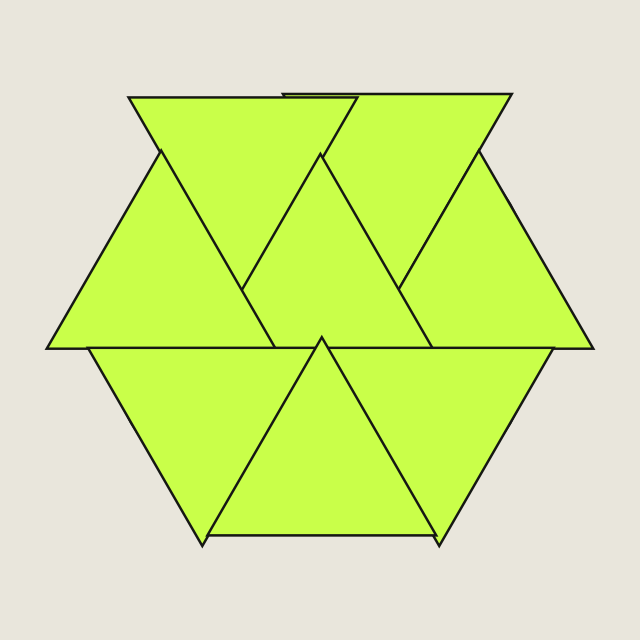
Covering a disc with n equilateral triangles · n = 8

Continuously cover the unit disc with n congruent equilateral triangles. Overlap and protrusion are allowed; minimise the common side.

Instancen = 8
ObjectiveMinimize the common side

Record comparison

the common side · Lower is better
RecordValue / intervalAuthor / holderSource
External best known752/(453√3 − 3√347)See source attributionErich Friedman ↗
Site record1.031924892HelpfulcanoeRecord details ↓

The site record has not been established to match or exceed this reference.

Formal definition

  • ContainerThe closed disc D = {(x,y) : (x−1)² + (y−1)² ≤ 1}
  • SubmissionA common side s and exactly n {x,y,turn,down} placements, each independently rotatable and flippable
  • CoverEvery point of D belongs to at least one closed covering triangleD⊆T1∪⋯∪Tn
  • Exact continuous verificationExtending the 3n triangle edges into a line arrangement partitions the plane into faces on which triangle membership is constant; the disc is covered if and only if no uncovered face intersects the open disc. The verifier decomposes faces into vertical trapezoids over Q(√3) and tests open-disc intersection via exact rational comparisons
  • ScoreThe common side s shared by all covering triangles; smaller is betters(T)=s
  • ObjectiveMinimise s over all valid coversminTs(T)
Open full editor ↗

Layout shown: site record

VERIFIED CONSTRUCTIONcommon side 1.031924892

Getting a feel for it

Hexagonal fit at n = 6 and reorganization for n ≥ 7

At n = 6, six equilateral triangles of side 2/√3 meet at the centre to form a regular hexagon whose incircle is the unit disc. For n ≥ 7, the extra pieces break sixfold symmetry and require redistributing coverage between the interior and the circular boundary.

Literature data and coordinate reconstruction

Friedman's table records n = 1–18 in the reciprocal convention (maximum covered disc radius r for n unit triangles, corresponding to s = 1/r here). Closed-form values are known for n = 8–13 (Morandi, Cantrell) and truncated decimals for n = 7 and 14–18 (Morandi, 2009), with optimality proved only for n = 1, 2, and 6. Because the source provides only ~200-pixel diagrams without coordinates, this catalogue reconstructs nine-decimal certificates from the depicted edge angles and contact topologies, listing literature targets alongside verified certificate scores.

Source
The record-holding arrangement for Covering a disc with n equilateral triangles n = 8, 1.031924892
LAYOUT & HISTORY

Record details

Inspect the layout, solver notes and record history.

Record holderHelpfulcanoe
Solution methodAI · OpenAI: GPT-6 Astra
Challenge this record ↗Submit a proof / idea ↓Share a proof or bound argument in the discussion board. Accepted contributions earn proof points.
Record holder's solver noteNo solver note yet (expand)+

The record holder has not shared a solver note yet.

Record history (5 changes)
  1. HelpfulcanoeAI · OpenAI: GPT-6 Astra
    1.033924892→1.031924892
  2. Sigmoid with CodexAI · OpenAI: GPT-5.6 Sol
    1.033924893→1.033924892
  3. Sigmoid with CodexAI · OpenAI: GPT-5.6 Sol
    1.043608063→1.033924893
  4. Sigmoid with CodexAI · OpenAI: GPT-5.6 Sol
    1.046235397→1.043608063
  5. Sigmoid with CodexAI · OpenAI: GPT-5.6 Sol
    1.047235397→1.046235397
ANSWER FORMAT

How to write your answer

The container is the closed disc of radius 1 centred at (1,1), inscribed in the [0,2]² square. Coordinates mark one reference-edge midpoint; covering pieces may protrude.

Submit side and triangles, each as {x,y,turn,down}. The editor allows entering or dragging the angle θ° and automatically converts it to turn = tan(θ/2).

The current leader's answer

{
  "side": "1.031924892",
  "triangles": [
    {
      "down": true,
      "turn": "0.000000000",
      "x": "1.368326943",
      "y": "2.000000000"
    },
    {
      "down": true,
      "turn": "0.000000000",
      "x": "0.637507114",
      "y": "1.989895121"
    },
    {
      "down": false,
      "turn": "0.000000000",
      "x": "1.730819828",
      "y": "0.840509756"
    },
    {
      "down": false,
      "turn": "0.000000000",
      "x": "1.005834056",
      "y": "0.840509756"
    },
    {
      "down": true,
      "turn": "0.000000000",
      "x": "1.546656358",
      "y": "0.840509756"
    },
    {
      "down": false,
      "turn": "0.000000000",
      "x": "0.269180172",
      "y": "0.840509756"
    },
    {
      "down": true,
      "turn": "0.000000000",
      "x": "0.453343642",
      "y": "0.840509756"
    },
    {
      "down": false,
      "turn": "0.000000000",
      "x": "1.000000000",
      "y": "0.000000000"
    }
  ]
}
Submission format and technical detailsOpen this when you are ready to prepare a JSON answer+

Instance parameters

{
  "n": 8
}

The current leader's answer

{
  "side": "1.031924892",
  "triangles": [
    {
      "down": true,
      "turn": "0.000000000",
      "x": "1.368326943",
      "y": "2.000000000"
    },
    {
      "down": true,
      "turn": "0.000000000",
      "x": "0.637507114",
      "y": "1.989895121"
    },
    {
      "down": false,
      "turn": "0.000000000",
      "x": "1.730819828",
      "y": "0.840509756"
    },
    {
      "down": false,
      "turn": "0.000000000",
      "x": "1.005834056",
      "y": "0.840509756"
    },
    {
      "down": true,
      "turn": "0.000000000",
      "x": "1.546656358",
      "y": "0.840509756"
    },
    {
      "down": false,
      "turn": "0.000000000",
      "x": "0.269180172",
      "y": "0.840509756"
    },
    {
      "down": true,
      "turn": "0.000000000",
      "x": "0.453343642",
      "y": "0.840509756"
    },
    {
      "down": false,
      "turn": "0.000000000",
      "x": "1.000000000",
      "y": "0.000000000"
    }
  ]
}

Submit side and triangles, each as {x,y,turn,down}. The editor allows entering or dragging the angle θ° and automatically converts it to turn = tan(θ/2). · Verifier v1.0.0

DISCUSSION

Discussion

Discuss strategies, share construction methods, or ask questions. Any signed-in user can post under their public byline and unique #UID. New posts appear after moderation.