P76 · Extremal configurations · Classic · Hard

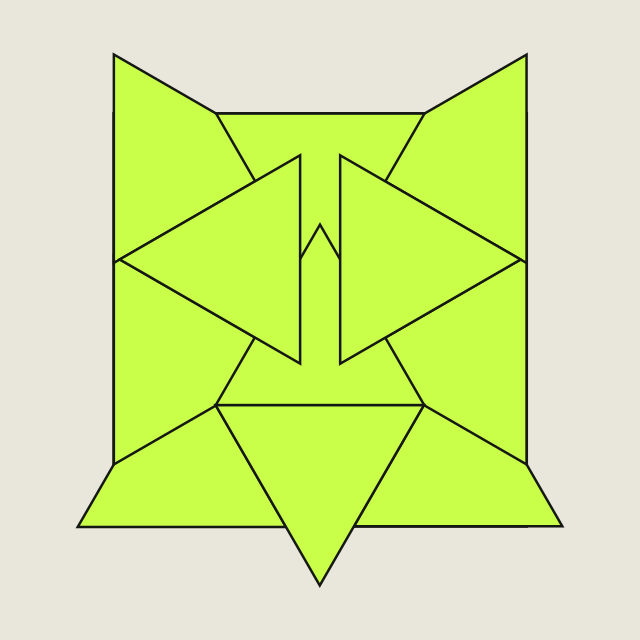
Covering a square with n equilateral triangles · n = 11

Cover the unit square with n congruent equilateral triangles. Every piece may be translated, rotated and flipped independently; arbitrary overlap and protrusion are allowed. Minimise the common side.

Instancen = 11
ObjectiveMinimize the common side

Formal definition

  • ContainerThe closed unit square K = [0,1] × [0,1]
  • Piecesn equilateral triangles of common side s; every piece may be translated and rotated independently, with the third vertex on either side of its reference edge
  • SubmissionGive the common side s plus one reference-edge midpoint, rotation and orientation for each triangle; submit exactly n pieces
  • CoverEvery point of the square lies in at least one closed triangle; triangles may overlap and protrudeKT1Tn
  • Exact rotationThe certificate writes rotations as turn = tan(θ/2). Half-angle identities make cos θ and sin θ rational, so every vertex and intersection is computed exactly in Q(√3)
  • Continuous verificationThe verifier builds the planar arrangement of triangle and square edges, then performs an exact algebraic vertical sweep for uncovered faces; it uses neither pixels nor random sampling
  • ScoreThe side s shared by every submitted triangle; smaller is betters(T)=s
  • ObjectiveMinimise s over all legal coversminTs(T)
Open the full editor
VERIFIED CONSTRUCTIONcommon side 0.504894626

Getting a feel for it

Why this is not tiling

A square has 90° corners and an equilateral triangle has 60° corners. The boundary angles do not match, so good covers must overlap and protrude. Adding one piece can reorganise the whole contact pattern rather than append one more tile.

The published frontier

Friedman's public table gives the best known constructions for n=1–12, with nontrivial layouts already at n=2 and independent rotations from n ≥ 4. This site reconstructs the pictured arrangements and rechecks continuous coverage instead of copying numbers alone.

Source
The record-holding arrangement for Covering a square with n equilateral triangles n = 11, 0.504894626
Current leader

0.504894626

the common side

Answer sourceMaurizio Morandi
Solution methodPublished reference construction
Challenge this record
ANSWER FORMAT

How to write your answer

The container is the unit square [0,1]². Covering triangles may protrude; (x,y) marks the midpoint of one edge.

Submit side and triangles. Each piece is {x,y,turn,down}: (x,y) is one edge's midpoint; turn = tan(θ/2) encodes that edge's angle θ; down chooses the side containing the third vertex. The editor writes turn automatically. Decimals have at most nine places.

The current leader's answer

{
  "side": "0.504894626",
  "triangles": [
    {
      "down": false,
      "turn": "0",
      "x": "0.164844752",
      "y": "-0.0018"
    },
    {
      "down": false,
      "turn": "0",
      "x": "0.834155248",
      "y": "0"
    },
    {
      "down": true,
      "turn": "-1",
      "x": "1",
      "y": "0.402315561"
    },
    {
      "down": true,
      "turn": "-1",
      "x": "1",
      "y": "0.890367224"
    },
    {
      "down": false,
      "turn": "-1",
      "x": "0",
      "y": "0.402299758"
    },
    {
      "down": false,
      "turn": "-1",
      "x": "0",
      "y": "0.890663570"
    },
    {
      "down": true,
      "turn": "0",
      "x": "0.5002",
      "y": "1"
    },
    {
      "down": false,
      "turn": "-0.577350269",
      "x": "0.372704629",
      "y": "0.075116352"
    },
    {
      "down": false,
      "turn": "0",
      "x": "0.4995",
      "y": "0.293742138"
    },
    {
      "down": false,
      "turn": "-0.267949192",
      "x": "0.232703934",
      "y": "0.520324859"
    },
    {
      "down": false,
      "turn": "-1",
      "x": "0.548348607",
      "y": "0.646336092"
    }
  ]
}
Submission format and technical detailsOpen this when you are ready to prepare a JSON answer

Instance parameters

{
  "n": 11
}

The current leader's answer

{
  "side": "0.504894626",
  "triangles": [
    {
      "down": false,
      "turn": "0",
      "x": "0.164844752",
      "y": "-0.0018"
    },
    {
      "down": false,
      "turn": "0",
      "x": "0.834155248",
      "y": "0"
    },
    {
      "down": true,
      "turn": "-1",
      "x": "1",
      "y": "0.402315561"
    },
    {
      "down": true,
      "turn": "-1",
      "x": "1",
      "y": "0.890367224"
    },
    {
      "down": false,
      "turn": "-1",
      "x": "0",
      "y": "0.402299758"
    },
    {
      "down": false,
      "turn": "-1",
      "x": "0",
      "y": "0.890663570"
    },
    {
      "down": true,
      "turn": "0",
      "x": "0.5002",
      "y": "1"
    },
    {
      "down": false,
      "turn": "-0.577350269",
      "x": "0.372704629",
      "y": "0.075116352"
    },
    {
      "down": false,
      "turn": "0",
      "x": "0.4995",
      "y": "0.293742138"
    },
    {
      "down": false,
      "turn": "-0.267949192",
      "x": "0.232703934",
      "y": "0.520324859"
    },
    {
      "down": false,
      "turn": "-1",
      "x": "0.548348607",
      "y": "0.646336092"
    }
  ]
}

Submit side and triangles. Each piece is {x,y,turn,down}: (x,y) is one edge's midpoint; turn = tan(θ/2) encodes that edge's angle θ; down chooses the side containing the third vertex. The editor writes turn automatically. Decimals have at most nine places. · Verifier v1.0.0

DISCUSSION

Discussion

Talk strategy, share methods, ask why you are stuck. Posts carry your public byline, the same name your records use; the #number after it is the account's signup ordinal, so a name cannot be worn by someone else. The floor is earned: break a record once, anywhere, and it is yours for good. New posts appear after an automated review.

No threads yet. Be the first to talk about this problem?