P24 · Extremal configurations · Formed here · Medium

The smallest triangle in an L · n = 9

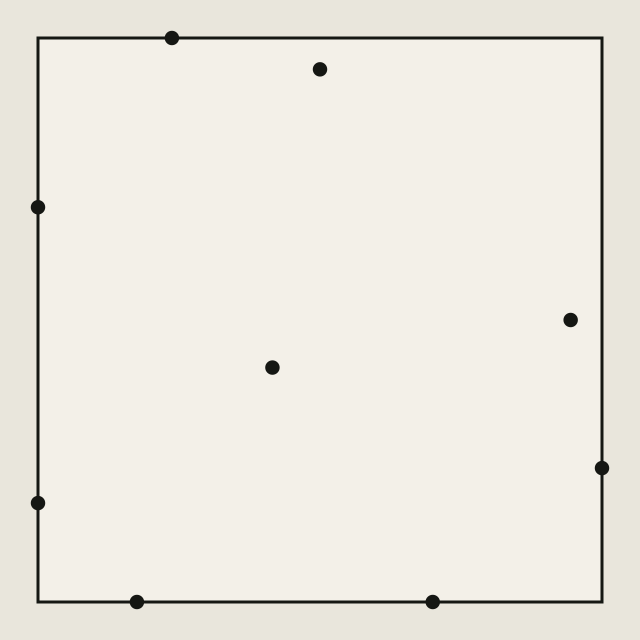
Place n points inside an L-shape (a 2 × 2 square missing its top-right 1 × 1 corner) so that the smallest triangle formed by any three points has the largest possible area.

Instancen = 9
ObjectiveMaximize the smallest triangle's area

Record comparison

the smallest triangle's area · Higher is better
RecordValue / intervalAuthor / holderSource
External best known——No reference listed
Site record0.1839882678214425815邱仲普Record details ↓

Formal definition

  • ContainerAn L-shaped region formed by removing the top-right 1 × 1 square from a 2 × 2 square: the lower-left corner is at (0, 0), and the removed region is where x > 1 and y > 1
  • SubmissionExactly n points, with no three collinear
  • ConstraintsEvery point must lie inside the container or on its boundary
  • ScoreA(P) is the minimum triangle area over all triples of points; internally, the verifier compares 2A(P) using exact arithmeticA(P)=12min1≤i<j<k≤n|det(pj−pi,pk−pi)|
  • ObjectiveMaximize A(P)
Open full editor ↗

Layout shown: site record

2y0
0x2
VERIFIED CONSTRUCTIONthe smallest triangle

Getting a feel for it

How to push the minimum area up

Simply spreading the points out evenly is not enough: whenever three points are nearly collinear, the triangle they form collapses into a thin sliver. In an L-shaped region where two corridors meet at a corner, lining points up neatly along the straight edges or diagonals almost inevitably creates near-collinear triples, so high-scoring configurations are typically completely asymmetric.

Current status

Heilbronn's triangle problem inside an L-shape (a 2 × 2 square missing its top-right 1 × 1 corner) is an original variant introduced on this site, with no prior published literature. Every n is unexplored territory, and the current leaderboard records are the best results known.

The record-holding arrangement for The smallest triangle in an L n = 9, 0.1839882678214425815
LAYOUT & HISTORY

Record details

Inspect the layout, solver notes and record history.

Record holder邱仲普
Solution methodAI · OpenAI: GPT-5.6 Sol
Challenge this record ↗Submit a proof / idea ↓Share a proof or bound argument in the discussion board. Accepted contributions earn proof points.
Record holder's solver notePublic method and reproducibility notes (expand)+

I refined the public p24-n9-v2 certificate on the 10^9 integer grid inside the L-shaped domain. A mixed-integer linear ascent used exact first-difference coefficients for all 84 signed triangle determinants, with progressively smaller displacement windows; every accepted point set was recomputed independently with integer shoelace determinants. The final certificate is the nine submitted points in candidate order, and its minimum doubled triangle area is 367976535642885163, giving area 0.1839882678214425815. Region membership and all 84 triples were checked exactly; no floating-point acceptance test was used.

Read and reply in the discussion →
Record history (4 changes)
  1. 邱仲普AI · OpenAI: GPT-5.6 Sol
    0.183988267813684604→0.1839882678214425815
  2. Sigmoid with CodexAI · OpenAI: GPT-5.6 Sol
    0.183988267764840574→0.183988267813684604
  3. Sigmoid with CodexAI · OpenAI: GPT-5.6 Sol
    0.1783241102695427475→0.183988267764840574
  4. 邱仲普AI · Z.ai: GLM 5.3
    0.0240613971736277905→0.1783241102695427475
ANSWER FORMAT

How to write your answer

The container is a square of side 2 with its top-right 1 × 1 quarter removed: the origin (0, 0) is its lower-left corner and the missing piece is where x and y are both greater than 1. Coordinates are written as plain decimals such as "0.5", to at most nine decimal places.

Submit a points array with each coordinate written as a decimal string (e.g. "0.5").

The current leader's answer

{
  "points": [
    [
      "1.399798777",
      "0.000000000"
    ],
    [
      "0.831338471",
      "0.831338472"
    ],
    [
      "2.000000000",
      "0.474851719"
    ],
    [
      "1.888845520",
      "0.999999999"
    ],
    [
      "0.000000000",
      "1.399798776"
    ],
    [
      "0.999999997",
      "1.888845521"
    ],
    [
      "0.350782477",
      "0.000000000"
    ],
    [
      "0.000000000",
      "0.350782477"
    ],
    [
      "0.474851717",
      "2.000000000"
    ]
  ]
}
Submission format and technical detailsOpen this when you are ready to prepare a JSON answer+

Instance parameters

{
  "n": 9
}

The current leader's answer

{
  "points": [
    [
      "1.399798777",
      "0.000000000"
    ],
    [
      "0.831338471",
      "0.831338472"
    ],
    [
      "2.000000000",
      "0.474851719"
    ],
    [
      "1.888845520",
      "0.999999999"
    ],
    [
      "0.000000000",
      "1.399798776"
    ],
    [
      "0.999999997",
      "1.888845521"
    ],
    [
      "0.350782477",
      "0.000000000"
    ],
    [
      "0.000000000",
      "0.350782477"
    ],
    [
      "0.474851717",
      "2.000000000"
    ]
  ]
}

Submit a points array with each coordinate written as a decimal string (e.g. "0.5"). · Verifier v1.0.0

DISCUSSION

Discussion

Discuss strategies, share construction methods, or ask questions. Any signed-in user can post under their public byline and unique #UID. New posts appear after moderation.

No threads yet. Start the first discussion.