P29 · Extremal configurations · Classic

Heilbronn's problem in a triangle · n = 7

Also known asHeilbronn triangle problem in a triangle

Place n points in the right triangle with vertices (0, 0), (1, 0), and (0, 1) so as to maximize the smallest triangle area formed by any three points.

Instancen = 7
ObjectiveMaximize the smallest triangle's area

Record comparison

the smallest triangle's area · Higher is better
RecordValue / intervalAuthor / holderSource
Proven optimum7/144See source attributionarxiv.org ↗
Site record0.048611111055555543Reference answerRecord details ↓

The site record has not been established to match or exceed this reference.

FinishedA construction reaching the theoretical ceiling is already published, leaving nothing further to improve

Formal definition

  • ContainerThe right triangle with vertices (0, 0), (1, 0), and (0, 1), defined by x ≥ 0, y ≥ 0, and x + y ≤ 1
  • SubmissionExactly n points, with no three collinear
  • ConstraintsEvery point lies inside the triangle or on its boundary
  • ScoreA(P) is the minimum triangle area over all point triples; internally, the verifier compares 2A(P) in exact arithmeticA(P)=12min1≤i<j<k≤n|det(pj−pi,pk−pi)|
  • ObjectiveMaximize A(P)
Inspect in editor ↗

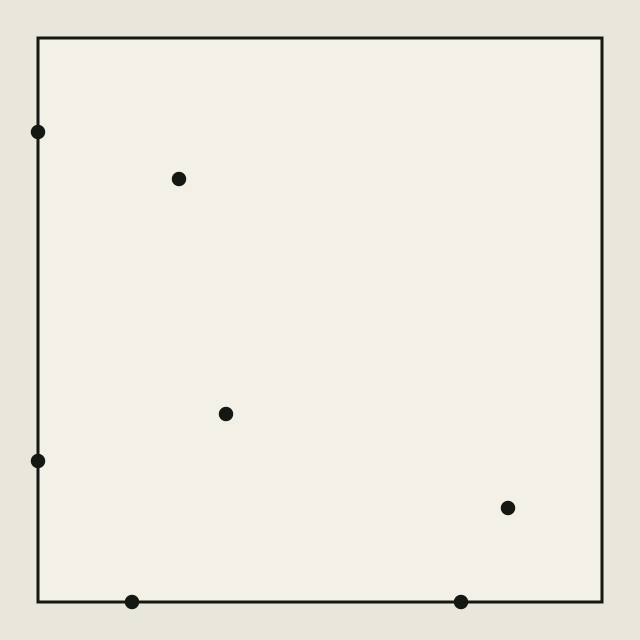
Layout shown: site record

1y0
0x1
VERIFIED CONSTRUCTIONthe smallest triangle

Getting a feel for it

Why it is hard

Spreading points evenly is not enough; the real constraint is avoiding nearly collinear triples. Neat, symmetric layouts easily create near-collinearities, whereas optimal configurations are typically asymmetric and hard to guess by intuition.

Known results

Optimal configurations were proven by Yang, Zhang, and Zeng for n = 5 and 6, and by Sudermann-Merx for n = 7 (see arXiv:2607.15021). All cases with n ≥ 8 remain open.

Source
The record-holding arrangement for Heilbronn's problem in a triangle n = 7, 0.048611111055555543
LAYOUT & HISTORY

Record details

Inspect the layout, solver notes and record history.

Answer sourceReference answer
Solution method—
The optimum is proven; no further improvement is possibleSubmit a proof / idea ↓Share a proof or bound argument in the discussion board. Accepted contributions earn proof points.
Record holder's solver noteNo solver note yet (expand)+

The record holder has not shared a solver note yet.

Record history (1 changes)
  1. Sigmoid with CodexAI · OpenAI: GPT-5.6 Sol
    0.0486111109722222225→0.048611111055555543
ANSWER FORMAT

How to write your answer

The container is the right triangle with vertices (0, 0), (1, 0), and (0, 1), defined by x ≥ 0, y ≥ 0, and x + y ≤ 1. Write coordinates as decimal strings such as "0.5", with at most nine decimal places.

Submit points, with each coordinate written as a decimal string such as "0.5".

The current leader's answer

{
  "points": [
    [
      "0.166666668",
      "0.000000000"
    ],
    [
      "0.750000003",
      "0.000000000"
    ],
    [
      "0.000000000",
      "0.250000000"
    ],
    [
      "0.833333332",
      "0.166666668"
    ],
    [
      "0.000000000",
      "0.833333328"
    ],
    [
      "0.249999997",
      "0.750000003"
    ],
    [
      "0.333333332",
      "0.333333334"
    ]
  ]
}
Submission format and technical detailsOpen this when you are ready to prepare a JSON answer+

Instance parameters

{
  "n": 7
}

The current leader's answer

{
  "points": [
    [
      "0.166666668",
      "0.000000000"
    ],
    [
      "0.750000003",
      "0.000000000"
    ],
    [
      "0.000000000",
      "0.250000000"
    ],
    [
      "0.833333332",
      "0.166666668"
    ],
    [
      "0.000000000",
      "0.833333328"
    ],
    [
      "0.249999997",
      "0.750000003"
    ],
    [
      "0.333333332",
      "0.333333334"
    ]
  ]
}

Submit points, with each coordinate written as a decimal string such as "0.5". · Verifier v1.0.0

DISCUSSION

Discussion

Discuss strategies, share construction methods, or ask questions. Any signed-in user can post under their public byline and unique #UID. New posts appear after moderation.

No threads yet. Start the first discussion.