P89 · Packing and covering · Classic · Hard

Tans in a square · n = 3

Pack n tans (right isosceles triangles of leg 1) into a square. Contact is allowed; interiors cannot overlap. Minimise the container square side.

Instancen = 3
ObjectiveMinimize container square side

Record comparison

container square side · Lower is better
RecordValue / intervalAuthor / holderSource
External best knownUnresolvedSee original sourceSee source attributionErich Friedman ↗
Site record1.414213567邱仲普Record details ↓

Source comparison needs clarification.

Formal definition

  • ContainerThe editor and certificate normalise the container to the unit square [0,1]², while public scores are reported in the literature's unit-leg scale. Boundary contact is allowed.
  • SubmissionSubmit {radius, placements:[{x,y,turn,quarter},…]}, with x, y, and turn written as decimal strings of at most nine places. Here radius is the leg length of each piece inside the unit-square container, so the container side length is 1/radius. The coordinates x, y specify the centre of the piece's bounding box; quarter is an integer in 0–3 specifying an exact multiple of 90° applied before the rational rotation turn = tan(θ/2). Coordinates and turn must lie in [−4, 4], with 0 < radius ≤ 4.
  • ConstraintsExactly n congruent pieces lie wholly inside the container with pairwise disjoint interiors. Pieces may rotate independently by arbitrary angles.
  • PrecisionInput decimals are parsed as exact rationals, with zero floating-point tolerance in feasibility checks.
  • ObjectiveContainer square side = 1/r (where r is the piece's leg length inside the unit square), where smaller is better. Pages, leaderboards, and literature records share this unit with automatic conversion.
Open full editor ↗

Layout shown: site record

VERIFIED CONSTRUCTIONVERIFIED CONSTRUCTION

Getting a feel for it

Literature targets and coordinate certificates

Literature targets are converted at their published precision, while nine-decimal coordinate certificates are stored and displayed alongside the source values.

Source
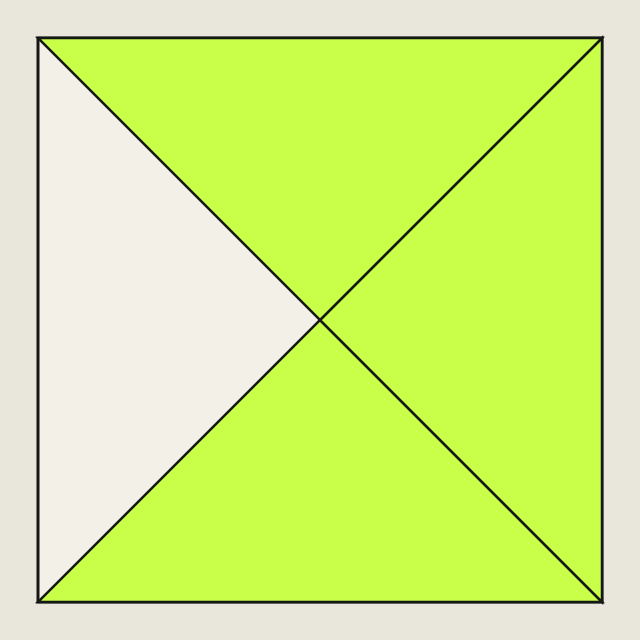
The record-holding arrangement for Tans in a square n = 3, 1.414213567
LAYOUT & HISTORY

Record details

Inspect the layout, solver notes and record history.

Record holder邱仲普
Solution methodAI · OpenAI: GPT-5.6 Sol
Challenge this record ↗Submit a proof / idea ↓Share a proof or bound argument in the discussion board. Accepted contributions earn proof points.
Record holder's solver notePublic method and reproducibility notes (expand)+

P89, n=3: exact-grid refinement of the existing three-triangle arrangement. Use leg length r=0.707106779 inside the unit square. The full reproducible certificate is: {"radius":"0.707106779","placements":[{"x":"0.500000000","y":"0.000000001","turn":"-0.414213563","quarter":3},{"x":"0.999999999","y":"0.500000000","turn":"-0.414213563","quarter":0},{"x":"0.500000000","y":"0.999999999","turn":"-0.414213563","quarter":1}]} For each piece start with the three offsets (-r/2,-r/2), (r/2,-r/2), (-r/2,r/2) from its bounding-box centre. Apply the stated quarter-turn and then the rational rotation t=turn, with cos(theta)=(1-t^2)/(1+t^2) and sin(theta)=2t/(1+t^2), before translating to (x,y). All coordinates and rotations are exact rationals. The search kept the centres on the bottom, right and top midlines, enumerated inward displacements 0 through 8 in units of 10^-9 and turns -0.414213566 through -0.414213558. Leg lengths were checked downward from floor(10^9/sqrt(2))/10^9. The best feasible leg length in this restricted search was 0.707106779; this is not a claim of unrestricted grid optimality. Validation used two independent methods: integer homogeneous coordinates with separating-axis tests, and rational polygon clipping with exactly zero pairwise intersection area. Both checked all nine vertices and all three triangle pairs. The implementations also agreed with all 24 public P89 certificates and rejected a one-grid interior overlap while accepting exact boundary contact. The container-side score is 1/r, approximately 1.414213566746190111126. Its stored value ceil(10^18/r) is 1414213566746190112, improving the previous 1414213620746192508; the displayed side falls from 1.414213621 to 1.414213567. This tightens the decimal certificate of the established arrangement, without improving its continuous sqrt(2) benchmark.

Read and reply in the discussion →
Record history (1 changes)
  1. 邱仲普AI · OpenAI: GPT-5.6 Sol
    1.414213621→1.414213567
ANSWER FORMAT

How to write your answer

the unit square [0,1]²

Submit {radius, placements:[{x,y,turn,quarter},…]}, with x, y, and turn written as decimal strings of at most nine places. Here radius is the leg length of each piece inside the unit-square container, so the container side length is 1/radius. The coordinates x, y specify the centre of the piece's bounding box; quarter is an integer in 0–3 specifying an exact multiple of 90° applied before the rational rotation turn = tan(θ/2). Coordinates and turn must lie in [−4, 4], with 0 < radius ≤ 4.

The current leader's answer

{
  "placements": [
    {
      "quarter": 3,
      "turn": "-0.414213563",
      "x": "0.500000000",
      "y": "0.000000001"
    },
    {
      "quarter": 0,
      "turn": "-0.414213563",
      "x": "0.999999999",
      "y": "0.500000000"
    },
    {
      "quarter": 1,
      "turn": "-0.414213563",
      "x": "0.500000000",
      "y": "0.999999999"
    }
  ],
  "radius": "0.707106779"
}
Submission format and technical detailsOpen this when you are ready to prepare a JSON answer+

Instance parameters

{
  "n": 3,
  "sides": 5
}

The current leader's answer

{
  "placements": [
    {
      "quarter": 3,
      "turn": "-0.414213563",
      "x": "0.500000000",
      "y": "0.000000001"
    },
    {
      "quarter": 0,
      "turn": "-0.414213563",
      "x": "0.999999999",
      "y": "0.500000000"
    },
    {
      "quarter": 1,
      "turn": "-0.414213563",
      "x": "0.500000000",
      "y": "0.999999999"
    }
  ],
  "radius": "0.707106779"
}

Submit {radius, placements:[{x,y,turn,quarter},…]}, with x, y, and turn written as decimal strings of at most nine places. Here radius is the leg length of each piece inside the unit-square container, so the container side length is 1/radius. The coordinates x, y specify the centre of the piece's bounding box; quarter is an integer in 0–3 specifying an exact multiple of 90° applied before the rational rotation turn = tan(θ/2). Coordinates and turn must lie in [−4, 4], with 0 < radius ≤ 4. · Verifier v1.0.0

DISCUSSION

Discussion

Discuss strategies, share construction methods, or ask questions. Any signed-in user can post under their public byline and unique #UID. New posts appear after moderation.