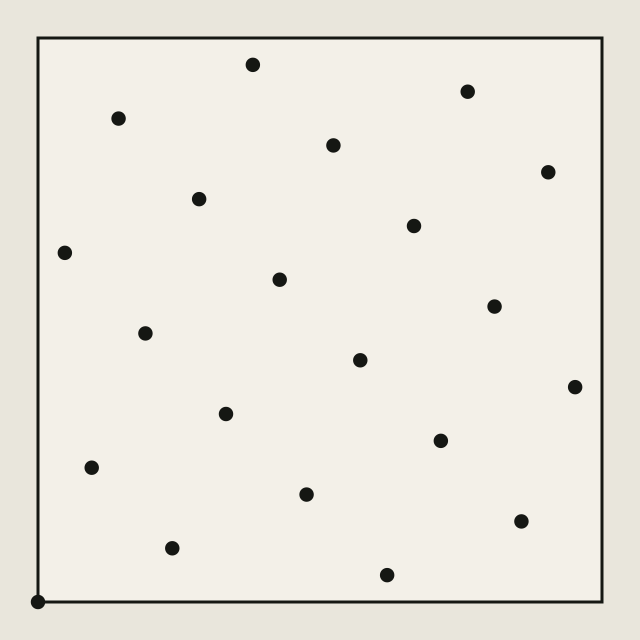
Optimal quadrature points on the torus · d = 2, n = 21
Also known asquadrature on the toruslattice rulesquasi-Monte Carlo on the torus
Place n equal-weight quadrature points on the torus Tᵈ. Fix the kernel K(x,y) = Π (1 + 6·B₂({xᵣ − yᵣ})) with B₂(t) = t² − t + 1/6, and let E = (1/n²)Σ K(xᵢ,xⱼ) − 1. The score is the worst-case integration error √E; smaller is better.
Instanced = 2, n = 21
ObjectiveMinimize the worst-case integration error
Record comparison
the worst-case integration error · Lower is better| Record | Value / interval | Author / holder | Source |
|---|---|---|---|
| Proven optimum | √4371/441 | zzzcy #308 | MinMax Arena ↗ |
| Site record | 0.149917321325 | Sigmoid with Codex | Record details ↓ |
The continuous optimum is proved, so competition submissions are closed. Historical records and contribution points are retained. Because finite-decimal coordinates cannot attain this value exactly, the current certificate is not claimed optimal on the nine-decimal grid.
Formal definition
- ContainerThe d-dimensional torus: coordinates modulo 1, written in [0, 1)
- SubmissionExactly n points, each d decimal coordinates; coincidences are allowed
- Bernoulli polynomialThis problem fixes the second Bernoulli polynomial B₂
- KernelBraces denote the fractional part (coordinate differences modulo 1). The kernel fixes the coefficient at 6; it belongs to the same family as periodic L2 discrepancy (coefficient 3) and diaphony (coefficient 2π²), with a different weight
- ScoreE(P) is the squared worst-case error of the equal-weight quadrature rule; the kernel integrates to 1 over the torus, so E(P) ≥ 0
- ScoringThe record is stored as the exact integer n²S²ᵈ·E after clearing denominators; the page displays the error √E, rounded up at the twelfth decimal
- ObjectiveMake E(P), equivalently √E(P), as small as possible over all legal point sets P