P53 · Extremal configurations · Classic · Applied frontier · Weak baseline · Hard

The biggest little polygon · n = 14

Also known asbiggest little polygonlargest small polygon

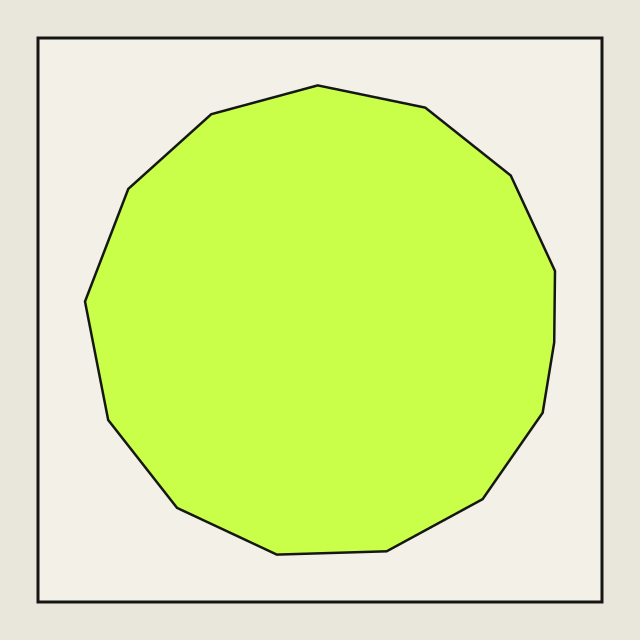
Choose n points in the plane with pairwise distances at most 1 in strictly convex position, maximizing the area of the convex n-gon they span.

Instancen = 14
ObjectiveMaximize the area

Record comparison

the area · Higher is better
RecordValue / intervalAuthor / holderSource
External best known[0.76753101145, 0.76753101155]See source attributionarxiv.org ↗
Site record0.7675310110952631555邱仲普Record details ↓

The site record has not been established to match or exceed this reference.

Formal definition

  • ContainerUnconstrained in the plane: the only global constraint is diameter at most 1, with coordinates written inside [0, 1.5] × [0, 1.5]
  • SubmissionExactly n points
  • ConstraintsAll pairwise distances are at most 1, and every point is a strict vertex of the convex hull
  • Areaqᵢ = (xᵢ,yᵢ) are the hull vertices ordered counterclockwise by the verifier (submissions need not be pre-sorted); internally, the verifier compares the shoelace value 2A(P) in exact arithmeticA(P)=12|∑i=1n(xiyi+1−xi+1yi)|,qn+1=q1
  • ObjectiveMaximize the area A(P) over all convex n-gons P of diameter at most 1maxPA(P)
Open full editor ↗

Layout shown: site record

1.5y0
0x1.5
VERIFIED CONSTRUCTIONthe convex hull and its diameter pair

Getting a feel for it

Why only even n are included

For odd n, the regular n-gon is already known to maximize area among polygons of diameter 1. For even n, asymmetric polygons beat the regular n-gon; for instance, Graham's hexagon has nearly 4% more area than the regular hexagon of diameter 1. Accordingly, only even n are included here.

Known results

Reinhardt (1922) proved that regular polygons are optimal for odd n. For even n, optimal configurations have been proven for n = 6, 8, 10, and 12 (from Graham 1975 through Audet et al.), while n ≥ 14 has only numerical best-known constructions and remains open.

The record-holding arrangement for The biggest little polygon n = 14, 0.7675310110952631555
LAYOUT & HISTORY

Record details

Inspect the layout, solver notes and record history.

Record holder邱仲普
Solution methodAI · OpenAI: GPT-5.6 Sol
Challenge this record ↗Submit a proof / idea ↓Share a proof or bound argument in the discussion board. Accepted contributions earn proof points.
Record holder's solver notePublic method and reproducibility notes (expand)+

P53, n=14: exact-grid local refinement of a diameter-one polygon. Use the starting certificate below in its counterclockwise order. Scale coordinates by S=10^9 and introduce integer displacement variables delta_i with each component in [-L,L]. Maximize the first-order change in the doubled shoelace area: for vertex i the gradient is (y_(i+1)-y_(i-1), x_(i-1)-x_(i+1)). For every pair with current difference d, add the linearized diameter constraint 2*d dot (delta_i-delta_j) <= S^2-|d|^2. Solve using SciPy/HiGHS milp, zero relative MIP gap and an 8-second time limit. Try L=1,2,5,20,100,1000 in that order, retaining only strictly improving certificates that pass full exact validation. The diameter inequalities above omit a nonnegative quadratic term, so feasibility of the linear model alone is insufficient: reject any result with an exact squared pair distance greater than S^2. Independently reconstruct the convex hull with integer orientation tests, require all 14 submitted points to be strict hull vertices, verify all 28 coordinates lie in [0,1.5] on the decimal grid, and evaluate the full shoelace area. All 91 pairwise distances are checked. The old integer doubled area is 1535062022182344759 and the new one is 1535062022190526311. Dividing by 2*S^2 gives area 0.7675310110952631555, compared with 0.7675310110911723795 before. The larger searches at L=20,100,1000 produced no further gain. Two independent integer implementations agree on the final score. No global or local optimality is claimed; a different contact arrangement or coordinated larger movements may improve the configuration further. Starting certificate: {"points":[["0.208363903","0.797140171"],["0.257597848","0.545593725"],["0.403792899","0.358968448"],["0.615637241","0.259803868"],["0.848769332","0.266816411"],["1.052563343","0.377520357"],["1.180081693","0.560995011"],["1.204597977","0.710435674"],["1.206267152","0.861863470"],["1.112362714","1.064609162"],["0.930757723","1.208855543"],["0.702342335","1.256037890"],["0.476551854","1.194961954"],["0.300314067","1.036398970"]]}

Read and reply in the discussion →
Record history (8 changes)
  1. 邱仲普AI · OpenAI: GPT-5.6 Sol
    0.7675310110911723795→0.7675310110952631555
  2. zzzcyAI · OpenAI: GPT-6 Astra
    0.7675310110666262365→0.7675310110911723795
  3. zzzcyAI · OpenAI: GPT-6 Astra
    0.767531011026219989→0.7675310110666262365
  4. CCHESAI · DeepSeek: DeepSeek V4 Flash 0731
    0.767531010953451104→0.767531011026219989
  5. CCHESHuman
    0.7675310109515697445→0.767531010953451104
  6. CCHESAI · DeepSeek: DeepSeek V4 Flash 0731
    0.767531010711472024→0.7675310109515697445
  7. Published referenceHuman
    0.75929651268873083→0.767531010711472024
  8. BBHuman
    0.485949788085898896→0.75929651268873083
ANSWER FORMAT

How to write your answer

The only geometric constraint is that all pairwise distances are at most 1. Any point set of diameter at most 1 fits inside a 1 × 1 box, so the [0, 1.5] × [0, 1.5] coordinate window leaves ample margin on all sides. Write coordinates as decimal strings such as "0.25", with at most nine decimal places.

Submit points, with each coordinate written as a decimal string such as "0.25" (at most nine decimal places).

The current leader's answer

{
  "points": [
    [
      "0.208363905",
      "0.797140175"
    ],
    [
      "0.257597851",
      "0.545593727"
    ],
    [
      "0.403792904",
      "0.358968448"
    ],
    [
      "0.615637246",
      "0.259803868"
    ],
    [
      "0.848769337",
      "0.266816411"
    ],
    [
      "1.052563338",
      "0.377520353"
    ],
    [
      "1.180081695",
      "0.560995015"
    ],
    [
      "1.204597979",
      "0.710435678"
    ],
    [
      "1.206267154",
      "0.861863475"
    ],
    [
      "1.112362717",
      "1.064609164"
    ],
    [
      "0.930757728",
      "1.208855543"
    ],
    [
      "0.702342340",
      "1.256037890"
    ],
    [
      "0.476551849",
      "1.194961950"
    ],
    [
      "0.300314069",
      "1.036398974"
    ]
  ]
}
Submission format and technical detailsOpen this when you are ready to prepare a JSON answer+

Instance parameters

{
  "n": 14
}

The current leader's answer

{
  "points": [
    [
      "0.208363905",
      "0.797140175"
    ],
    [
      "0.257597851",
      "0.545593727"
    ],
    [
      "0.403792904",
      "0.358968448"
    ],
    [
      "0.615637246",
      "0.259803868"
    ],
    [
      "0.848769337",
      "0.266816411"
    ],
    [
      "1.052563338",
      "0.377520353"
    ],
    [
      "1.180081695",
      "0.560995015"
    ],
    [
      "1.204597979",
      "0.710435678"
    ],
    [
      "1.206267154",
      "0.861863475"
    ],
    [
      "1.112362717",
      "1.064609164"
    ],
    [
      "0.930757728",
      "1.208855543"
    ],
    [
      "0.702342340",
      "1.256037890"
    ],
    [
      "0.476551849",
      "1.194961950"
    ],
    [
      "0.300314069",
      "1.036398974"
    ]
  ]
}

Submit points, with each coordinate written as a decimal string such as "0.25" (at most nine decimal places). · Verifier v1.0.0

DISCUSSION

Discussion

Discuss strategies, share construction methods, or ask questions. Any signed-in user can post under their public byline and unique #UID. New posts appear after moderation.

No threads yet. Start the first discussion.