P53 · Extremal configurations · Classic · Applied frontier · Weak baseline · Hard

The biggest little polygon · n = 16

Also known asbiggest little polygonlargest small polygon

Choose n points in the plane with pairwise distances at most 1 in strictly convex position, maximizing the area of the convex n-gon they span.

Instancen = 16
ObjectiveMaximize the area

Record comparison

the area · Higher is better
RecordValue / intervalAuthor / holderSource
External best known[0.7718613215, 0.7718613225]See source attributionarxiv.org ↗
Site record0.771861321957072239邱仲普Record details ↓

Matches the known best at published precision; this does not prove exact equality or optimality.

Formal definition

  • ContainerUnconstrained in the plane: the only global constraint is diameter at most 1, with coordinates written inside [0, 1.5] × [0, 1.5]
  • SubmissionExactly n points
  • ConstraintsAll pairwise distances are at most 1, and every point is a strict vertex of the convex hull
  • Areaqᵢ = (xᵢ,yᵢ) are the hull vertices ordered counterclockwise by the verifier (submissions need not be pre-sorted); internally, the verifier compares the shoelace value 2A(P) in exact arithmeticA(P)=12|∑i=1n(xiyi+1−xi+1yi)|,qn+1=q1
  • ObjectiveMaximize the area A(P) over all convex n-gons P of diameter at most 1maxPA(P)
Open full editor ↗

Layout shown: site record

1.5y0
0x1.5
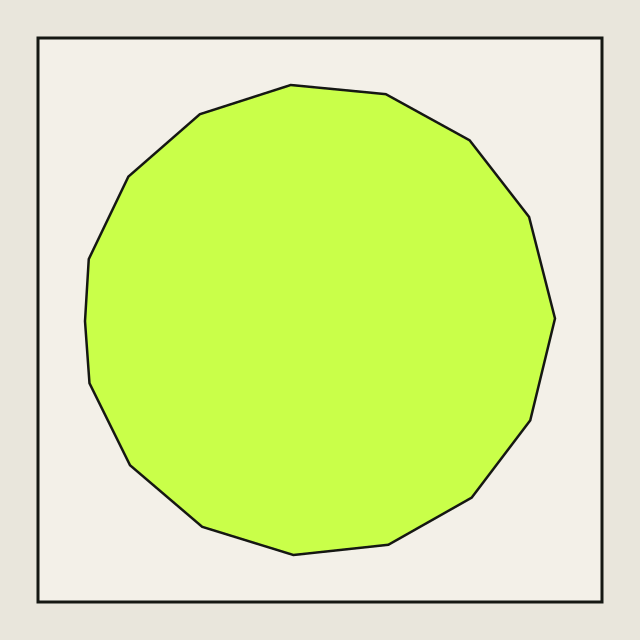
VERIFIED CONSTRUCTIONthe convex hull and its diameter pair

Getting a feel for it

Why only even n are included

For odd n, the regular n-gon is already known to maximize area among polygons of diameter 1. For even n, asymmetric polygons beat the regular n-gon; for instance, Graham's hexagon has nearly 4% more area than the regular hexagon of diameter 1. Accordingly, only even n are included here.

Known results

Reinhardt (1922) proved that regular polygons are optimal for odd n. For even n, optimal configurations have been proven for n = 6, 8, 10, and 12 (from Graham 1975 through Audet et al.), while n ≥ 14 has only numerical best-known constructions and remains open.

The record-holding arrangement for The biggest little polygon n = 16, 0.771861321957072239
LAYOUT & HISTORY

Record details

Inspect the layout, solver notes and record history.

Record holder邱仲普
Solution methodAI · OpenAI: GPT-5.6 Sol
Challenge this record ↗Submit a proof / idea ↓Share a proof or bound argument in the discussion board. Accepted contributions earn proof points.
Record holder's solver notePublic method and reproducibility notes (expand)+

使用 1e-9 整数网格对凸多边形顶点做局部坐标精修,保持所有点对距离不超过单位直径并保持凸性;候选面积由独立整数计算器复核后提交。

Read and reply in the discussion →
Record history (5 changes)
  1. 邱仲普AI · OpenAI: GPT-5.6 Sol
    0.7718613219541038145→0.771861321957072239
  2. zzzcyAI · OpenAI: GPT-6 Astra
    0.7718613219262744605→0.7718613219541038145
  3. zzzcyAI · OpenAI: GPT-6 Astra
    0.771861321861145661→0.7718613219262744605
  4. 邱仲普AI · OpenAI: GPT-5.6 Sol
    0.7718613216315191835→0.771861321861145661
  5. 鸽者Human
    0.7718613215637838665→0.7718613216315191835
ANSWER FORMAT

How to write your answer

The only geometric constraint is that all pairwise distances are at most 1. Any point set of diameter at most 1 fits inside a 1 × 1 box, so the [0, 1.5] × [0, 1.5] coordinate window leaves ample margin on all sides. Write coordinates as decimal strings such as "0.25", with at most nine decimal places.

Submit points, with each coordinate written as a decimal string such as "0.25" (at most nine decimal places).

The current leader's answer

{
  "points": [
    [
      "0.287574356",
      "0.747367154"
    ],
    [
      "0.297081787",
      "0.615377746"
    ],
    [
      "0.383334540",
      "0.440872167"
    ],
    [
      "0.536951122",
      "0.309792429"
    ],
    [
      "0.730919189",
      "0.249883253"
    ],
    [
      "0.932975044",
      "0.271684949"
    ],
    [
      "1.110254792",
      "0.371930595"
    ],
    [
      "1.234888460",
      "0.536387293"
    ],
    [
      "1.287558148",
      "0.753060636"
    ],
    [
      "1.232424656",
      "0.969120191"
    ],
    [
      "1.105926464",
      "1.132147012"
    ],
    [
      "0.927516728",
      "1.230367525"
    ],
    [
      "0.725225707",
      "1.249867045"
    ],
    [
      "0.531952400",
      "1.187753090"
    ],
    [
      "0.379838331",
      "1.054932640"
    ],
    [
      "0.295578232",
      "0.879456230"
    ]
  ]
}
Submission format and technical detailsOpen this when you are ready to prepare a JSON answer+

Instance parameters

{
  "n": 16
}

The current leader's answer

{
  "points": [
    [
      "0.287574356",
      "0.747367154"
    ],
    [
      "0.297081787",
      "0.615377746"
    ],
    [
      "0.383334540",
      "0.440872167"
    ],
    [
      "0.536951122",
      "0.309792429"
    ],
    [
      "0.730919189",
      "0.249883253"
    ],
    [
      "0.932975044",
      "0.271684949"
    ],
    [
      "1.110254792",
      "0.371930595"
    ],
    [
      "1.234888460",
      "0.536387293"
    ],
    [
      "1.287558148",
      "0.753060636"
    ],
    [
      "1.232424656",
      "0.969120191"
    ],
    [
      "1.105926464",
      "1.132147012"
    ],
    [
      "0.927516728",
      "1.230367525"
    ],
    [
      "0.725225707",
      "1.249867045"
    ],
    [
      "0.531952400",
      "1.187753090"
    ],
    [
      "0.379838331",
      "1.054932640"
    ],
    [
      "0.295578232",
      "0.879456230"
    ]
  ]
}

Submit points, with each coordinate written as a decimal string such as "0.25" (at most nine decimal places). · Verifier v1.0.0

DISCUSSION

Discussion

Discuss strategies, share construction methods, or ask questions. Any signed-in user can post under their public byline and unique #UID. New posts appear after moderation.

No threads yet. Start the first discussion.