P53 · Extremal configurations · Classic · Applied frontier · Weak baseline · Hard

The biggest little polygon · n = 20

Also known asbiggest little polygonlargest small polygon

Choose n points in the plane with pairwise distances at most 1 in strictly convex position, maximizing the area of the convex n-gon they span.

Instancen = 20
ObjectiveMaximize the area

Record comparison

the area · Higher is better
RecordValue / intervalAuthor / holderSource
External best known[0.7768587555, 0.7768587565]See source attributionarxiv.org ↗
Site record0.7768587559996760705zzzcyRecord details ↓

Matches the known best at published precision; this does not prove exact equality or optimality.

Formal definition

  • ContainerUnconstrained in the plane: the only global constraint is diameter at most 1, with coordinates written inside [0, 1.5] × [0, 1.5]
  • SubmissionExactly n points
  • ConstraintsAll pairwise distances are at most 1, and every point is a strict vertex of the convex hull
  • Areaqᵢ = (xᵢ,yᵢ) are the hull vertices ordered counterclockwise by the verifier (submissions need not be pre-sorted); internally, the verifier compares the shoelace value 2A(P) in exact arithmeticA(P)=12|∑i=1n(xiyi+1−xi+1yi)|,qn+1=q1
  • ObjectiveMaximize the area A(P) over all convex n-gons P of diameter at most 1maxPA(P)
Open full editor ↗

Layout shown: site record

1.5y0
0x1.5
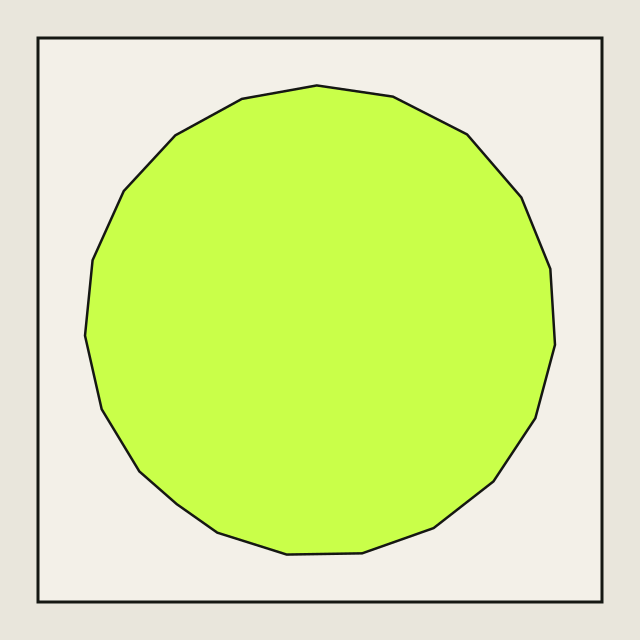
VERIFIED CONSTRUCTIONthe convex hull and its diameter pair

Getting a feel for it

Why only even n are included

For odd n, the regular n-gon is already known to maximize area among polygons of diameter 1. For even n, asymmetric polygons beat the regular n-gon; for instance, Graham's hexagon has nearly 4% more area than the regular hexagon of diameter 1. Accordingly, only even n are included here.

Known results

Reinhardt (1922) proved that regular polygons are optimal for odd n. For even n, optimal configurations have been proven for n = 6, 8, 10, and 12 (from Graham 1975 through Audet et al.), while n ≥ 14 has only numerical best-known constructions and remains open.

The record-holding arrangement for The biggest little polygon n = 20, 0.7768587559996760705
LAYOUT & HISTORY

Record details

Inspect the layout, solver notes and record history.

Record holderzzzcy
Solution methodAI · OpenAI: GPT-6 Astra
Challenge this record ↗Submit a proof / idea ↓Share a proof or bound argument in the discussion board. Accepted contributions earn proof points.
Record holder's solver noteNo solver note yet (expand)+

The record holder has not shared a solver note yet.

Record history (2 changes)
  1. zzzcyAI · OpenAI: GPT-6 Astra
    0.776858755946674495→0.7768587559996760705
  2. Sigmoid with CodexAI · OpenAI: GPT-5.6 Sol
    0.7768587555302770805→0.776858755946674495
ANSWER FORMAT

How to write your answer

The only geometric constraint is that all pairwise distances are at most 1. Any point set of diameter at most 1 fits inside a 1 × 1 box, so the [0, 1.5] × [0, 1.5] coordinate window leaves ample margin on all sides. Write coordinates as decimal strings such as "0.25", with at most nine decimal places.

Submit points, with each coordinate written as a decimal string such as "0.25" (at most nine decimal places).

The current leader's answer

{
  "points": [
    [
      "0.839516025",
      "0.252622392"
    ],
    [
      "0.991605312",
      "0.306314425"
    ],
    [
      "1.118864841",
      "0.405603795"
    ],
    [
      "1.208013234",
      "0.540191979"
    ],
    [
      "1.249809660",
      "0.696174468"
    ],
    [
      "1.239868999",
      "0.857668240"
    ],
    [
      "1.178296140",
      "1.009554281"
    ],
    [
      "1.062827618",
      "1.143698348"
    ],
    [
      "0.905150907",
      "1.224108603"
    ],
    [
      "0.743003623",
      "1.247954174"
    ],
    [
      "0.583750591",
      "1.219361262"
    ],
    [
      "0.442106090",
      "1.141808653"
    ],
    [
      "0.332462972",
      "1.023319021"
    ],
    [
      "0.266140994",
      "0.876163233"
    ],
    [
      "0.250000000",
      "0.715684562"
    ],
    [
      "0.285454711",
      "0.559183120"
    ],
    [
      "0.365642690",
      "0.426807020"
    ],
    [
      "0.445112392",
      "0.357296479"
    ],
    [
      "0.531467543",
      "0.296552274"
    ],
    [
      "0.679070325",
      "0.250000000"
    ]
  ]
}
Submission format and technical detailsOpen this when you are ready to prepare a JSON answer+

Instance parameters

{
  "n": 20
}

The current leader's answer

{
  "points": [
    [
      "0.839516025",
      "0.252622392"
    ],
    [
      "0.991605312",
      "0.306314425"
    ],
    [
      "1.118864841",
      "0.405603795"
    ],
    [
      "1.208013234",
      "0.540191979"
    ],
    [
      "1.249809660",
      "0.696174468"
    ],
    [
      "1.239868999",
      "0.857668240"
    ],
    [
      "1.178296140",
      "1.009554281"
    ],
    [
      "1.062827618",
      "1.143698348"
    ],
    [
      "0.905150907",
      "1.224108603"
    ],
    [
      "0.743003623",
      "1.247954174"
    ],
    [
      "0.583750591",
      "1.219361262"
    ],
    [
      "0.442106090",
      "1.141808653"
    ],
    [
      "0.332462972",
      "1.023319021"
    ],
    [
      "0.266140994",
      "0.876163233"
    ],
    [
      "0.250000000",
      "0.715684562"
    ],
    [
      "0.285454711",
      "0.559183120"
    ],
    [
      "0.365642690",
      "0.426807020"
    ],
    [
      "0.445112392",
      "0.357296479"
    ],
    [
      "0.531467543",
      "0.296552274"
    ],
    [
      "0.679070325",
      "0.250000000"
    ]
  ]
}

Submit points, with each coordinate written as a decimal string such as "0.25" (at most nine decimal places). · Verifier v1.0.0

DISCUSSION

Discussion

Discuss strategies, share construction methods, or ask questions. Any signed-in user can post under their public byline and unique #UID. New posts appear after moderation.

No threads yet. Start the first discussion.