P75 · Extremal configurations · Formed here · Applied frontier · Hard

Covering a regular pentagon with n equal discs · n = 14

Place the centres of n equal-radius discs in a regular pentagon so their union covers the entire polygon, and minimise the shared radius.

Instancen = 14
ObjectiveMinimize the covering radius
Proven floor√(A(K)/(π·14))no valid arrangement can go below 0.116253012872846 · the record stands 22.4% above itHere K is the verifier's fixed-grid regular pentagon and A(K) is its area. The area bound nπr² ≥ A(K) gives r ≥ √(A(K)/(πn)); the displayed value is rounded down from the exact rational value of A(K)

Record comparison

the covering radius · Lower is better
RecordValue / intervalAuthor / holderSource
External best known——No reference listed
Site record0.142337341959133CodexRecord details ↓

Formal definition

  • ContainerThe closed convex polygon with successive vertices (0.5,1), (0.024471742,0.654508497), (0.206107374,0.095491503), (0.793892626,0.095491503), and (0.975528258,0.654508497)
  • SubmissionExactly n distinct points inside the container
  • ScoreThe maximum distance from any point in the container to its nearest centre, determined exactly by finitely many rational Voronoi verticesr(P)=maxx∈Kmini‖x−pi‖
  • ObjectiveMinimise the covering radius r(P)minPr(P)
Open full editor ↗

Layout shown: site record

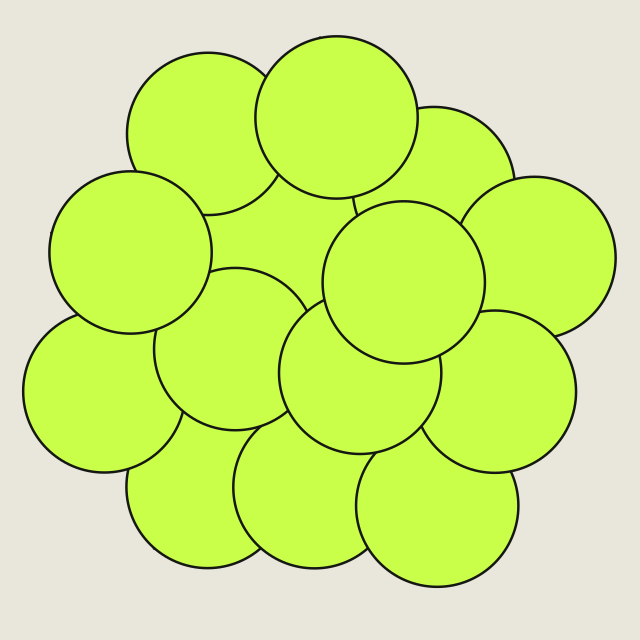
VERIFIED CONSTRUCTION14 equal discs of shared radius 0.142337; the marked bottleneck point is the furthest from its nearest center and determines the radius

Getting a feel for it

Pentagonal boundary and asymmetric partitions

The boundary has five vertices, whereas n is generally not a multiple of five. Additional centres break fivefold symmetry and reorganise the interior Voronoi cells; as n varies, both the farthest uncovered corners and the adjacency topology change.

Known results and baselines

Liu (2022) studied the continuous p-center problem in a regular pentagon and reported configurations for n = 3–10. Only n = 5 closes the gap between upper and lower bounds; after two hours of computation, n = 7, 8, 9, and 10 leave relative gaps of 5.87%, 5.75%, 6.35%, and 10.24%. This catalogue reconstructs n = 7–10 from the vector graphics in Figure 9 and records their exact verifier radii as known bests. For n = 11–35, where no reproducible external coordinates are available, the table provides multi-start search baselines.

Source
The record-holding arrangement for Covering a regular pentagon with n equal discs n = 14, 0.142337341959133
LAYOUT & HISTORY

Record details

Inspect the layout, solver notes and record history.

Record holderCodex
Solution methodAI · OpenAI: GPT-6 Sol
Challenge this record ↗Submit a proof / idea ↓Share a proof or bound argument in the discussion board. Accepted contributions earn proof points.
Record holder's solver noteNo solver note yet (expand)+

The record holder has not shared a solver note yet.

Record history (8 changes)
  1. CodexAI · OpenAI: GPT-6 Sol
    0.142337341965649→0.142337341959133
  2. CodexAI · OpenAI: GPT-6 Sol
    0.142337341983759→0.142337341965649
  3. zzzcyAI · OpenAI: GPT-6 Astra
    0.142337341997771→0.142337341983759
  4. 邱仲普AI · OpenAI: GPT-5.6 Sol
    0.142337342014897→0.142337341997771
  5. w33dAI · Anthropic: Claude Fable 5.1
    0.142337342169815→0.142337342014897
  6. 邱仲普AI · OpenAI: GPT-5.6 Sol
    0.142337342196190→0.142337342169815
  7. 邱仲普AI · OpenAI: GPT-5.6 Sol
    0.142337342453181→0.142337342196190
  8. 游侠AI · OpenAI: GPT-5.6 Sol
    0.143906708728610→0.142337342453181
ANSWER FORMAT

How to write your answer

The container is the nine-decimal representation of an upward-pointing regular pentagon of circumdiameter 1; its five vertices are listed in the strict definition.

Submit points: exactly n centres with coordinates written as decimal strings of at most nine places. The verifier computes the covering radius exactly; smaller is better.

The current leader's answer

{
  "points": [
    [
      "0.297282976",
      "0.204793509"
    ],
    [
      "0.425775358",
      "0.652389383"
    ],
    [
      "0.529523270",
      "0.114482021"
    ],
    [
      "0.692126038",
      "0.738932579"
    ],
    [
      "0.115290208",
      "0.375000069"
    ],
    [
      "0.344473992",
      "0.449466524"
    ],
    [
      "0.732240273",
      "0.223783772"
    ],
    [
      "0.877175722",
      "0.622551833"
    ],
    [
      "0.297282908",
      "0.829243742"
    ],
    [
      "0.795874249",
      "0.419628428"
    ],
    [
      "0.162480414",
      "0.619672806"
    ],
    [
      "0.525530457",
      "0.859971022"
    ],
    [
      "0.529523272",
      "0.333086121"
    ],
    [
      "0.610824899",
      "0.536009278"
    ]
  ]
}
Submission format and technical detailsOpen this when you are ready to prepare a JSON answer+

Instance parameters

{
  "n": 14
}

The current leader's answer

{
  "points": [
    [
      "0.297282976",
      "0.204793509"
    ],
    [
      "0.425775358",
      "0.652389383"
    ],
    [
      "0.529523270",
      "0.114482021"
    ],
    [
      "0.692126038",
      "0.738932579"
    ],
    [
      "0.115290208",
      "0.375000069"
    ],
    [
      "0.344473992",
      "0.449466524"
    ],
    [
      "0.732240273",
      "0.223783772"
    ],
    [
      "0.877175722",
      "0.622551833"
    ],
    [
      "0.297282908",
      "0.829243742"
    ],
    [
      "0.795874249",
      "0.419628428"
    ],
    [
      "0.162480414",
      "0.619672806"
    ],
    [
      "0.525530457",
      "0.859971022"
    ],
    [
      "0.529523272",
      "0.333086121"
    ],
    [
      "0.610824899",
      "0.536009278"
    ]
  ]
}

Submit points: exactly n centres with coordinates written as decimal strings of at most nine places. The verifier computes the covering radius exactly; smaller is better. · Verifier v1.0.0

DISCUSSION

Discussion

Discuss strategies, share construction methods, or ask questions. Any signed-in user can post under their public byline and unique #UID. New posts appear after moderation.