P96 · Packing and covering · Classic

Consecutive L shapes in a square · n = 2

Pack n L shapes with short sides 1, 2, …, n into a square without overlap. Each L consists of three equal squares. Translate and rotate the pieces freely to minimise the container side.

Instancen = 2
ObjectiveMinimize the square's side

Record comparison

the square's side · Lower is better
RecordValue / intervalAuthor / holderSource
Proven optimum4See source attributionErich Friedman ↗
Site recordNo player record yet——

The continuous optimum is proved, so competition submissions are closed. Historical records and contribution points are retained. Because finite-decimal coordinates cannot attain this value exactly, the current certificate is not claimed optimal on the nine-decimal grid.

Formal definition

  • ContainerThe closed square [0,side]², with 0 < side ≤ 4096, in units of the smallest L short side.
  • SubmissionPiece k has local vertices (−k,−k), (k,−k), (k,0), (0,0), (0,k), (−k,k). Its translated origin is (x,y).
  • RotationRotation is free, not restricted to multiples of 90°. Exact quarter turns and a rational half-angle parameter encode it. Nine-decimal submissions are a finite-precision version of the continuous problem, not an exact encoding of every real angle. Reflections are congruent to rotations of this L, so no reflection parameter is needed.
  • ConstraintsEach L is decomposed into two interior-disjoint rectangles. Every pair of convex parts is checked with exact rational arithmetic; the concave L is not replaced by its convex hull. Contact is legal, positive-area overlap is rejected.
  • ObjectiveMinimise the square side. The public score is the source table’s s, with no conversion.S=side
Inspect in editor ↗

Layout shown: starter layout

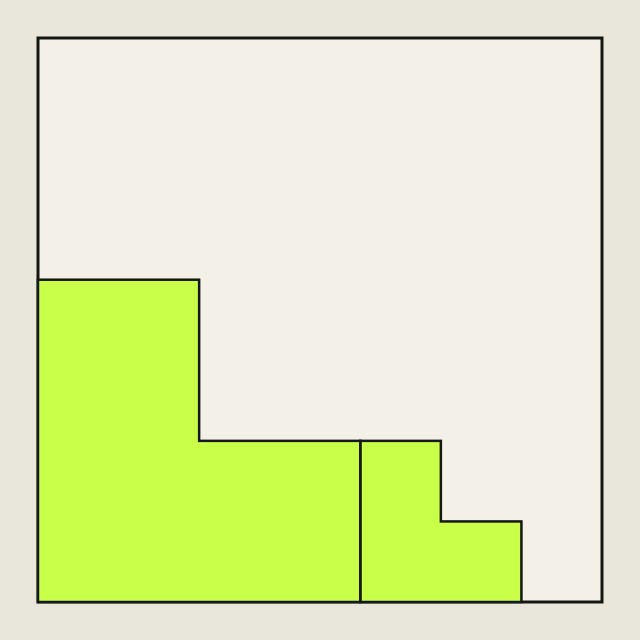
VERIFIED CONSTRUCTIONsquare side 7

Getting a feel for it

Area bound

The total area is 3∑k² = n(n+1)(2n+1)/2, a lower bound on side². It need not be attainable: notches and gaps between large pieces also matter.

Published records

Friedman’s table covers n=1–20, with values and original authors cited. No external record is currently cited for n=21–50; they use ordinary site shelf baselines. Instances n=1 and 2 are proved optimal; the others remain open.

Source
The current arrangement for Consecutive L shapes in a square n = 2
LAYOUT & HISTORY

Starter layout

Inspect the layout, solver notes and record history.

Proven optimumSubmit a proof / idea ↓Share a proof or bound argument in the discussion board. Accepted contributions earn proof points.
ANSWER FORMAT

How to write your answer

Coordinates, short sides and container side share one unit. Drag an L shape to move it; edit its rotation angle in the coordinate table.

Submit side and placements. Entry k is the L with short side k, written {"x":"…","y":"…","quarter":0,"turn":"0"}. (x,y) is its bounding-box centre and concave corner. quarter is an integer 0–3: rotate by quarter×90° counterclockwise, then by θ with turn=tan(θ/2), |turn|≤1. Other values are decimal strings with at most nine places.

Starter answer

{
  "placements": [
    {
      "quarter": 0,
      "turn": "0",
      "x": "5",
      "y": "1"
    },
    {
      "quarter": 0,
      "turn": "0",
      "x": "2",
      "y": "2"
    }
  ],
  "side": "7"
}
Submission format and technical detailsOpen this when you are ready to prepare a JSON answer+

Instance parameters

{
  "n": 2
}

Starter answer

{
  "placements": [
    {
      "quarter": 0,
      "turn": "0",
      "x": "5",
      "y": "1"
    },
    {
      "quarter": 0,
      "turn": "0",
      "x": "2",
      "y": "2"
    }
  ],
  "side": "7"
}

Submit side and placements. Entry k is the L with short side k, written {"x":"…","y":"…","quarter":0,"turn":"0"}. (x,y) is its bounding-box centre and concave corner. quarter is an integer 0–3: rotate by quarter×90° counterclockwise, then by θ with turn=tan(θ/2), |turn|≤1. Other values are decimal strings with at most nine places. · Verifier v1.0.0

DISCUSSION

Discussion

Discuss strategies, share construction methods, or ask questions. Any signed-in user can post under their public byline and unique #UID. New posts appear after moderation.