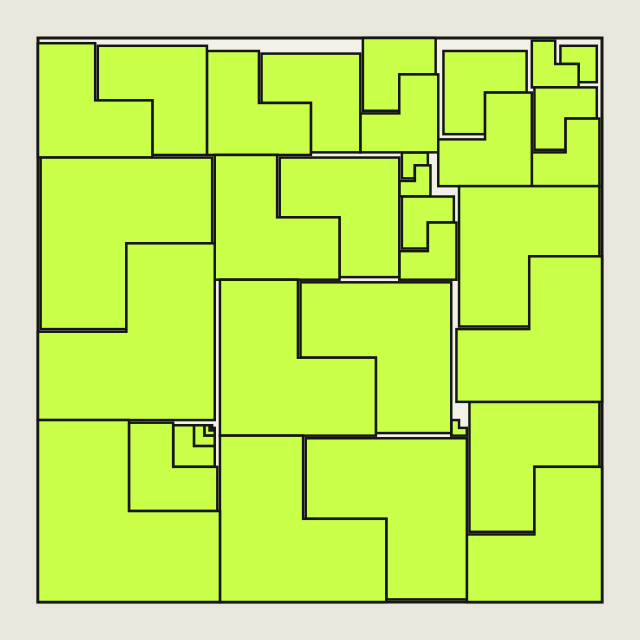
Consecutive L shapes in a square · n = 35
Pack n L shapes with short sides 1, 2, …, n into a square without overlap. Each L consists of three equal squares. Translate and rotate the pieces freely to minimise the container side.
Instancen = 35
ObjectiveMinimize the square's side
Record comparison
the square's side · Lower is better| Record | Value / interval | Author / holder | Source |
|---|---|---|---|
| External best known | — | — | No reference listed |
| Site record | 217 | condor | Record details ↓ |
Formal definition
- ContainerThe closed square [0,side]², with 0 < side ≤ 4096, in units of the smallest L short side.
- SubmissionPiece k has local vertices (−k,−k), (k,−k), (k,0), (0,0), (0,k), (−k,k). Its translated origin is (x,y).
- RotationRotation is free, not restricted to multiples of 90°. Exact quarter turns and a rational half-angle parameter encode it. Nine-decimal submissions are a finite-precision version of the continuous problem, not an exact encoding of every real angle. Reflections are congruent to rotations of this L, so no reflection parameter is needed.
- ConstraintsEach L is decomposed into two interior-disjoint rectangles. Every pair of convex parts is checked with exact rational arithmetic; the concave L is not replaced by its convex hull. Contact is legal, positive-area overlap is rejected.
- ObjectiveMinimise the square side. The public score is the source table’s s, with no conversion.