P96 · Packing and covering · Classic · Hard

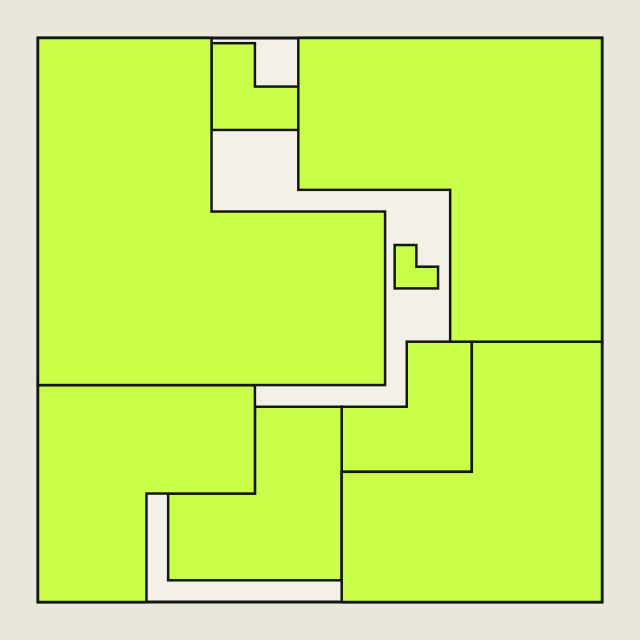
Consecutive L shapes in a square · n = 8

Pack n L shapes with short sides 1, 2, …, n into a square without overlap. Each L consists of three equal squares. Translate and rotate the pieces freely to minimise the container side.

Instancen = 8
ObjectiveMinimize the square's side

Record comparison

the square's side · Lower is better
RecordValue / intervalAuthor / holderSource
External best known26Erich Friedman1998Erich Friedman ↗
Site record26qiboqiRecord details ↓

Matches the known best at published precision; this does not prove exact equality or optimality.

Formal definition

  • ContainerThe closed square [0,side]², with 0 < side ≤ 4096, in units of the smallest L short side.
  • SubmissionPiece k has local vertices (−k,−k), (k,−k), (k,0), (0,0), (0,k), (−k,k). Its translated origin is (x,y).
  • RotationRotation is free, not restricted to multiples of 90°. Exact quarter turns and a rational half-angle parameter encode it. Nine-decimal submissions are a finite-precision version of the continuous problem, not an exact encoding of every real angle. Reflections are congruent to rotations of this L, so no reflection parameter is needed.
  • ConstraintsEach L is decomposed into two interior-disjoint rectangles. Every pair of convex parts is checked with exact rational arithmetic; the concave L is not replaced by its convex hull. Contact is legal, positive-area overlap is rejected.
  • ObjectiveMinimise the square side. The public score is the source table’s s, with no conversion.S=side
Open full editor ↗

Layout shown: site record

VERIFIED CONSTRUCTIONsquare side 26

Getting a feel for it

Area bound

The total area is 3∑k² = n(n+1)(2n+1)/2, a lower bound on side². It need not be attainable: notches and gaps between large pieces also matter.

Published records

Friedman’s table covers n=1–20, with values and original authors cited. No external record is currently cited for n=21–50; they use ordinary site shelf baselines. Instances n=1 and 2 are proved optimal; the others remain open.

Source
The record-holding arrangement for Consecutive L shapes in a square n = 8, 26
LAYOUT & HISTORY

Record details

Inspect the layout, solver notes and record history.

Record holderqiboqi
Solution methodHuman
Challenge this record ↗Submit a proof / idea ↓Share a proof or bound argument in the discussion board. Accepted contributions earn proof points.
Record holder's solver noteNo solver note yet (expand)+

The record holder has not shared a solver note yet.

Record history (2 changes)
  1. qiboqiHuman
    26.04347826→26
  2. qiboqiHuman
    35→26.04347826
ANSWER FORMAT

How to write your answer

Coordinates, short sides and container side share one unit. Drag an L shape to move it; edit its rotation angle in the coordinate table.

Submit side and placements. Entry k is the L with short side k, written {"x":"…","y":"…","quarter":0,"turn":"0"}. (x,y) is its bounding-box centre and concave corner. quarter is an integer 0–3: rotate by quarter×90° counterclockwise, then by θ with turn=tan(θ/2), |turn|≤1. Other values are decimal strings with at most nine places.

The current leader's answer

{
  "placements": [
    {
      "quarter": 0,
      "turn": "0.000000000",
      "x": "17.442030533",
      "y": "15.456521739"
    },
    {
      "quarter": 0,
      "turn": "0.000000000",
      "x": "10.000000000",
      "y": "23.760869565"
    },
    {
      "quarter": 1,
      "turn": "0.000000000",
      "x": "17.000000000",
      "y": "9.000000000"
    },
    {
      "quarter": 1,
      "turn": "0.000000000",
      "x": "10.000000000",
      "y": "5.000000000"
    },
    {
      "quarter": 3,
      "turn": "0.000000000",
      "x": "5.000000000",
      "y": "5.000000000"
    },
    {
      "quarter": 1,
      "turn": "0.000000000",
      "x": "20.000000000",
      "y": "6.000000000"
    },
    {
      "quarter": 2,
      "turn": "0.000000000",
      "x": "19.000000000",
      "y": "19.000000000"
    },
    {
      "quarter": 0,
      "turn": "0.000000000",
      "x": "8.000000000",
      "y": "18.000000000"
    }
  ],
  "side": "26"
}
Submission format and technical detailsOpen this when you are ready to prepare a JSON answer+

Instance parameters

{
  "n": 8
}

The current leader's answer

{
  "placements": [
    {
      "quarter": 0,
      "turn": "0.000000000",
      "x": "17.442030533",
      "y": "15.456521739"
    },
    {
      "quarter": 0,
      "turn": "0.000000000",
      "x": "10.000000000",
      "y": "23.760869565"
    },
    {
      "quarter": 1,
      "turn": "0.000000000",
      "x": "17.000000000",
      "y": "9.000000000"
    },
    {
      "quarter": 1,
      "turn": "0.000000000",
      "x": "10.000000000",
      "y": "5.000000000"
    },
    {
      "quarter": 3,
      "turn": "0.000000000",
      "x": "5.000000000",
      "y": "5.000000000"
    },
    {
      "quarter": 1,
      "turn": "0.000000000",
      "x": "20.000000000",
      "y": "6.000000000"
    },
    {
      "quarter": 2,
      "turn": "0.000000000",
      "x": "19.000000000",
      "y": "19.000000000"
    },
    {
      "quarter": 0,
      "turn": "0.000000000",
      "x": "8.000000000",
      "y": "18.000000000"
    }
  ],
  "side": "26"
}

Submit side and placements. Entry k is the L with short side k, written {"x":"…","y":"…","quarter":0,"turn":"0"}. (x,y) is its bounding-box centre and concave corner. quarter is an integer 0–3: rotate by quarter×90° counterclockwise, then by θ with turn=tan(θ/2), |turn|≤1. Other values are decimal strings with at most nine places. · Verifier v1.0.0

DISCUSSION

Discussion

Discuss strategies, share construction methods, or ask questions. Any signed-in user can post under their public byline and unique #UID. New posts appear after moderation.