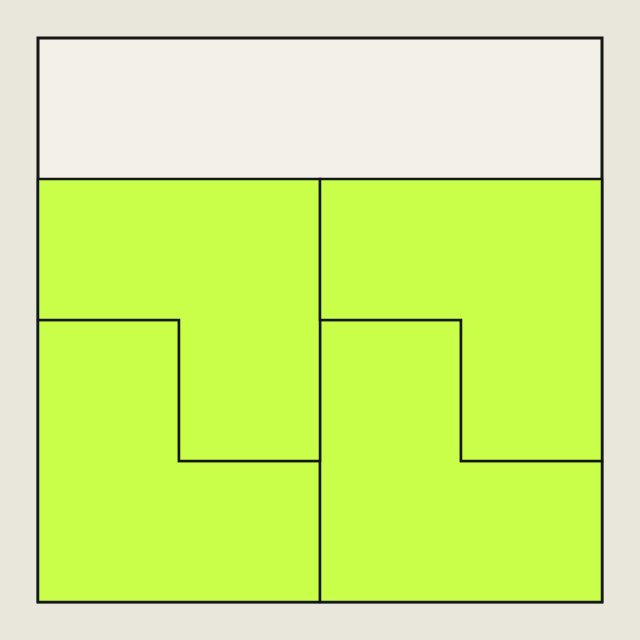
L's in a square · n = 4
Pack n L-trominoes (three unit cells) into a square. Contact is allowed; interiors cannot overlap. Minimise the container square side.
Instancen = 4
ObjectiveMinimize container square side
Record comparison
container square side · Lower is better| Record | Value / interval | Author / holder | Source |
|---|---|---|---|
| External best known | UnresolvedSee original source | See source attribution | Erich Friedman ↗ |
| Site record | No player record yet | — | — |
Formal definition
- ContainerThe editor and certificate normalise the container to the unit square [0,1]², while public scores are reported in the literature's unit-cell L-tromino scale. Boundary contact is allowed.
- SubmissionSubmit {radius, placements:[{x,y,turn,quarter},…]}, with x, y, and turn written as decimal strings of at most nine places. Here radius is the unit-cell side of each L-tromino inside the unit-square container, so the container side length is 1/radius. The coordinates x, y specify the centre of the piece's 2 × 2 bounding box; quarter is an integer in 0–3 specifying an exact multiple of 90° applied before the rational rotation turn = tan(θ/2). Coordinates and turn must lie in [−4, 4], with 0 < radius ≤ 4.
- ConstraintsExactly n congruent L-trominoes lie wholly inside the container with pairwise disjoint interiors. Pieces may rotate independently by arbitrary angles.
- PrecisionInput decimals are parsed as exact rationals, with zero floating-point tolerance in feasibility checks.
- ObjectiveContainer square side = 1/r (where r is the tromino's cell side inside the unit square), where smaller is better. Pages, leaderboards, and literature records share this unit with automatic conversion.