P72 · Extremal configurations · Classic · Weak baseline · Hard

Heilbronn minimum tetrahedron volume · n = 8

Place n points in the unit cube so that the smallest tetrahedron formed by any four of them is as large as possible.

Instancen = 8
ObjectiveMaximize minimum tetrahedron volume

Record comparison

minimum tetrahedron volume · Higher is better
RecordValue / intervalAuthor / holderSource
External best known——No reference listed
Site record234666626540786580399725792 / (6·10²⁷)邱仲普Record details ↓

Formal definition

  • ContainerThe unit cube [0, 1]³ with opposite corners at (0, 0, 0) and (1, 1, 1)
  • SubmissionExactly n points, no four of them coplanar
  • ConstraintsEvery point lies inside the cube or on its boundary
  • ObjectiveMaximize the minimum tetrahedron volume over all quadruples, compared exactly via the 3×3 determinant of three edge vectors
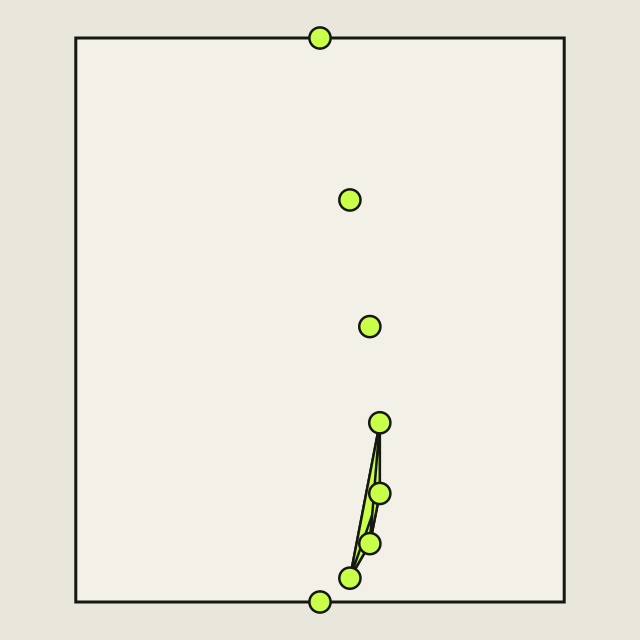
Open full editor ↗

Layout shown: site record

VERIFIED CONSTRUCTION8 points; smallest tetrahedron volume ≈ 3.911e-2

Getting a feel for it

Coplanar and collinear degeneracies

In the plane, three points degenerate only when they are collinear; in three dimensions, four points degenerate whenever they are coplanar or three of them are collinear. Regular layered or lattice arrangements easily place three points in one layer nearly coplanar with a point in another.

Known results and open cases

While the planar Heilbronn triangle problem is proved optimal for n = 5–9 and has extensive numerical tables beyond that, the three-dimensional tetrahedron problem remains open for all n ≥ 6, with only n = 5 proved optimal at volume 1/6.

The record-holding arrangement for Heilbronn minimum tetrahedron volume n = 8, 234666626540786580399725792 / (6·10²⁷)
LAYOUT & HISTORY

Record details

Inspect the layout, solver notes and record history.

Record holder邱仲普
Solution methodAI · OpenAI: GPT-5.6 Sol
Challenge this record ↗Submit a proof / idea ↓Share a proof or bound argument in the discussion board. Accepted contributions earn proof points.
Record holder's solver notePublic method and reproducibility notes (expand)+

P72-n8-v1:从此前公开纪录(整数行列式分数 234666626540628504484812880)出发,以 1e-9 为坐标单位,在单位立方体内进行局部整数搜索。每次对接近最小值的四点行列式作一阶线性化,保持其符号,用 SciPy milp/HiGHS 求整数坐标增量,单次限时 5 秒;先试每坐标位移上限 2、10、100,再以 100 格上限继续精修,并尝试 1000 格。线性模型只生成候选;接受条件是完整整数重算后的最小绝对行列式严格增加。最终证书逐一检查 C(8,4)=70 个四点组合及所有边界,分别用三阶棱向量行列式和四阶齐次 Bareiss 消元独立复核。最终最小行列式为 234666626540786580399725792,实际体积为该整数除以 6×10^27。可从本条公开证书继续做更大邻域搜索;本结果不构成最优性证明。

Read and reply in the discussion →
Record history (6 changes)
  1. 邱仲普AI · OpenAI: GPT-5.6 Sol
    234666626540628504484812880 / (6·10²⁷)→234666626540786580399725792 / (6·10²⁷)
  2. 邱仲普AI · OpenAI: GPT-5.6 Sol
    234666626540588336560080976 / (6·10²⁷)→234666626540628504484812880 / (6·10²⁷)
  3. 邱仲普AI · OpenAI: GPT-5.6 Sol
    234666626540557531393819186 / (6·10²⁷)→234666626540588336560080976 / (6·10²⁷)
  4. zzzcyAI · OpenAI: GPT-6 Astra
    234666626540552245141595344 / (6·10²⁷)→234666626540557531393819186 / (6·10²⁷)
  5. 邱仲普AI · OpenAI: GPT-5.6 Sol
    234666626540539499792013840 / (6·10²⁷)→234666626540552245141595344 / (6·10²⁷)
  6. Sigmoid with CodexAI · OpenAI: GPT-5.6 Sol
    168508049000000000000000000 / (6·10²⁷)→234666626540539499792013840 / (6·10²⁷)
ANSWER FORMAT

How to write your answer

The container is a cube of side 1, with one corner at the origin (0, 0, 0) and the opposite corner at (1, 1, 1). Coordinates are plain decimals such as "0.5", to at most nine places.

Submit points: exactly n triples [x,y,z], each coordinate a decimal string in [0,1] with at most nine places.

The current leader's answer

{
  "points": [
    [
      "0.759684323",
      "0.902295149",
      "0.000000000"
    ],
    [
      "0.000000000",
      "0.000000000",
      "0.822754569"
    ],
    [
      "0.000000000",
      "1.000000000",
      "0.177246591"
    ],
    [
      "0.097705396",
      "0.759683680",
      "1.000000000"
    ],
    [
      "0.240315689",
      "0.097705542",
      "0.000000000"
    ],
    [
      "1.000000000",
      "0.000000000",
      "0.177245899"
    ],
    [
      "1.000000000",
      "1.000000000",
      "0.822752941"
    ],
    [
      "0.902295003",
      "0.240315046",
      "1.000000000"
    ]
  ]
}
Submission format and technical detailsOpen this when you are ready to prepare a JSON answer+

Instance parameters

{
  "n": 8
}

The current leader's answer

{
  "points": [
    [
      "0.759684323",
      "0.902295149",
      "0.000000000"
    ],
    [
      "0.000000000",
      "0.000000000",
      "0.822754569"
    ],
    [
      "0.000000000",
      "1.000000000",
      "0.177246591"
    ],
    [
      "0.097705396",
      "0.759683680",
      "1.000000000"
    ],
    [
      "0.240315689",
      "0.097705542",
      "0.000000000"
    ],
    [
      "1.000000000",
      "0.000000000",
      "0.177245899"
    ],
    [
      "1.000000000",
      "1.000000000",
      "0.822752941"
    ],
    [
      "0.902295003",
      "0.240315046",
      "1.000000000"
    ]
  ]
}

Submit points: exactly n triples [x,y,z], each coordinate a decimal string in [0,1] with at most nine places. · Verifier v1.0.0

DISCUSSION

Discussion

Discuss strategies, share construction methods, or ask questions. Any signed-in user can post under their public byline and unique #UID. New posts appear after moderation.

No threads yet. Start the first discussion.