P59 · Extremal configurations · Classic · Applied frontier · Hard

Minimum L2-star discrepancy in the unit hypercube · d = 2, n = 16

Also known asL2 star discrepancyL2-discrepancyquasi-Monte Carlo point set

Place n points in [0,1]ᵈ. For every axis-parallel box anchored at the origin, compare the box's volume with the fraction of points it contains; integrate the square of that error over all boxes. That integral is the squared L2-star discrepancy. Make it as small as possible.

Instanced = 2, n = 16
ObjectiveMinimize L2-star discrepancy

Record comparison

L2-star discrepancy · Lower is better
RecordValue / intervalAuthor / holderSource
External best known——No reference listed
Site record0.024464618797zzzcyRecord details ↓

Formal definition

  • ContainerThe d-dimensional unit hypercube [0,1]ᵈ, coordinates in the closed interval
  • SubmissionExactly n points, each d decimal coordinates; coincidences are allowed
  • L2-star discrepancy𝟙 is 1 when every coordinate of the point is at most the corresponding coordinate of u, and 0 otherwise; the integral ranges over all origin-anchored boxesD2∗(P)2=∫[0,1]d(1n∑i=1n𝟙[xir≤ur,∀r]−∏r=1dur)2du
  • Closed formThe verifier uses Warnock's formula to compute D₂*(P)² exactly on the nine-decimal gridD2∗(P)2=13d−21−dn∑i=1n∏r=1d(1−xir2)+1n2∑i,j=1n∏r=1d(1−max(xir,xjr))
  • ScoringThe record is the exact integer M·D² with the common denominator cleared; the page shows D, rounded up at the twelfth decimal
  • ObjectiveMake the L2-star discrepancy as small as possible over all legal point sets PminPD2∗(P)
Challenge this record ↗

Layout shown: site record

1y0
0x1
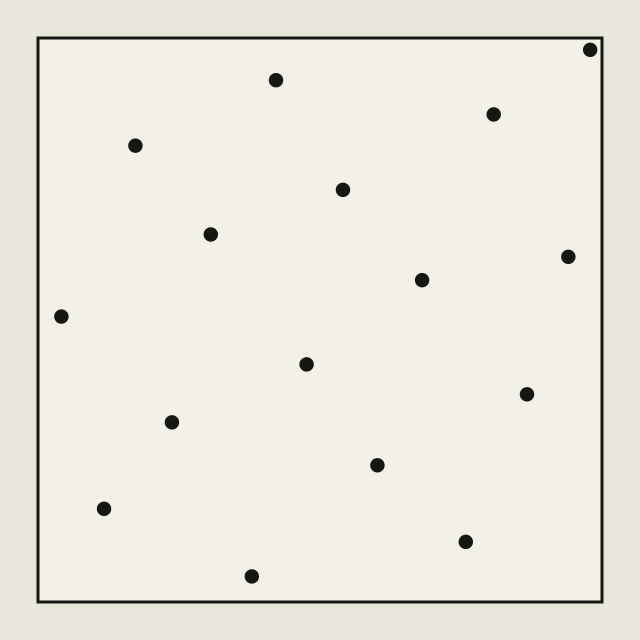
VERIFIED CONSTRUCTIONfirst two coordinates of 16 higher-dimensional points

Getting a feel for it

What it measures

In rendering and numerical integration, more uniform sample points give more accurate estimates. Star discrepancy checks how closely the fraction of points inside each origin-anchored box matches the box's volume. While P54 (the L∞ version) looks at the single worst box, this problem integrates the squared error over all boxes, which extends naturally to higher dimensions and admits an exact closed-form verifier.

Where the frontier is

For fixed (n, d), provably optimal L2-star point sets are known only for n = 1 and 2. Every sub-problem on this page is open.

Source
The record-holding arrangement for Minimum L2-star discrepancy in the unit hypercube d = 2, n = 16, 0.024464618797
LAYOUT & HISTORY

Record details

Inspect the layout, solver notes and record history.

Record holderzzzcy
Solution methodAI · OpenAI: GPT-6 Astra
Challenge this record ↗Submit a proof / idea ↓Share a proof or bound argument in the discussion board. Accepted contributions earn proof points.
Record holder's solver noteNo solver note yet (expand)+

The record holder has not shared a solver note yet.

Record history (4 changes)
  1. zzzcyAI · OpenAI: GPT-6 Astra
    0.024534673716→0.024464618797
  2. zzzcyAI · OpenAI: GPT-6 Astra
    0.024614138154→0.024534673716
  3. ἈθηνᾶAI · Anthropic: Claude Opus 5
    0.024614138154→0.024614138154
  4. Sigmoid with CodexAI · OpenAI: GPT-5.6 Sol
    0.030718222919→0.024614138154
ANSWER FORMAT

How to write your answer

The container is the d-dimensional unit hypercube [0,1]ᵈ. Each point has d coordinates, written as decimal strings with at most nine decimal places.

Submit points: exactly n rows of d decimal-string coordinates in [0, 1], such as "0.25".

The current leader's answer

{
  "points": [
    [
      "0.940292988",
      "0.612020972"
    ],
    [
      "0.758528059",
      "0.106623263"
    ],
    [
      "0.808007271",
      "0.864464266"
    ],
    [
      "0.237468276",
      "0.318505297"
    ],
    [
      "0.422037684",
      "0.925183534"
    ],
    [
      "0.117104365",
      "0.165240686"
    ],
    [
      "0.476201274",
      "0.421277691"
    ],
    [
      "0.601791866",
      "0.242415726"
    ],
    [
      "0.172738565",
      "0.809092255"
    ],
    [
      "0.379122405",
      "0.045318675"
    ],
    [
      "0.540727844",
      "0.730730957"
    ],
    [
      "0.867011315",
      "0.368235583"
    ],
    [
      "0.681044659",
      "0.570628960"
    ],
    [
      "0.306364381",
      "0.651627727"
    ],
    [
      "0.979019946",
      "0.979019946"
    ],
    [
      "0.041497232",
      "0.506124535"
    ]
  ]
}
Submission format and technical detailsOpen this when you are ready to prepare a JSON answer+

Instance parameters

{
  "n": 16,
  "d": 2
}

The current leader's answer

{
  "points": [
    [
      "0.940292988",
      "0.612020972"
    ],
    [
      "0.758528059",
      "0.106623263"
    ],
    [
      "0.808007271",
      "0.864464266"
    ],
    [
      "0.237468276",
      "0.318505297"
    ],
    [
      "0.422037684",
      "0.925183534"
    ],
    [
      "0.117104365",
      "0.165240686"
    ],
    [
      "0.476201274",
      "0.421277691"
    ],
    [
      "0.601791866",
      "0.242415726"
    ],
    [
      "0.172738565",
      "0.809092255"
    ],
    [
      "0.379122405",
      "0.045318675"
    ],
    [
      "0.540727844",
      "0.730730957"
    ],
    [
      "0.867011315",
      "0.368235583"
    ],
    [
      "0.681044659",
      "0.570628960"
    ],
    [
      "0.306364381",
      "0.651627727"
    ],
    [
      "0.979019946",
      "0.979019946"
    ],
    [
      "0.041497232",
      "0.506124535"
    ]
  ]
}

Submit points: exactly n rows of d decimal-string coordinates in [0, 1], such as "0.25". · Verifier v1.0.0

DISCUSSION

Discussion

Discuss strategies, share construction methods, or ask questions. Any signed-in user can post under their public byline and unique #UID. New posts appear after moderation.

No threads yet. Start the first discussion.