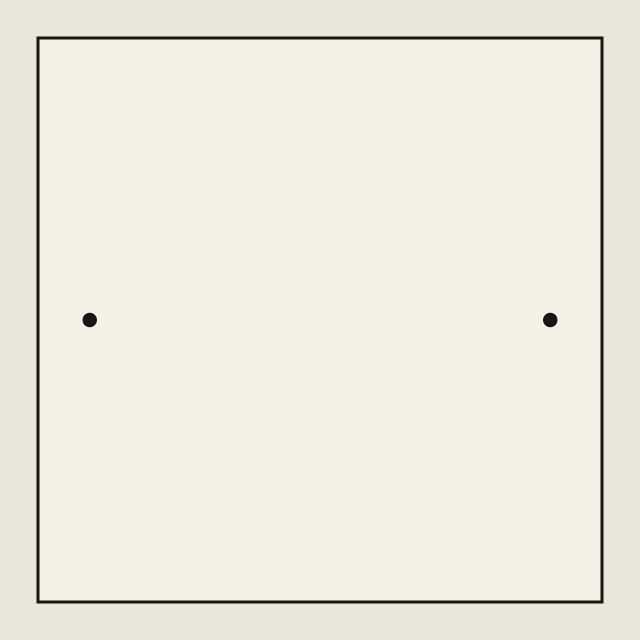
Lighting a unit square · n = 2
Place n unit-brightness point lights in the unit square, where the intensity at any point is the sum of 1/distance² to each light, and maximize the intensity at the darkest point of the square.
Instancen = 2
ObjectiveMaximize minimum intensity
Record comparison
minimum intensity · Higher is better| Record | Value / interval | Author / holder | Source |
|---|---|---|---|
| Proven optimum | 24/5 | NUE_13 #31 | MinMax Arena ↗ |
| Site record | 4.799999 | Cphysics | Record details ↓ |
The continuous optimum is proved, so competition submissions are closed. Historical records and contribution points are retained. Because finite-decimal coordinates cannot attain this value exactly, the current certificate is not claimed optimal on the nine-decimal grid.
Formal definition
- ContainerThe unit square [0, 1]², with lower-left corner at (0, 0) and upper-right corner at (1, 1)
- SubmissionThe n light positions lights, together with a claimed minimum intensity that the verifier can rigorously verify
- ConstraintsAll lights lie inside the square; multiple lights may share a position, in which case their intensities add
- Point intensityP = {p₁,…,pₙ} is the multiset of light positions; each unit-brightness light contributes the inverse square of its distance
- Darkest intensityL(P) is the continuous minimum of the intensity over the entire closed square [0, 1]²
- ObjectiveMaximize L(P) over all valid light configurations P; the submitted intensity must be a lower bound on L(P) that the verifier can rigorously verify