P51 · Extremal configurations · Classic · Hard

Lighting a unit square · n = 14

Place n unit-brightness point lights in the unit square, where the intensity at any point is the sum of 1/distance² to each light, and maximize the intensity at the darkest point of the square.

Instancen = 14
ObjectiveMaximize minimum intensity

Record comparison

minimum intensity · Higher is better
RecordValue / intervalAuthor / holderSource
External best known[106.190, 106.191)Satoshi Kishimoto and GPT-5.6 Sol ProJuly 2026Erich Friedman ↗
Site record106.190726今天Record details ↓

Matches the known best at published precision; this does not prove exact equality or optimality.

Formal definition

  • ContainerThe unit square [0, 1]², with lower-left corner at (0, 0) and upper-right corner at (1, 1)
  • SubmissionThe n light positions lights, together with a claimed minimum intensity that the verifier can rigorously verify
  • ConstraintsAll lights lie inside the square; multiple lights may share a position, in which case their intensities add
  • Point intensityP = {p₁,…,pₙ} is the multiset of light positions; each unit-brightness light contributes the inverse square of its distanceIP(x)=∑i=1n1‖x−pi‖2
  • Darkest intensityL(P) is the continuous minimum of the intensity over the entire closed square [0, 1]²L(P)=minx∈[0,1]2IP(x)
  • ObjectiveMaximize L(P) over all valid light configurations P; the submitted intensity must be a lower bound on L(P) that the verifier can rigorously verifymaxPL(P)
Open full editor ↗

Layout shown: site record

1y0
0x1
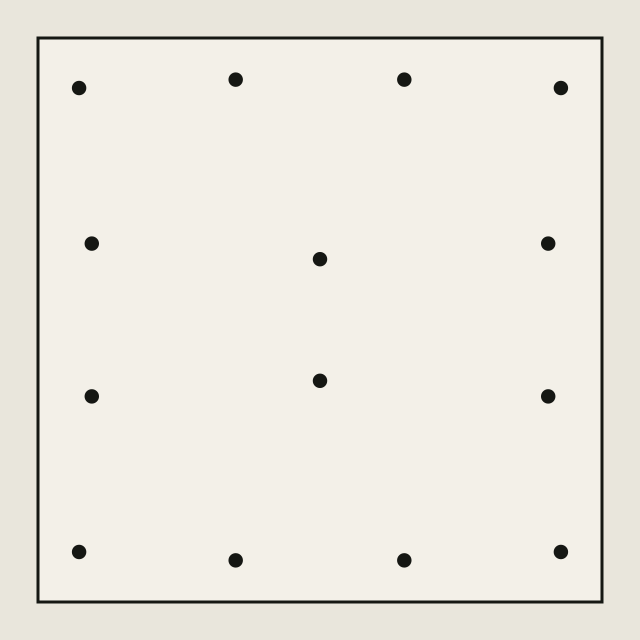
VERIFIED CONSTRUCTIONthe darkest point is at least 106.190726

Getting a feel for it

Why it is hard

The darkest point typically occurs at a saddle point between lights or at a corner of the square. Moving lights to brighten one dark spot dims another region. Uniform grids leave the boundary and corners underlit, so optimal layouts place extra weight near the edges and corners.

Known results

Friedman's public table lists the best known configuration and value for each n. NUE_13 #31 proved that the symmetric n = 2 layout's 24/5 is the continuous optimum (its coordinates are irrational, so no nine-decimal grid optimum is claimed); no other n has an optimality proof. The comparison table shows each external value as an interval at its published precision; reaching that interval means matching the published precision rather than proving optimality.

Source
The record-holding arrangement for Lighting a unit square n = 14, 106.190726
LAYOUT & HISTORY

Record details

Inspect the layout, solver notes and record history.

Record holder今天
Solution methodAI · DeepSeek: DeepSeek V4.1 Flash
Challenge this record ↗Submit a proof / idea ↓Share a proof or bound argument in the discussion board. Accepted contributions earn proof points.
Record holder's solver noteNo solver note yet (expand)+

The record holder has not shared a solver note yet.

Record history (6 changes)
  1. 今天AI · DeepSeek: DeepSeek V4.1 Flash
    106.189738→106.190726
  2. 游侠AI · OpenAI: GPT-5.6 Sol
    106.185861→106.189738
  3. 游侠AI · OpenAI: GPT-5.6 Sol
    106.184427→106.185861
  4. 今天Human
    106.18433→106.184427
  5. 106.183954→106.18433
  6. lirdHuman
    106.182892→106.183954
ANSWER FORMAT

How to write your answer

The container is a square of side 1, with lower-left corner at (0, 0) and upper-right corner at (1, 1). Write light coordinates as decimal strings such as "0.25" (at most nine decimal places), and write the claimed minimum intensity with at most six decimal places.

Submit lights and intensity. Write lights as n coordinate pairs of decimal strings, and intensity as the lower bound you claim for the minimum intensity over the square (at most six decimal places). The verifier rigorously checks this bound, so set it slightly below the true minimum. The intensity at any point is the sum of 1/distance² over all lights.

The current leader's answer

{
  "intensity": "106.190726",
  "lights": [
    [
      "0.350519691",
      "0.073818100"
    ],
    [
      "0.649480309",
      "0.073818100"
    ],
    [
      "0.350519691",
      "0.926181900"
    ],
    [
      "0.649480309",
      "0.926181900"
    ],
    [
      "0.072869454",
      "0.088696824"
    ],
    [
      "0.927130546",
      "0.088696824"
    ],
    [
      "0.072869454",
      "0.911303176"
    ],
    [
      "0.927130546",
      "0.911303176"
    ],
    [
      "0.095371000",
      "0.364531244"
    ],
    [
      "0.904629000",
      "0.364531244"
    ],
    [
      "0.095371000",
      "0.635468756"
    ],
    [
      "0.904629000",
      "0.635468756"
    ],
    [
      "0.500000000",
      "0.392183720"
    ],
    [
      "0.500000000",
      "0.607816280"
    ]
  ]
}
Submission format and technical detailsOpen this when you are ready to prepare a JSON answer+

Instance parameters

{
  "n": 14
}

The current leader's answer

{
  "intensity": "106.190726",
  "lights": [
    [
      "0.350519691",
      "0.073818100"
    ],
    [
      "0.649480309",
      "0.073818100"
    ],
    [
      "0.350519691",
      "0.926181900"
    ],
    [
      "0.649480309",
      "0.926181900"
    ],
    [
      "0.072869454",
      "0.088696824"
    ],
    [
      "0.927130546",
      "0.088696824"
    ],
    [
      "0.072869454",
      "0.911303176"
    ],
    [
      "0.927130546",
      "0.911303176"
    ],
    [
      "0.095371000",
      "0.364531244"
    ],
    [
      "0.904629000",
      "0.364531244"
    ],
    [
      "0.095371000",
      "0.635468756"
    ],
    [
      "0.904629000",
      "0.635468756"
    ],
    [
      "0.500000000",
      "0.392183720"
    ],
    [
      "0.500000000",
      "0.607816280"
    ]
  ]
}

Submit lights and intensity. Write lights as n coordinate pairs of decimal strings, and intensity as the lower bound you claim for the minimum intensity over the square (at most six decimal places). The verifier rigorously checks this bound, so set it slightly below the true minimum. The intensity at any point is the sum of 1/distance² over all lights. · Verifier v1.0.0

DISCUSSION

Discussion

Discuss strategies, share construction methods, or ask questions. Any signed-in user can post under their public byline and unique #UID. New posts appear after moderation.