P87 · Packing and covering · Classic

Equal discs covering a disc · n = 20

Cover the largest possible disc with n unit-radius discs. Maximise the covered disc radius.

Instancen = 20
ObjectiveMaximize covered disc radius

Record comparison

covered disc radius · Higher is better
RecordValue / intervalAuthor / holderSource
Proven optimum[3.692105318041154517751303788941, 3.692105318041154517751303788942]VonEquinoxDiskCoveringSolve ↗
Site recordNo player record yet——

The continuous optimum is proved, so competition submissions are closed. Historical records and contribution points are retained. Because finite-decimal coordinates cannot attain this value exactly, the current certificate is not claimed optimal on the nine-decimal grid.

Formal definition

  • ContainerThe editor and certificate normalise the target disc to the closed unit disc centred at (1,1), while public scores are reported in the literature's unit-covering-disc scale.
  • SubmissionSubmit {radius, placements:[{x,y,turn},…]}, with each value written as a decimal string of at most nine places. Here x, y are centre coordinates; circles require turn = 0 and polygons use turn = tan(θ/2). Coordinates and turn must lie in [−4, 4], with 0 < radius ≤ 4.
  • ConstraintsThe n distinct centres lie inside the target disc. Covering discs may overlap and protrude, and their union must cover every point of the target disc.
  • PrecisionInput decimals are parsed as exact rationals, with zero floating-point tolerance in feasibility checks.
  • ObjectiveCovered disc radius R = 1/r, where larger is better.
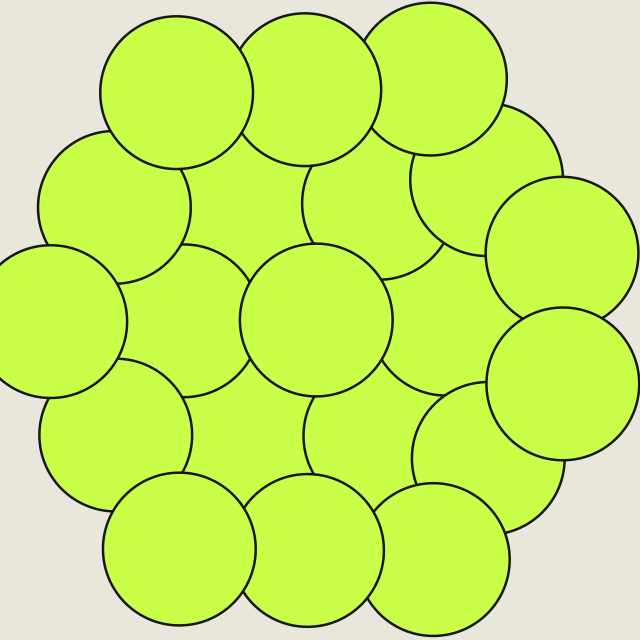
Inspect in editor ↗

Layout shown: starter layout

VERIFIED CONSTRUCTIONVERIFIED CONSTRUCTION

Getting a feel for it

Literature targets and coordinate certificates

Literature targets are converted at their published precision, while nine-decimal coordinate certificates are stored and displayed alongside the source values.

Source
The current arrangement for Equal discs covering a disc n = 20
LAYOUT & HISTORY

Starter layout

Inspect the layout, solver notes and record history.

Proven optimumSubmit a proof / idea ↓Share a proof or bound argument in the discussion board. Accepted contributions earn proof points.
ANSWER FORMAT

How to write your answer

the closed unit disc centred at (1,1)

Submit {radius, placements:[{x,y,turn},…]}, with each value written as a decimal string of at most nine places. Here x, y are centre coordinates; circles require turn = 0 and polygons use turn = tan(θ/2). Coordinates and turn must lie in [−4, 4], with 0 < radius ≤ 4.

Starter answer

{
  "placements": [
    {
      "turn": "0.000000000",
      "x": "0.746562324",
      "y": "0.592839512"
    },
    {
      "turn": "0.000000000",
      "x": "0.741716268",
      "y": "1.404103824"
    },
    {
      "turn": "0.000000000",
      "x": "0.517096317",
      "y": "0.997115435"
    },
    {
      "turn": "0.000000000",
      "x": "1.212389086",
      "y": "0.589005845"
    },
    {
      "turn": "0.000000000",
      "x": "1.448670835",
      "y": "1.002680105"
    },
    {
      "turn": "0.000000000",
      "x": "1.207464024",
      "y": "1.413502162"
    },
    {
      "turn": "0.000000000",
      "x": "0.986809809",
      "y": "0.999921252"
    },
    {
      "turn": "0.000000000",
      "x": "1.590879903",
      "y": "1.497783371"
    },
    {
      "turn": "0.000000000",
      "x": "1.596784434",
      "y": "0.509311023"
    },
    {
      "turn": "0.000000000",
      "x": "0.270911507",
      "y": "1.399352982"
    },
    {
      "turn": "0.000000000",
      "x": "0.275734426",
      "y": "0.591965507"
    },
    {
      "turn": "0.000000000",
      "x": "1.858363990",
      "y": "1.236847818"
    },
    {
      "turn": "0.000000000",
      "x": "1.861132352",
      "y": "0.773423406"
    },
    {
      "turn": "0.000000000",
      "x": "1.391633634",
      "y": "1.854262988"
    },
    {
      "turn": "0.000000000",
      "x": "1.401811025",
      "y": "0.150476607"
    },
    {
      "turn": "0.000000000",
      "x": "0.955802655",
      "y": "0.182792357"
    },
    {
      "turn": "0.000000000",
      "x": "0.946043111",
      "y": "1.816621354"
    },
    {
      "turn": "0.000000000",
      "x": "0.045177150",
      "y": "0.994296405"
    },
    {
      "turn": "0.000000000",
      "x": "0.501239693",
      "y": "0.187809217"
    },
    {
      "turn": "0.000000000",
      "x": "0.491572491",
      "y": "1.806174434"
    }
  ],
  "radius": "0.270848179"
}
Submission format and technical detailsOpen this when you are ready to prepare a JSON answer+

Instance parameters

{
  "n": 20,
  "sides": 5
}

Starter answer

{
  "placements": [
    {
      "turn": "0.000000000",
      "x": "0.746562324",
      "y": "0.592839512"
    },
    {
      "turn": "0.000000000",
      "x": "0.741716268",
      "y": "1.404103824"
    },
    {
      "turn": "0.000000000",
      "x": "0.517096317",
      "y": "0.997115435"
    },
    {
      "turn": "0.000000000",
      "x": "1.212389086",
      "y": "0.589005845"
    },
    {
      "turn": "0.000000000",
      "x": "1.448670835",
      "y": "1.002680105"
    },
    {
      "turn": "0.000000000",
      "x": "1.207464024",
      "y": "1.413502162"
    },
    {
      "turn": "0.000000000",
      "x": "0.986809809",
      "y": "0.999921252"
    },
    {
      "turn": "0.000000000",
      "x": "1.590879903",
      "y": "1.497783371"
    },
    {
      "turn": "0.000000000",
      "x": "1.596784434",
      "y": "0.509311023"
    },
    {
      "turn": "0.000000000",
      "x": "0.270911507",
      "y": "1.399352982"
    },
    {
      "turn": "0.000000000",
      "x": "0.275734426",
      "y": "0.591965507"
    },
    {
      "turn": "0.000000000",
      "x": "1.858363990",
      "y": "1.236847818"
    },
    {
      "turn": "0.000000000",
      "x": "1.861132352",
      "y": "0.773423406"
    },
    {
      "turn": "0.000000000",
      "x": "1.391633634",
      "y": "1.854262988"
    },
    {
      "turn": "0.000000000",
      "x": "1.401811025",
      "y": "0.150476607"
    },
    {
      "turn": "0.000000000",
      "x": "0.955802655",
      "y": "0.182792357"
    },
    {
      "turn": "0.000000000",
      "x": "0.946043111",
      "y": "1.816621354"
    },
    {
      "turn": "0.000000000",
      "x": "0.045177150",
      "y": "0.994296405"
    },
    {
      "turn": "0.000000000",
      "x": "0.501239693",
      "y": "0.187809217"
    },
    {
      "turn": "0.000000000",
      "x": "0.491572491",
      "y": "1.806174434"
    }
  ],
  "radius": "0.270848179"
}

Submit {radius, placements:[{x,y,turn},…]}, with each value written as a decimal string of at most nine places. Here x, y are centre coordinates; circles require turn = 0 and polygons use turn = tan(θ/2). Coordinates and turn must lie in [−4, 4], with 0 < radius ≤ 4. · Verifier v1.0.0

DISCUSSION

Discussion

Discuss strategies, share construction methods, or ask questions. Any signed-in user can post under their public byline and unique #UID. New posts appear after moderation.

No threads yet. Start the first discussion.