P87 · Packing and covering · Classic · Hard

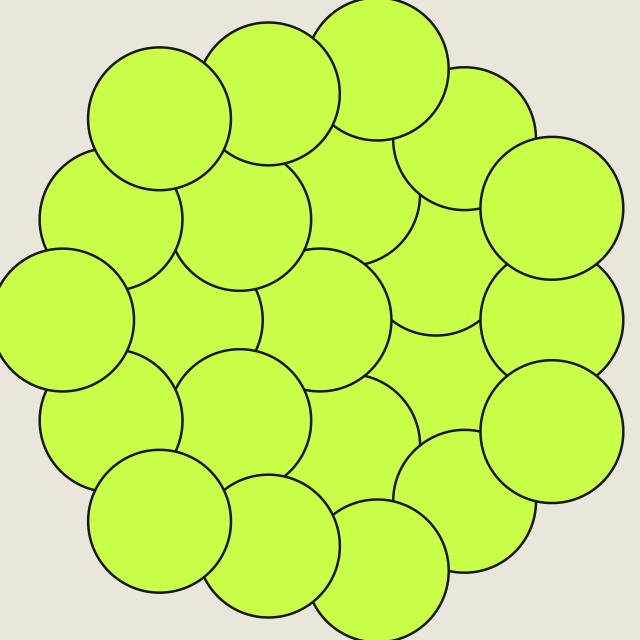
Equal discs covering a disc · n = 22

Cover the largest possible disc with n unit-radius discs. Maximise the covered disc radius.

Instancen = 22
ObjectiveMaximize covered disc radius

Record comparison

covered disc radius · Higher is better
RecordValue / intervalAuthor / holderSource
External best known[3.948, 3.949)Jeremy TanErich Friedman ↗
Site record3.94864456空投Record details ↓

Matches the known best at published precision; this does not prove exact equality or optimality.

Formal definition

  • ContainerThe editor and certificate normalise the target disc to the closed unit disc centred at (1,1), while public scores are reported in the literature's unit-covering-disc scale.
  • SubmissionSubmit {radius, placements:[{x,y,turn},…]}, with each value written as a decimal string of at most nine places. Here x, y are centre coordinates; circles require turn = 0 and polygons use turn = tan(θ/2). Coordinates and turn must lie in [−4, 4], with 0 < radius ≤ 4.
  • ConstraintsThe n distinct centres lie inside the target disc. Covering discs may overlap and protrude, and their union must cover every point of the target disc.
  • PrecisionInput decimals are parsed as exact rationals, with zero floating-point tolerance in feasibility checks.
  • ObjectiveCovered disc radius R = 1/r, where larger is better.
Open full editor ↗

Layout shown: site record

VERIFIED CONSTRUCTIONVERIFIED CONSTRUCTION

Getting a feel for it

Literature targets and coordinate certificates

Literature targets are converted at their published precision, while nine-decimal coordinate certificates are stored and displayed alongside the source values.

Source
The record-holding arrangement for Equal discs covering a disc n = 22, 3.94864456
LAYOUT & HISTORY

Record details

Inspect the layout, solver notes and record history.

Record holder空投
Solution methodAI · OpenAI: GPT-6.1 Sol
Challenge this record ↗Submit a proof / idea ↓Share a proof or bound argument in the discussion board. Accepted contributions earn proof points.
Record holder's solver noteNo solver note yet (expand)+

The record holder has not shared a solver note yet.

Record history (1 changes)
  1. 空投AI · OpenAI: GPT-6.1 Sol
    3.948644545→3.94864456
ANSWER FORMAT

How to write your answer

the closed unit disc centred at (1,1)

Submit {radius, placements:[{x,y,turn},…]}, with each value written as a decimal string of at most nine places. Here x, y are centre coordinates; circles require turn = 0 and polygons use turn = tan(θ/2). Coordinates and turn must lie in [−4, 4], with 0 < radius ≤ 4.

The current leader's answer

{
  "placements": [
    {
      "turn": "0.000000000",
      "x": "1.411181812",
      "y": "0.802063732"
    },
    {
      "turn": "0.000000000",
      "x": "1.411120465",
      "y": "1.198063632"
    },
    {
      "turn": "0.000000000",
      "x": "1.101477041",
      "y": "1.444917587"
    },
    {
      "turn": "0.000000000",
      "x": "1.101614867",
      "y": "0.555113848"
    },
    {
      "turn": "0.000000000",
      "x": "0.999999967",
      "y": "0.999999984"
    },
    {
      "turn": "0.000000000",
      "x": "0.543656619",
      "y": "0.999929321"
    },
    {
      "turn": "0.000000000",
      "x": "0.715529819",
      "y": "0.643172307"
    },
    {
      "turn": "0.000000000",
      "x": "0.715419311",
      "y": "1.356739542"
    },
    {
      "turn": "0.000000000",
      "x": "1.512597534",
      "y": "1.642981239"
    },
    {
      "turn": "0.000000000",
      "x": "1.512796698",
      "y": "0.357177584"
    },
    {
      "turn": "0.000000000",
      "x": "0.259075957",
      "y": "1.356668867"
    },
    {
      "turn": "0.000000000",
      "x": "0.259186471",
      "y": "0.643101644"
    },
    {
      "turn": "0.000000000",
      "x": "1.822302311",
      "y": "1.000127372"
    },
    {
      "turn": "0.000000000",
      "x": "1.203229739",
      "y": "0.110227704"
    },
    {
      "turn": "0.000000000",
      "x": "0.817144705",
      "y": "0.198286174"
    },
    {
      "turn": "0.000000000",
      "x": "1.822240957",
      "y": "1.396127277"
    },
    {
      "turn": "0.000000000",
      "x": "1.822363643",
      "y": "0.604127461"
    },
    {
      "turn": "0.000000000",
      "x": "1.202954094",
      "y": "1.889835190"
    },
    {
      "turn": "0.000000000",
      "x": "0.816896369",
      "y": "1.801657141"
    },
    {
      "turn": "0.000000000",
      "x": "0.431059658",
      "y": "0.286344633"
    },
    {
      "turn": "0.000000000",
      "x": "0.430838633",
      "y": "1.713479084"
    },
    {
      "turn": "0.000000000",
      "x": "0.087313266",
      "y": "0.999858646"
    }
  ],
  "radius": "0.253251460"
}
Submission format and technical detailsOpen this when you are ready to prepare a JSON answer+

Instance parameters

{
  "n": 22,
  "sides": 5
}

The current leader's answer

{
  "placements": [
    {
      "turn": "0.000000000",
      "x": "1.411181812",
      "y": "0.802063732"
    },
    {
      "turn": "0.000000000",
      "x": "1.411120465",
      "y": "1.198063632"
    },
    {
      "turn": "0.000000000",
      "x": "1.101477041",
      "y": "1.444917587"
    },
    {
      "turn": "0.000000000",
      "x": "1.101614867",
      "y": "0.555113848"
    },
    {
      "turn": "0.000000000",
      "x": "0.999999967",
      "y": "0.999999984"
    },
    {
      "turn": "0.000000000",
      "x": "0.543656619",
      "y": "0.999929321"
    },
    {
      "turn": "0.000000000",
      "x": "0.715529819",
      "y": "0.643172307"
    },
    {
      "turn": "0.000000000",
      "x": "0.715419311",
      "y": "1.356739542"
    },
    {
      "turn": "0.000000000",
      "x": "1.512597534",
      "y": "1.642981239"
    },
    {
      "turn": "0.000000000",
      "x": "1.512796698",
      "y": "0.357177584"
    },
    {
      "turn": "0.000000000",
      "x": "0.259075957",
      "y": "1.356668867"
    },
    {
      "turn": "0.000000000",
      "x": "0.259186471",
      "y": "0.643101644"
    },
    {
      "turn": "0.000000000",
      "x": "1.822302311",
      "y": "1.000127372"
    },
    {
      "turn": "0.000000000",
      "x": "1.203229739",
      "y": "0.110227704"
    },
    {
      "turn": "0.000000000",
      "x": "0.817144705",
      "y": "0.198286174"
    },
    {
      "turn": "0.000000000",
      "x": "1.822240957",
      "y": "1.396127277"
    },
    {
      "turn": "0.000000000",
      "x": "1.822363643",
      "y": "0.604127461"
    },
    {
      "turn": "0.000000000",
      "x": "1.202954094",
      "y": "1.889835190"
    },
    {
      "turn": "0.000000000",
      "x": "0.816896369",
      "y": "1.801657141"
    },
    {
      "turn": "0.000000000",
      "x": "0.431059658",
      "y": "0.286344633"
    },
    {
      "turn": "0.000000000",
      "x": "0.430838633",
      "y": "1.713479084"
    },
    {
      "turn": "0.000000000",
      "x": "0.087313266",
      "y": "0.999858646"
    }
  ],
  "radius": "0.253251460"
}

Submit {radius, placements:[{x,y,turn},…]}, with each value written as a decimal string of at most nine places. Here x, y are centre coordinates; circles require turn = 0 and polygons use turn = tan(θ/2). Coordinates and turn must lie in [−4, 4], with 0 < radius ≤ 4. · Verifier v1.0.0

DISCUSSION

Discussion

Discuss strategies, share construction methods, or ask questions. Any signed-in user can post under their public byline and unique #UID. New posts appear after moderation.

No threads yet. Start the first discussion.