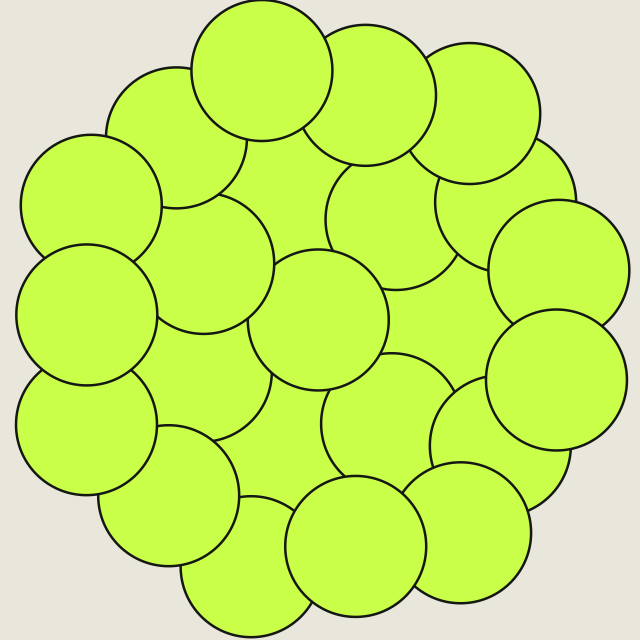
Equal discs covering a disc · n = 23
Cover the largest possible disc with n unit-radius discs. Maximise the covered disc radius.
Instancen = 23
ObjectiveMaximize covered disc radius
Best known, unproven4.000Source-precision interval: 4–4.001 (values inside match)exhibited site certificate 4.000739688Compiled by Erich Friedman; n=23 Found by Jeremy Tan in 2018. Source expression: r = 4.000+.
Formal definition
- ContainerThe editor and certificate normalize to the closed unit disc centred at (1,1). This is a coordinate convention only; scores use the literature's unit-piece scale. Boundary contact is allowed.
- SubmissionSubmit {radius, placements:[{x,y,turn},…]}, with decimal strings of at most nine places. x,y are centres; circles require turn=0, polygons use turn=tan(θ/2). Coordinates and turn lie in ±4; 0 < radius ≤ 4.
- ConstraintsThe n distinct centres lie in the target disc. Covering discs may overlap and protrude, but must cover every target point.
- PrecisionInput decimals are exact rationals; regular-polygon vertices are algebraic, not rounded templates. Feasibility has no floating-point tolerance. A finite-decimal certificate is not a continuous optimality proof.
- ObjectiveCovered disc radius R = 1/r, larger is better.