P94 · Packing and covering · Classic

Sum of radii in the regular pentagon · n = 1

Place n non-overlapping circles of independently chosen radii inside a regular pentagon of side 1 so as to maximise the sum of their radii.

Instancen = 1
ObjectiveMaximize the sum of the radii

Record comparison

the sum of the radii · Higher is better
RecordValue / intervalAuthor / holderSource
Proven optimum√(25 + 10√5)/10zzzcy #3082026-10-27MinMax Arena ↗
Site recordNo player record yet——

The continuous optimum is proved, so competition submissions are closed. Historical records and contribution points are retained. Because finite-decimal coordinates cannot attain this value exactly, the current certificate is not claimed optimal on the nine-decimal grid.

Formal definition

  • ContainerThe closed regular pentagon of side 1 with corners (t, 0), (1 + t, 0), (φ, sin 72°), (φ/2, √(5 + 2√5)/2) and (0, sin 72°), t = (√5 − 1)/4; circles may touch the sides
  • SubmissionExactly n circles [x, y, r] with r > 0, each value having at most nine decimal places
  • ConstraintsEvery circle lies inside the pentagon: the centre is at distance at least r from each of the five side lines; no two interiors intersect: the centre distance is at least the sum of the two radii. The side equations involve √5 and √(10 + 2√5) and are decided by an exact sign test in that number field, with tangency allowed
  • ScoreThe sum of the radii, computed as an exact integer sum and displayed to nine decimal places; larger is betterS=Σr
  • ObjectiveMaximise the sum of the radii over all valid arrangementsmaxSΣr
Read the optimality proof ↗

Layout shown: starter layout

1.538841769y0
0x1.618033989
VERIFIED CONSTRUCTIONscored by the sum of the radii

Getting a feel for it

The incircle and five 108° corners

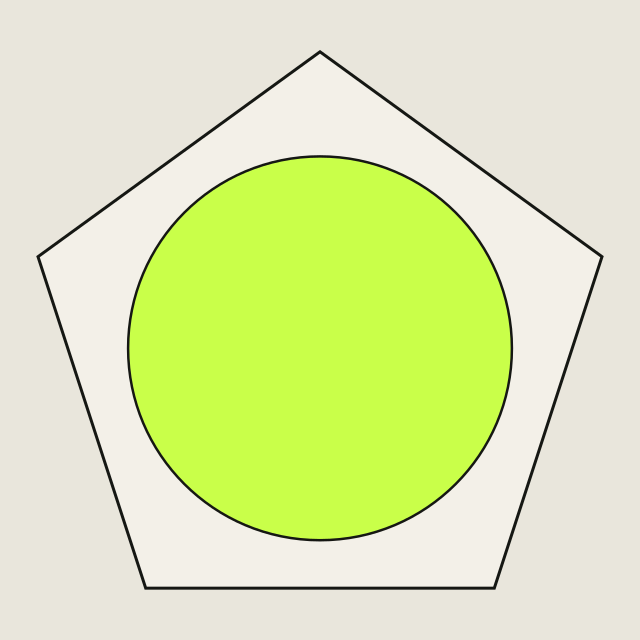
One circle can be at most the incircle, of radius cot(π/5)/2 ≈ 0.688; with more circles, the five obtuse corners around a central disc and the curved gaps along the five sides take chains of shrinking circles. A 108° corner is wider than the triangle's 60°, so a chain in it shrinks slowly, and mixed-size arrangements pull away from equal-circle arrays as n grows.

Literature records

Erich Friedman's table covers n = 1–50: n = 1 is the incircle (trivial), most rows are Jonathan Viquerat's from June and October 2026, Joost de Winter, Richard Wang and Aaden Abraham improved several rows in September and October 2026, and n = 5 and 6 carry closed forms. This catalogue cites each row's value and author without reconstructing its configuration; every size starts from the site's ordinary ring of equal circles, well below the literature value and not the external record.

Source
The current arrangement for Sum of radii in the regular pentagon n = 1
LAYOUT & HISTORY

Starter layout

Inspect the layout, solver notes and record history.

Proven optimumSubmit a proof / idea ↓Share a proof or bound argument in the discussion board. Accepted contributions earn proof points.Read the published proof ↗
ANSWER FORMAT

How to write your answer

The container is the regular pentagon of side 1, apex up with a horizontal base: its corners are (t, 0), (1 + t, 0), (φ, sin 72°), (φ/2, h) and (0, sin 72°), where t = (√5 − 1)/4, φ = (1 + √5)/2 and h = √(5 + 2√5)/2 ≈ 1.538842. Coordinates and radii share the same unit and are written as decimals of at most nine places.

Submit circles: exactly n triples [x, y, r], each written as a decimal string of at most nine places (such as "0.25"). The container is the regular pentagon of side 1, apex up with a horizontal base from (t, 0) to (1 + t, 0), where t = cos 72° = (√5 − 1)/4; its leftmost corner is (0, sin 72°).

Starter answer

{
  "circles": [
    [
      "0.809016994",
      "0.688190960",
      "0.550552768"
    ]
  ]
}
Submission format and technical detailsOpen this when you are ready to prepare a JSON answer+

Instance parameters

{
  "n": 1
}

Starter answer

{
  "circles": [
    [
      "0.809016994",
      "0.688190960",
      "0.550552768"
    ]
  ]
}

Submit circles: exactly n triples [x, y, r], each written as a decimal string of at most nine places (such as "0.25"). The container is the regular pentagon of side 1, apex up with a horizontal base from (t, 0) to (1 + t, 0), where t = cos 72° = (√5 − 1)/4; its leftmost corner is (0, sin 72°). · Verifier v1.0.0

DISCUSSION

Discussion

Discuss strategies, share construction methods, or ask questions. Any signed-in user can post under their public byline and unique #UID. New posts appear after moderation.