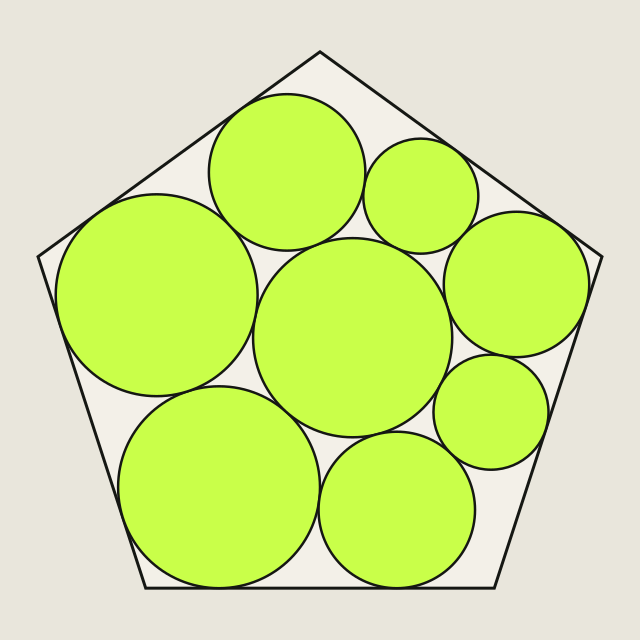
Sum of radii in the regular pentagon · n = 8
Place n non-overlapping circles of independently chosen radii inside a regular pentagon of side 1 so as to maximise the sum of their radii.
Instancen = 8
ObjectiveMaximize the sum of the radii
Record comparison
the sum of the radii · Higher is better| Record | Value / interval | Author / holder | Source |
|---|---|---|---|
| Proven optimum | [1.852488899111271345913487762578, 1.852488899111271345913487762579] | zzzcy #3082026-10-27 | MinMax Arena ↗ |
| Site record | 1.852488896 | zzzcy | Record details ↓ |
The continuous optimum is proved, so competition submissions are closed. Historical records and contribution points are retained. Because finite-decimal coordinates cannot attain this value exactly, the current certificate is not claimed optimal on the nine-decimal grid.
Formal definition
- ContainerThe closed regular pentagon of side 1 with corners (t, 0), (1 + t, 0), (φ, sin 72°), (φ/2, √(5 + 2√5)/2) and (0, sin 72°), t = (√5 − 1)/4; circles may touch the sides
- SubmissionExactly n circles [x, y, r] with r > 0, each value having at most nine decimal places
- ConstraintsEvery circle lies inside the pentagon: the centre is at distance at least r from each of the five side lines; no two interiors intersect: the centre distance is at least the sum of the two radii. The side equations involve √5 and √(10 + 2√5) and are decided by an exact sign test in that number field, with tangency allowed
- ScoreThe sum of the radii, computed as an exact integer sum and displayed to nine decimal places; larger is better
- ObjectiveMaximise the sum of the radii over all valid arrangements