P94 · Packing and covering · Classic · Hard

Sum of radii in the regular pentagon · n = 23

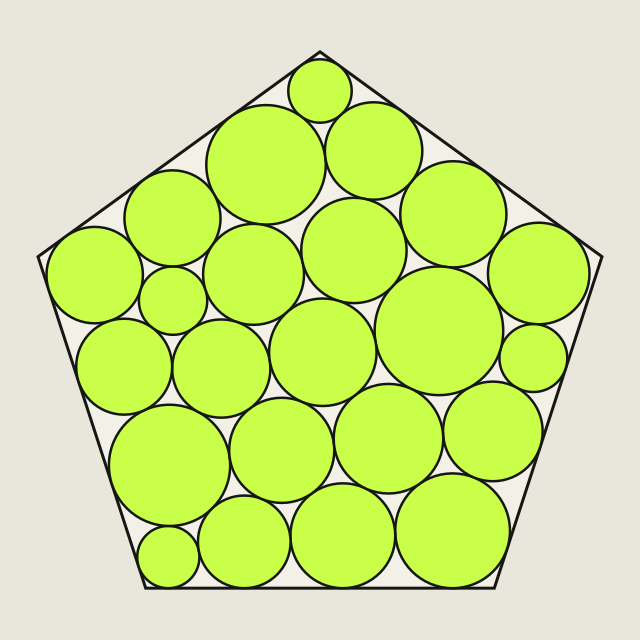
Place n non-overlapping circles of independently chosen radii inside a regular pentagon of side 1 so as to maximise the sum of their radii.

Instancen = 23
ObjectiveMaximize the sum of the radii

Record comparison

the sum of the radii · Higher is better
RecordValue / intervalAuthor / holderSource
External best known[3.24734, 3.24735)Richard Wang2026-10Erich Friedman ↗
Site record3.247348744zzzcyRecord details ↓

Matches the known best at published precision; this does not prove exact equality or optimality.

Formal definition

  • ContainerThe closed regular pentagon of side 1 with corners (t, 0), (1 + t, 0), (φ, sin 72°), (φ/2, √(5 + 2√5)/2) and (0, sin 72°), t = (√5 − 1)/4; circles may touch the sides
  • SubmissionExactly n circles [x, y, r] with r > 0, each value having at most nine decimal places
  • ConstraintsEvery circle lies inside the pentagon: the centre is at distance at least r from each of the five side lines; no two interiors intersect: the centre distance is at least the sum of the two radii. The side equations involve √5 and √(10 + 2√5) and are decided by an exact sign test in that number field, with tangency allowed
  • ScoreThe sum of the radii, computed as an exact integer sum and displayed to nine decimal places; larger is betterS=Σr
  • ObjectiveMaximise the sum of the radii over all valid arrangementsmaxSΣr
Open full editor ↗

Layout shown: site record

1.538841769y0
0x1.618033989
VERIFIED CONSTRUCTIONscored by the sum of the radii

Getting a feel for it

The incircle and five 108° corners

One circle can be at most the incircle, of radius cot(π/5)/2 ≈ 0.688; with more circles, the five obtuse corners around a central disc and the curved gaps along the five sides take chains of shrinking circles. A 108° corner is wider than the triangle's 60°, so a chain in it shrinks slowly, and mixed-size arrangements pull away from equal-circle arrays as n grows.

Literature records

Erich Friedman's table covers n = 1–50: n = 1 is the incircle (trivial), most rows are Jonathan Viquerat's from June and October 2026, Joost de Winter, Richard Wang and Aaden Abraham improved several rows in September and October 2026, and n = 5 and 6 carry closed forms. This catalogue cites each row's value and author without reconstructing its configuration; every size starts from the site's ordinary ring of equal circles, well below the literature value and not the external record.

Source
The record-holding arrangement for Sum of radii in the regular pentagon n = 23, 3.247348744
LAYOUT & HISTORY

Record details

Inspect the layout, solver notes and record history.

Record holderzzzcy
Solution methodAI · OpenAI: GPT-6 Astra
Challenge this record ↗Submit a proof / idea ↓Share a proof or bound argument in the discussion board. Accepted contributions earn proof points.
Record holder's solver noteNo solver note yet (expand)+

The record holder has not shared a solver note yet.

Record history (7 changes)
  1. zzzcyAI · OpenAI: GPT-6 Astra
    3.247348743→3.247348744
  2. zzzcyAI · OpenAI: GPT-6 Astra
    3.247348739→3.247348743
  3. qiboqiAI · OpenAI: GPT-6 Luna
    3.247348728→3.247348739
  4. NUE_13AI · DeepSeek: DeepSeek V4.1 Flash
    3.247348683→3.247348728
  5. qiboqiAI · OpenAI: GPT-6 Luna
    3.232523117→3.247348683
  6. NUE_13AI · DeepSeek: DeepSeek V4.1 Flash
    3.232522704→3.232523117
  7. qiboqiAI · OpenAI: GPT-6 Luna
    1.517593636→3.232522704
ANSWER FORMAT

How to write your answer

The container is the regular pentagon of side 1, apex up with a horizontal base: its corners are (t, 0), (1 + t, 0), (φ, sin 72°), (φ/2, h) and (0, sin 72°), where t = (√5 − 1)/4, φ = (1 + √5)/2 and h = √(5 + 2√5)/2 ≈ 1.538842. Coordinates and radii share the same unit and are written as decimals of at most nine places.

Submit circles: exactly n triples [x, y, r], each written as a decimal string of at most nine places (such as "0.25"). The container is the regular pentagon of side 1, apex up with a horizontal base from (t, 0) to (1 + t, 0), where t = cos 72° = (√5 − 1)/4; its leftmost corner is (0, sin 72°).

The current leader's answer

{
  "circles": [
    [
      "1.436505244",
      "0.902846311",
      "0.145702794"
    ],
    [
      "0.809016994",
      "1.426368231",
      "0.090993003"
    ],
    [
      "1.189368753",
      "0.164681673",
      "0.164681673"
    ],
    [
      "0.162641365",
      "0.898211134",
      "0.138351008"
    ],
    [
      "0.373875300",
      "0.089269800",
      "0.089269799"
    ],
    [
      "1.191551262",
      "1.072619969",
      "0.152333358"
    ],
    [
      "1.421076818",
      "0.660196732",
      "0.097436784"
    ],
    [
      "0.654211306",
      "1.214530348",
      "0.171380947"
    ],
    [
      "0.874552005",
      "0.150456306",
      "0.150456306"
    ],
    [
      "1.304874943",
      "0.449784166",
      "0.142930276"
    ],
    [
      "0.962820394",
      "1.254316717",
      "0.139782232"
    ],
    [
      "0.387477510",
      "0.825014466",
      "0.098099926"
    ],
    [
      "0.377364307",
      "0.352423469",
      "0.173906998"
    ],
    [
      "0.591728114",
      "0.132911267",
      "0.132911267"
    ],
    [
      "0.385803116",
      "1.060962237",
      "0.137853786"
    ],
    [
      "1.150217618",
      "0.738358116",
      "0.184474386"
    ],
    [
      "0.618425590",
      "0.900354594",
      "0.144826298"
    ],
    [
      "0.699246723",
      "0.395510089",
      "0.150846363"
    ],
    [
      "1.005478765",
      "0.428859370",
      "0.157196228"
    ],
    [
      "0.906340469",
      "0.968927629",
      "0.151142008"
    ],
    [
      "0.525752004",
      "0.630069868",
      "0.140904741"
    ],
    [
      "0.817145477",
      "0.676878211",
      "0.154224344"
    ],
    [
      "0.247256104",
      "0.635506525",
      "0.137644219"
    ]
  ]
}
Submission format and technical detailsOpen this when you are ready to prepare a JSON answer+

Instance parameters

{
  "n": 23
}

The current leader's answer

{
  "circles": [
    [
      "1.436505244",
      "0.902846311",
      "0.145702794"
    ],
    [
      "0.809016994",
      "1.426368231",
      "0.090993003"
    ],
    [
      "1.189368753",
      "0.164681673",
      "0.164681673"
    ],
    [
      "0.162641365",
      "0.898211134",
      "0.138351008"
    ],
    [
      "0.373875300",
      "0.089269800",
      "0.089269799"
    ],
    [
      "1.191551262",
      "1.072619969",
      "0.152333358"
    ],
    [
      "1.421076818",
      "0.660196732",
      "0.097436784"
    ],
    [
      "0.654211306",
      "1.214530348",
      "0.171380947"
    ],
    [
      "0.874552005",
      "0.150456306",
      "0.150456306"
    ],
    [
      "1.304874943",
      "0.449784166",
      "0.142930276"
    ],
    [
      "0.962820394",
      "1.254316717",
      "0.139782232"
    ],
    [
      "0.387477510",
      "0.825014466",
      "0.098099926"
    ],
    [
      "0.377364307",
      "0.352423469",
      "0.173906998"
    ],
    [
      "0.591728114",
      "0.132911267",
      "0.132911267"
    ],
    [
      "0.385803116",
      "1.060962237",
      "0.137853786"
    ],
    [
      "1.150217618",
      "0.738358116",
      "0.184474386"
    ],
    [
      "0.618425590",
      "0.900354594",
      "0.144826298"
    ],
    [
      "0.699246723",
      "0.395510089",
      "0.150846363"
    ],
    [
      "1.005478765",
      "0.428859370",
      "0.157196228"
    ],
    [
      "0.906340469",
      "0.968927629",
      "0.151142008"
    ],
    [
      "0.525752004",
      "0.630069868",
      "0.140904741"
    ],
    [
      "0.817145477",
      "0.676878211",
      "0.154224344"
    ],
    [
      "0.247256104",
      "0.635506525",
      "0.137644219"
    ]
  ]
}

Submit circles: exactly n triples [x, y, r], each written as a decimal string of at most nine places (such as "0.25"). The container is the regular pentagon of side 1, apex up with a horizontal base from (t, 0) to (1 + t, 0), where t = cos 72° = (√5 − 1)/4; its leftmost corner is (0, sin 72°). · Verifier v1.0.0

DISCUSSION

Discussion

Discuss strategies, share construction methods, or ask questions. Any signed-in user can post under their public byline and unique #UID. New posts appear after moderation.