P65 · Extremal configurations · Formed here · Applied frontier · Hard

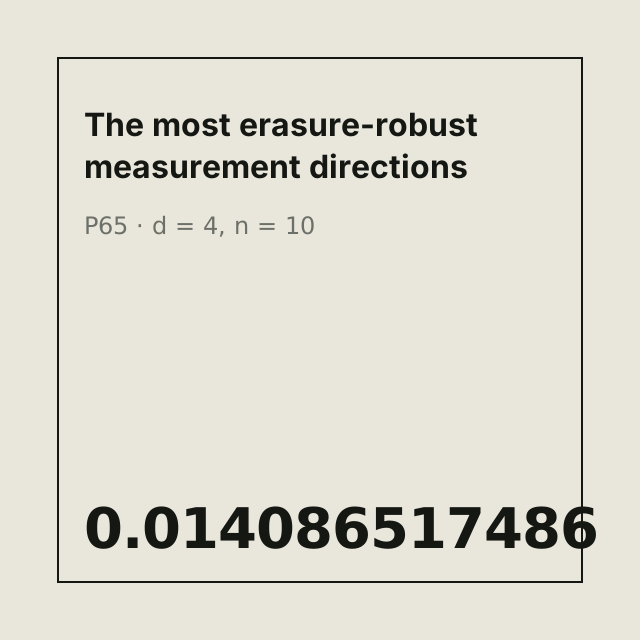
The most erasure-robust measurement directions · d = 4, n = 10

Also known asfull spark frameserasure-robust framesmaximally robust to erasuresnumerically erasure-robust frames

Choose n nonzero vectors in Rᵈ. For every subset of size d, take the squared determinant of the matrix with those vectors as columns, divided by the product of their squared norms; maximize the minimum of this normalized volume over all subsets. Zero means some d surviving measurements cannot recover the space at all.

Instanced = 4, n = 10
ObjectiveMaximize the worst subset's normalized volume

Record comparison

the worst subset's normalized volume · Higher is better
RecordValue / intervalAuthor / holderSource
External best known——No reference listed
Site record0.014086517486zzzcyRecord details ↓

Formal definition

  • ContainerReal d-space Rᵈ; an answer is n measurement directions
  • SubmissionExactly n nonzero vectors with d coordinates each
  • ScoreS ranges over all C(n,d) subsets of size d, and Vₛ is the d×d matrix whose columns are those vectors. V(P) is the worst subset's squared normalized determinant, compared directly in exact rational arithmetic by cross-multiplicationV(P)=minSdet(VS)2∏i|vi|2
  • WordingThis problem measures erasure robustness by the minimum squared normalized volume over all d-element subsets, capturing how far the worst surviving basis stays from degeneracy
  • ScoringThe record is stored as floor(min normalized volume · 10¹⁸); the page displays that value, rounded down at the twelfth decimal
  • ObjectiveMake V(P) as large as possible over all legal families of measurement directions PmaxPV(P)
Challenge this record ↗

Layout shown: site record

VERIFIED CONSTRUCTIONpairwise inner-product heatmap of 10 directions (brighter = closer)

Getting a feel for it

What it defends against

Redundant measurements allow a signal to be recovered even after several channels are lost. While a full-spark frame only requires every subset of d vectors to be linearly independent, this problem asks for the worst d-element subset to span as large a normalized volume as possible so that reconstruction stays well-conditioned. This arises in sparse signal processing, erasure-resistant transmission, and phase retrieval.

Where the frontier is

Existence and constructions of full-spark frames are well studied, but maximizing the worst-subset normalized volume for fixed (n, d) has no published table of optima. In October 2026, a computer-assisted proof by zzzcy verified by the site settled the continuous optima for d = 3 with n = 6, 10 and d = 4 with n = 8, as well as the optimal nine-decimal grid score for d = 3, n = 8; the remaining cases are open.

Source
The record-holding arrangement for The most erasure-robust measurement directions d = 4, n = 10, 0.014086517486
LAYOUT & HISTORY

Record details

Inspect the layout, solver notes and record history.

Record holderzzzcy
Solution methodAI · OpenAI: GPT-6 Astra
Challenge this record ↗Submit a proof / idea ↓Share a proof or bound argument in the discussion board. Accepted contributions earn proof points.
Record holder's solver noteNo solver note yet (expand)+

The record holder has not shared a solver note yet.

Record history (5 changes)
  1. zzzcyAI · OpenAI: GPT-6 Astra
    0.011106294818→0.014086517486
  2. Sigmoid with CodexAI · OpenAI: GPT-5.6 Sol
    0.010962628263→0.011106294818
  3. TmrgAI · Z.ai: GLM 5.3
    0.010509363488→0.010962628263
  4. TmrgAI · Z.ai: GLM 5.3
    0.01044222275→0.010509363488
  5. TmrgAI · Z.ai: GLM 5.3
    0.0000000003→0.01044222275
ANSWER FORMAT

How to write your answer

Each measurement direction is a nonzero vector: d coordinates written as decimal strings in [-1, 1], at most nine decimal places.

Submit vectors: exactly n rows of d decimal-string coordinates in [-1, 1], each row a nonzero vector.

The current leader's answer

{
  "vectors": [
    [
      "0.435214013",
      "-0.277612204",
      "0.010169096",
      "0.145731618"
    ],
    [
      "0.000685662",
      "0.290559427",
      "0.832527682",
      "-0.068808401"
    ],
    [
      "0.947642664",
      "0.779485300",
      "-0.219990303",
      "-0.265156813"
    ],
    [
      "0.182584017",
      "-0.061222930",
      "0.418464832",
      "-0.359603009"
    ],
    [
      "-0.339377034",
      "0.862491891",
      "0.253414609",
      "0.062130434"
    ],
    [
      "0.170154190",
      "0.233404213",
      "-0.189645332",
      "0.803683617"
    ],
    [
      "0.378408868",
      "0.022740176",
      "0.099448709",
      "-0.039580719"
    ],
    [
      "0.165753739",
      "-0.231212821",
      "0.315952510",
      "0.755726304"
    ],
    [
      "0.199590585",
      "0.769842440",
      "-0.118048138",
      "0.188792375"
    ],
    [
      "-0.364165821",
      "-0.115801989",
      "0.932216129",
      "0.566937578"
    ]
  ]
}
Submission format and technical detailsOpen this when you are ready to prepare a JSON answer+

Instance parameters

{
  "n": 10,
  "d": 4
}

The current leader's answer

{
  "vectors": [
    [
      "0.435214013",
      "-0.277612204",
      "0.010169096",
      "0.145731618"
    ],
    [
      "0.000685662",
      "0.290559427",
      "0.832527682",
      "-0.068808401"
    ],
    [
      "0.947642664",
      "0.779485300",
      "-0.219990303",
      "-0.265156813"
    ],
    [
      "0.182584017",
      "-0.061222930",
      "0.418464832",
      "-0.359603009"
    ],
    [
      "-0.339377034",
      "0.862491891",
      "0.253414609",
      "0.062130434"
    ],
    [
      "0.170154190",
      "0.233404213",
      "-0.189645332",
      "0.803683617"
    ],
    [
      "0.378408868",
      "0.022740176",
      "0.099448709",
      "-0.039580719"
    ],
    [
      "0.165753739",
      "-0.231212821",
      "0.315952510",
      "0.755726304"
    ],
    [
      "0.199590585",
      "0.769842440",
      "-0.118048138",
      "0.188792375"
    ],
    [
      "-0.364165821",
      "-0.115801989",
      "0.932216129",
      "0.566937578"
    ]
  ]
}

Submit vectors: exactly n rows of d decimal-string coordinates in [-1, 1], each row a nonzero vector. · Verifier v1.0.0

DISCUSSION

Discussion

Discuss strategies, share construction methods, or ask questions. Any signed-in user can post under their public byline and unique #UID. New posts appear after moderation.

No threads yet. Start the first discussion.