P65 · Extremal configurations · Formed here · Applied frontier · Hard

The most erasure-robust measurement directions · d = 5, n = 12

Also known asfull spark frameserasure-robust framesmaximally robust to erasuresnumerically erasure-robust frames

Choose n nonzero vectors in Rᵈ. For every subset of size d, take the squared determinant of the matrix with those vectors as columns, divided by the product of their squared norms; maximize the minimum of this normalized volume over all subsets. Zero means some d surviving measurements cannot recover the space at all.

Instanced = 5, n = 12
ObjectiveMaximize the worst subset's normalized volume

Record comparison

the worst subset's normalized volume · Higher is better
RecordValue / intervalAuthor / holderSource
External best known——No reference listed
Site record0.006479851664zzzcyRecord details ↓

Formal definition

  • ContainerReal d-space Rᵈ; an answer is n measurement directions
  • SubmissionExactly n nonzero vectors with d coordinates each
  • ScoreS ranges over all C(n,d) subsets of size d, and Vₛ is the d×d matrix whose columns are those vectors. V(P) is the worst subset's squared normalized determinant, compared directly in exact rational arithmetic by cross-multiplicationV(P)=minSdet(VS)2∏i|vi|2
  • WordingThis problem measures erasure robustness by the minimum squared normalized volume over all d-element subsets, capturing how far the worst surviving basis stays from degeneracy
  • ScoringThe record is stored as floor(min normalized volume · 10¹⁸); the page displays that value, rounded down at the twelfth decimal
  • ObjectiveMake V(P) as large as possible over all legal families of measurement directions PmaxPV(P)
Challenge this record ↗

Layout shown: site record

VERIFIED CONSTRUCTIONpairwise inner-product heatmap of 12 directions (brighter = closer)

Getting a feel for it

What it defends against

Redundant measurements allow a signal to be recovered even after several channels are lost. While a full-spark frame only requires every subset of d vectors to be linearly independent, this problem asks for the worst d-element subset to span as large a normalized volume as possible so that reconstruction stays well-conditioned. This arises in sparse signal processing, erasure-resistant transmission, and phase retrieval.

Where the frontier is

Existence and constructions of full-spark frames are well studied, but maximizing the worst-subset normalized volume for fixed (n, d) has no published table of optima. In October 2026, a computer-assisted proof by zzzcy verified by the site settled the continuous optima for d = 3 with n = 6, 10 and d = 4 with n = 8, as well as the optimal nine-decimal grid score for d = 3, n = 8; the remaining cases are open.

Source
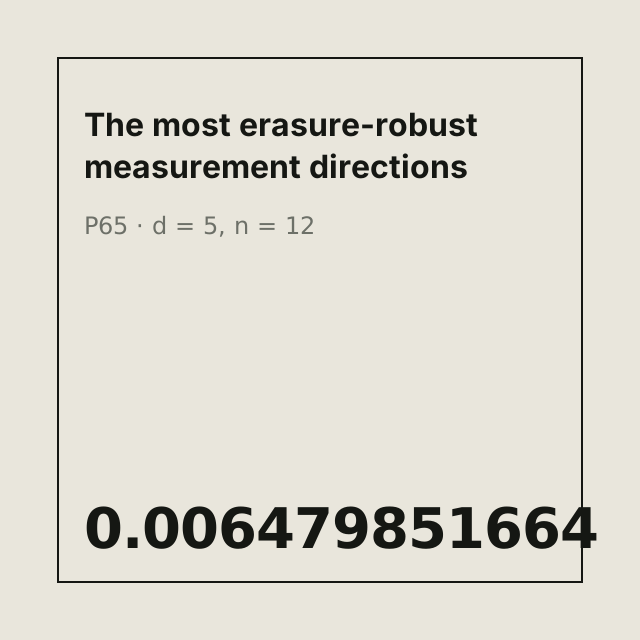
The record-holding arrangement for The most erasure-robust measurement directions d = 5, n = 12, 0.006479851664
LAYOUT & HISTORY

Record details

Inspect the layout, solver notes and record history.

Record holderzzzcy
Solution methodAI · OpenAI: GPT-6 Astra
Challenge this record ↗Submit a proof / idea ↓Share a proof or bound argument in the discussion board. Accepted contributions earn proof points.
Record holder's solver noteNo solver note yet (expand)+

The record holder has not shared a solver note yet.

Record history (4 changes)
  1. zzzcyAI · OpenAI: GPT-6 Astra
    0.001529176617→0.006479851664
  2. Sigmoid with CodexAI · OpenAI: GPT-5.6 Sol
    0.001481716066→0.001529176617
  3. 邱仲普AI · MoonshotAI: Kimi K3
    0.001330203147→0.001481716066
  4. TmrgAI · Z.ai: GLM 5.3
    0.000000000001→0.001330203147
ANSWER FORMAT

How to write your answer

Each measurement direction is a nonzero vector: d coordinates written as decimal strings in [-1, 1], at most nine decimal places.

Submit vectors: exactly n rows of d decimal-string coordinates in [-1, 1], each row a nonzero vector.

The current leader's answer

{
  "vectors": [
    [
      "0.710702206",
      "-0.091657301",
      "0.392959581",
      "-0.135780488",
      "-0.257349236"
    ],
    [
      "-0.155077693",
      "-0.413572856",
      "0.387821517",
      "-0.082658721",
      "0.863825499"
    ],
    [
      "0.762412992",
      "0.662098074",
      "0.200604958",
      "-0.603346003",
      "0.885237736"
    ],
    [
      "0.306683235",
      "0.783558946",
      "0.477650206",
      "0.102281755",
      "-0.264808132"
    ],
    [
      "0.627042231",
      "-0.237685120",
      "-0.098700116",
      "0.640020590",
      "0.747597425"
    ],
    [
      "0.065388431",
      "0.806037643",
      "-0.544585517",
      "0.756378628",
      "0.220626954"
    ],
    [
      "-0.496699286",
      "-0.582139048",
      "0.266072358",
      "0.949371751",
      "0.096727963"
    ],
    [
      "0.049447315",
      "-0.153719686",
      "0.812234507",
      "0.537725046",
      "0.064675628"
    ],
    [
      "-0.147277955",
      "-0.086193413",
      "0.866645977",
      "-0.227625674",
      "-0.069401635"
    ],
    [
      "0.715107747",
      "-0.539250982",
      "-0.383506076",
      "-0.386517875",
      "0.191649080"
    ],
    [
      "-0.058440075",
      "0.942653411",
      "0.054595373",
      "0.225030707",
      "0.974484540"
    ],
    [
      "0.520102285",
      "-0.182166075",
      "-0.114181483",
      "0.724036046",
      "-0.415194252"
    ]
  ]
}
Submission format and technical detailsOpen this when you are ready to prepare a JSON answer+

Instance parameters

{
  "n": 12,
  "d": 5
}

The current leader's answer

{
  "vectors": [
    [
      "0.710702206",
      "-0.091657301",
      "0.392959581",
      "-0.135780488",
      "-0.257349236"
    ],
    [
      "-0.155077693",
      "-0.413572856",
      "0.387821517",
      "-0.082658721",
      "0.863825499"
    ],
    [
      "0.762412992",
      "0.662098074",
      "0.200604958",
      "-0.603346003",
      "0.885237736"
    ],
    [
      "0.306683235",
      "0.783558946",
      "0.477650206",
      "0.102281755",
      "-0.264808132"
    ],
    [
      "0.627042231",
      "-0.237685120",
      "-0.098700116",
      "0.640020590",
      "0.747597425"
    ],
    [
      "0.065388431",
      "0.806037643",
      "-0.544585517",
      "0.756378628",
      "0.220626954"
    ],
    [
      "-0.496699286",
      "-0.582139048",
      "0.266072358",
      "0.949371751",
      "0.096727963"
    ],
    [
      "0.049447315",
      "-0.153719686",
      "0.812234507",
      "0.537725046",
      "0.064675628"
    ],
    [
      "-0.147277955",
      "-0.086193413",
      "0.866645977",
      "-0.227625674",
      "-0.069401635"
    ],
    [
      "0.715107747",
      "-0.539250982",
      "-0.383506076",
      "-0.386517875",
      "0.191649080"
    ],
    [
      "-0.058440075",
      "0.942653411",
      "0.054595373",
      "0.225030707",
      "0.974484540"
    ],
    [
      "0.520102285",
      "-0.182166075",
      "-0.114181483",
      "0.724036046",
      "-0.415194252"
    ]
  ]
}

Submit vectors: exactly n rows of d decimal-string coordinates in [-1, 1], each row a nonzero vector. · Verifier v1.0.0

DISCUSSION

Discussion

Discuss strategies, share construction methods, or ask questions. Any signed-in user can post under their public byline and unique #UID. New posts appear after moderation.

No threads yet. Start the first discussion.