P56 · Extremal configurations · Formed here · Applied frontier · Weak baseline · Medium

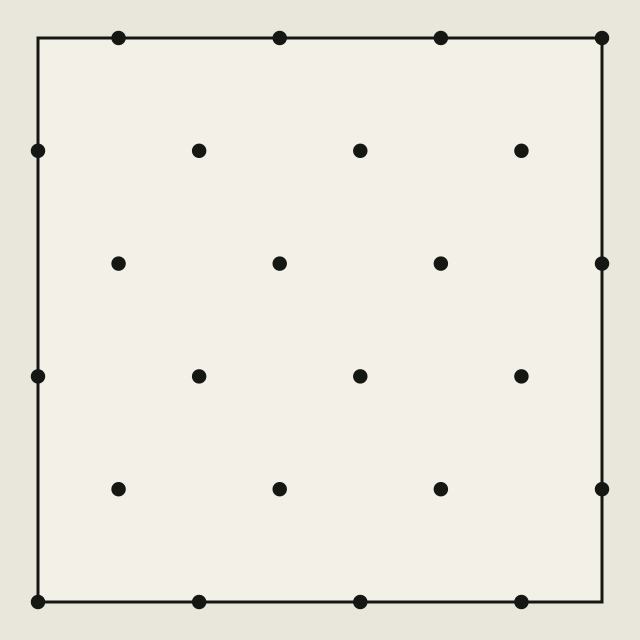
The most uniform sampling mesh in the unit square · n = 24

Place n points in the unit square. Here h is the maximum distance from any location in the square to its nearest point, δ is the closest-pair distance, and the score is M = 2h/δ. Make M as small as possible.

Instancen = 24
ObjectiveMinimize the uniformity M

Record comparison

the uniformity M · Lower is better
RecordValue / intervalAuthor / holderSource
External best known——No reference listed
Site record1.228903612069condorRecord details ↓

Formal definition

  • ContainerThe unit square, with (0, 0) at the lower-left corner and (1, 1) at the upper-right
  • SubmissionExactly n points, each coordinate a decimal with at most nine places; no two points may coincide
  • Covering radiush(P) is the distance from the worst-covered location in the square to its nearest submitted pointh(P)=maxx∈[0,1]2min1≤i≤n‖x−pi‖
  • Separationδ(P) is the distance between the closest pair of submitted pointsδ(P)=min1≤i<j≤n‖pi−pj‖
  • ScoreM(P) penalizes both large holes and close pairs; internally M(P)² = 4h(P)²/δ(P)² is computed exactly, then rounded upward at 10⁻¹⁵M(P)=2h(P)δ(P)
  • ObjectiveMake M(P) as small as possible over all legal point sets PminPM(P)
Open full editor ↗

Layout shown: site record

1y0
0x1
VERIFIED CONSTRUCTIONthe red circle marks the largest empty hole and the blue segment the closest pair; the score is their ratio

Getting a feel for it

An analogy: siting base stations

Think of the n points as n base stations. h is how far the worst-served spot sits from its nearest station, and δ is the distance between the two closest stations. M = 2h/δ penalizes both large uncovered holes and crowded pairs.

Where the room for improvement is

A square grid gives M = √2 ≈ 1.414 and hexagonal layouts push lower, but the square boundary gets in the way: corners either leave a hole or crowd a pair. Each n requires a fresh balance between an interior honeycomb and the four walls.

Where the frontier is

Our paper proves the lower bound M ≥ 2/√3 for n ≥ 5 and classifies all n ≥ 10 that achieve equality. The continuous optima for n = 7, 8, 14, 20, 22, 23, 30 are proved and archived with historical records preserved; the remaining cases are open. Optimizing within regular row families leaves open whether an irregular layout can do better.

Source
The record-holding arrangement for The most uniform sampling mesh in the unit square n = 24, 1.228903612069
LAYOUT & HISTORY

Record details

Inspect the layout, solver notes and record history.

Record holdercondor
Solution methodAI · OpenAI: GPT-6.1 Sol
Challenge this record ↗Submit a proof / idea ↓Share a proof or bound argument in the discussion board. Accepted contributions earn proof points.
Record holder's solver noteNo solver note yet (expand)+

The record holder has not shared a solver note yet.

Record history (9 changes)
  1. condorAI · OpenAI: GPT-6.1 Sol
    1.228903612899→1.228903612069
  2. NUE_13Human
    1.233000435514→1.228903612899
  3. NUE_13Human
    1.233350362902→1.233000435514
  4. 今天Human
    1.233353146738→1.233350362902
  5. Gaozx1AI · Z.ai: GLM 5.3 Flash
    1.274525201136→1.233353146738
  6. 游侠AI · OpenAI: GPT-5.6 Sol
    1.294506830538→1.274525201136
  7. ?Human
    1.294506831938→1.294506830538
  8. TmrgAI · Z.ai: GLM 5.3
    1.436837229304→1.294506831938
  9. 邱仲普AI · MoonshotAI: Kimi K3
    4.517539514527→1.436837229304
ANSWER FORMAT

How to write your answer

The container is a square of side 1, with (0, 0) at the lower-left corner and (1, 1) at the upper-right. Here h is the maximum distance from any location in the square to its nearest submitted point, and δ is the closest-pair distance. Coordinates are decimals such as "0.25", with at most nine decimal places.

Submit points, each coordinate written as a decimal string such as "0.25", to at most nine decimal places. The score is M = 2h/δ; smaller is better.

The current leader's answer

{
  "points": [
    [
      "0.000000000",
      "0.000000001"
    ],
    [
      "0.285714286",
      "0.000000001"
    ],
    [
      "0.571428572",
      "0.000000001"
    ],
    [
      "0.857142857",
      "0.000000000"
    ],
    [
      "0.142857143",
      "0.200000000"
    ],
    [
      "0.428571429",
      "0.200000000"
    ],
    [
      "0.714285715",
      "0.200000000"
    ],
    [
      "1.000000000",
      "0.199999999"
    ],
    [
      "0.000000000",
      "0.399999999"
    ],
    [
      "0.285714286",
      "0.399999999"
    ],
    [
      "0.571428572",
      "0.399999999"
    ],
    [
      "0.857142858",
      "0.399999999"
    ],
    [
      "0.142857143",
      "0.599999998"
    ],
    [
      "0.428571429",
      "0.599999998"
    ],
    [
      "0.714285715",
      "0.599999998"
    ],
    [
      "1.000000000",
      "0.599999999"
    ],
    [
      "0.000000000",
      "0.799999997"
    ],
    [
      "0.285714286",
      "0.799999997"
    ],
    [
      "0.571428572",
      "0.799999997"
    ],
    [
      "0.857142857",
      "0.799999998"
    ],
    [
      "0.142857143",
      "0.999999996"
    ],
    [
      "0.428571429",
      "0.999999996"
    ],
    [
      "0.714285714",
      "0.999999997"
    ],
    [
      "1.000000000",
      "0.999999997"
    ]
  ]
}
Submission format and technical detailsOpen this when you are ready to prepare a JSON answer+

Instance parameters

{
  "n": 24
}

The current leader's answer

{
  "points": [
    [
      "0.000000000",
      "0.000000001"
    ],
    [
      "0.285714286",
      "0.000000001"
    ],
    [
      "0.571428572",
      "0.000000001"
    ],
    [
      "0.857142857",
      "0.000000000"
    ],
    [
      "0.142857143",
      "0.200000000"
    ],
    [
      "0.428571429",
      "0.200000000"
    ],
    [
      "0.714285715",
      "0.200000000"
    ],
    [
      "1.000000000",
      "0.199999999"
    ],
    [
      "0.000000000",
      "0.399999999"
    ],
    [
      "0.285714286",
      "0.399999999"
    ],
    [
      "0.571428572",
      "0.399999999"
    ],
    [
      "0.857142858",
      "0.399999999"
    ],
    [
      "0.142857143",
      "0.599999998"
    ],
    [
      "0.428571429",
      "0.599999998"
    ],
    [
      "0.714285715",
      "0.599999998"
    ],
    [
      "1.000000000",
      "0.599999999"
    ],
    [
      "0.000000000",
      "0.799999997"
    ],
    [
      "0.285714286",
      "0.799999997"
    ],
    [
      "0.571428572",
      "0.799999997"
    ],
    [
      "0.857142857",
      "0.799999998"
    ],
    [
      "0.142857143",
      "0.999999996"
    ],
    [
      "0.428571429",
      "0.999999996"
    ],
    [
      "0.714285714",
      "0.999999997"
    ],
    [
      "1.000000000",
      "0.999999997"
    ]
  ]
}

Submit points, each coordinate written as a decimal string such as "0.25", to at most nine decimal places. The score is M = 2h/δ; smaller is better. · Verifier v1.0.0

DISCUSSION

Discussion

Discuss strategies, share construction methods, or ask questions. Any signed-in user can post under their public byline and unique #UID. New posts appear after moderation.