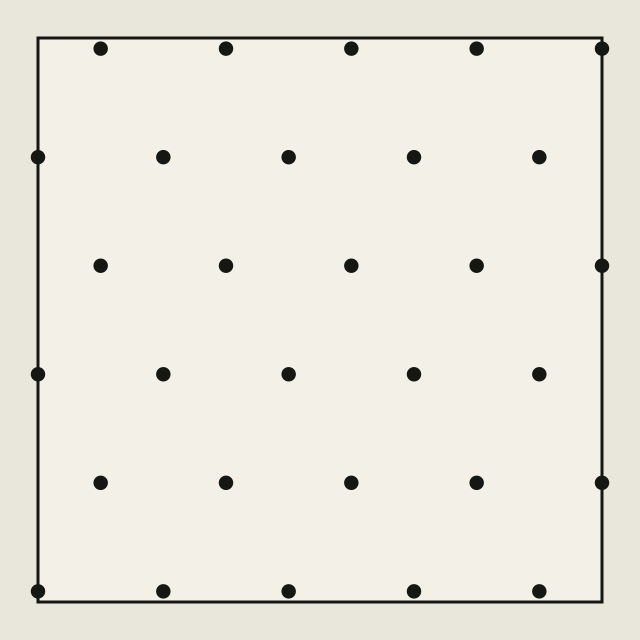
The most uniform sampling mesh in the unit square · n = 30
Place n points in the unit square. Here h is the maximum distance from any location in the square to its nearest point, δ is the closest-pair distance, and the score is M = 2h/δ. Make M as small as possible.
Instancen = 30
ObjectiveMinimize the uniformity M
Record comparison
the uniformity M · Lower is better| Record | Value / interval | Author / holder | Source |
|---|---|---|---|
| Proven optimum | 2/√3 | MinMax Arena | Site paper ↗ |
| Site record | 1.154700544784 | 今天 | Record details ↓ |
The continuous optimum is proved, so competition submissions are closed. Historical records and contribution points are retained. Because finite-decimal coordinates cannot attain this value exactly, the current certificate is not claimed optimal on the nine-decimal grid.
Formal definition
- ContainerThe unit square, with (0, 0) at the lower-left corner and (1, 1) at the upper-right
- SubmissionExactly n points, each coordinate a decimal with at most nine places; no two points may coincide
- Covering radiush(P) is the distance from the worst-covered location in the square to its nearest submitted point
- Separationδ(P) is the distance between the closest pair of submitted points
- ScoreM(P) penalizes both large holes and close pairs; internally M(P)² = 4h(P)²/δ(P)² is computed exactly, then rounded upward at 10⁻¹⁵
- ObjectiveMake M(P) as small as possible over all legal point sets P