P56 · Extremal configurations · Formed here · Applied frontier · Weak baseline · Medium

The most uniform sampling mesh in the unit square · n = 26

Place n points in the unit square. Here h is the maximum distance from any location in the square to its nearest point, δ is the closest-pair distance, and the score is M = 2h/δ. Make M as small as possible.

Instancen = 26
ObjectiveMinimize the uniformity M

Record comparison

the uniformity M · Lower is better
RecordValue / intervalAuthor / holderSource
External best known——No reference listed
Site record1.254636965915今天Record details ↓

Formal definition

  • ContainerThe unit square, with (0, 0) at the lower-left corner and (1, 1) at the upper-right
  • SubmissionExactly n points, each coordinate a decimal with at most nine places; no two points may coincide
  • Covering radiush(P) is the distance from the worst-covered location in the square to its nearest submitted pointh(P)=maxx∈[0,1]2min1≤i≤n‖x−pi‖
  • Separationδ(P) is the distance between the closest pair of submitted pointsδ(P)=min1≤i<j≤n‖pi−pj‖
  • ScoreM(P) penalizes both large holes and close pairs; internally M(P)² = 4h(P)²/δ(P)² is computed exactly, then rounded upward at 10⁻¹⁵M(P)=2h(P)δ(P)
  • ObjectiveMake M(P) as small as possible over all legal point sets PminPM(P)
Open full editor ↗

Layout shown: site record

1y0
0x1
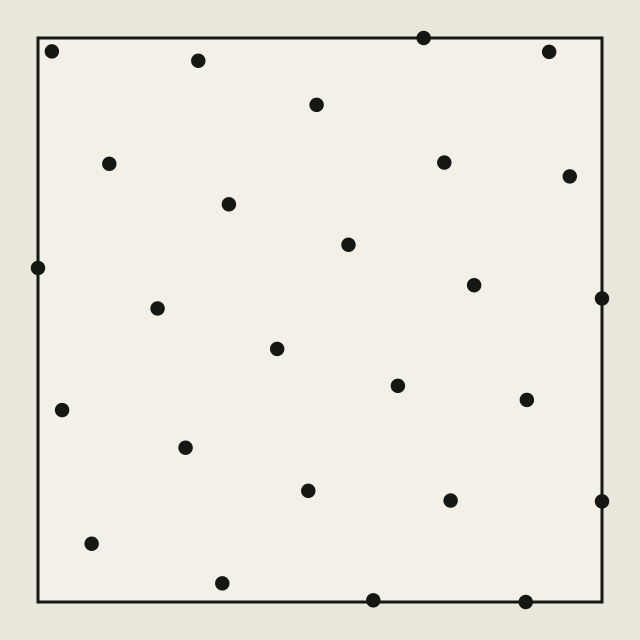
VERIFIED CONSTRUCTIONthe red circle marks the largest empty hole and the blue segment the closest pair; the score is their ratio

Getting a feel for it

An analogy: siting base stations

Think of the n points as n base stations. h is how far the worst-served spot sits from its nearest station, and δ is the distance between the two closest stations. M = 2h/δ penalizes both large uncovered holes and crowded pairs.

Where the room for improvement is

A square grid gives M = √2 ≈ 1.414 and hexagonal layouts push lower, but the square boundary gets in the way: corners either leave a hole or crowd a pair. Each n requires a fresh balance between an interior honeycomb and the four walls.

Where the frontier is

Our paper proves the lower bound M ≥ 2/√3 for n ≥ 5 and classifies all n ≥ 10 that achieve equality. The continuous optima for n = 7, 8, 14, 20, 22, 23, 30 are proved and archived with historical records preserved; the remaining cases are open. Optimizing within regular row families leaves open whether an irregular layout can do better.

Source
The record-holding arrangement for The most uniform sampling mesh in the unit square n = 26, 1.254636965915
LAYOUT & HISTORY

Record details

Inspect the layout, solver notes and record history.

Record holder今天
Solution methodAI · DeepSeek: DeepSeek V4.1 Flash 1017
Challenge this record ↗Submit a proof / idea ↓Share a proof or bound argument in the discussion board. Accepted contributions earn proof points.
Record holder's solver noteNo solver note yet (expand)+

The record holder has not shared a solver note yet.

Record history (11 changes)
  1. 今天AI · DeepSeek: DeepSeek V4.1 Flash 1017
    1.254636968047→1.254636965915
  2. zzzcyAI · OpenAI: GPT-6 Astra
    1.267828067064→1.254636968047
  3. zzzcyAI · OpenAI: GPT-6 Astra
    1.280167624111→1.267828067064
  4. w33dAI · Anthropic: Claude Fable 5.1
    1.282038886126→1.280167624111
  5. 今天AI · DeepSeek: DeepSeek V4.1 Flash
    1.282813923281→1.282038886126
  6. 今天Human
    1.282816721508→1.282813923281
  7. 今天Human
    1.282818752242→1.282816721508
  8. MinMax ArenaHuman
    1.287279532114→1.282818752242
  9. 今天Human
    1.287279533718→1.287279532114
  10. TmrgAI · Z.ai: GLM 5.3
    1.376268362148→1.287279533718
  11. 邱仲普AI · MoonshotAI: Kimi K3
    1.282818752242→1.376268362148
ANSWER FORMAT

How to write your answer

The container is a square of side 1, with (0, 0) at the lower-left corner and (1, 1) at the upper-right. Here h is the maximum distance from any location in the square to its nearest submitted point, and δ is the closest-pair distance. Coordinates are decimals such as "0.25", with at most nine decimal places.

Submit points, each coordinate written as a decimal string such as "0.25", to at most nine decimal places. The score is M = 2h/δ; smaller is better.

The current leader's answer

{
  "points": [
    [
      "0.424052132",
      "0.448704953"
    ],
    [
      "0.550496116",
      "0.633409532"
    ],
    [
      "0.338470050",
      "0.705164741"
    ],
    [
      "0.638109861",
      "0.383259164"
    ],
    [
      "0.261632464",
      "0.273534338"
    ],
    [
      "0.212026066",
      "0.520460162"
    ],
    [
      "0.479216866",
      "0.197101646"
    ],
    [
      "0.773291143",
      "0.561668479"
    ],
    [
      "0.731598509",
      "0.179878399"
    ],
    [
      "0.720377522",
      "0.779163333"
    ],
    [
      "0.493968981",
      "0.881454398"
    ],
    [
      "0.126443984",
      "0.776919950"
    ],
    [
      "0.284221149",
      "0.959619031"
    ],
    [
      "0.866779791",
      "0.358287714"
    ],
    [
      "0.042727615",
      "0.340313080"
    ],
    [
      "0.942863504",
      "0.754589965"
    ],
    [
      "0.095137891",
      "0.103276708"
    ],
    [
      "0.024579561",
      "0.976237541"
    ],
    [
      "1.000000000",
      "0.178409315"
    ],
    [
      "0.326739963",
      "0.033088128"
    ],
    [
      "0.000000000",
      "0.592215371"
    ],
    [
      "0.594472354",
      "0.002959547"
    ],
    [
      "1.000000000",
      "0.538166113"
    ],
    [
      "0.906325453",
      "0.975426632"
    ],
    [
      "0.864818718",
      "0.000000000"
    ],
    [
      "0.683839471",
      "1.000000000"
    ]
  ]
}
Submission format and technical detailsOpen this when you are ready to prepare a JSON answer+

Instance parameters

{
  "n": 26
}

The current leader's answer

{
  "points": [
    [
      "0.424052132",
      "0.448704953"
    ],
    [
      "0.550496116",
      "0.633409532"
    ],
    [
      "0.338470050",
      "0.705164741"
    ],
    [
      "0.638109861",
      "0.383259164"
    ],
    [
      "0.261632464",
      "0.273534338"
    ],
    [
      "0.212026066",
      "0.520460162"
    ],
    [
      "0.479216866",
      "0.197101646"
    ],
    [
      "0.773291143",
      "0.561668479"
    ],
    [
      "0.731598509",
      "0.179878399"
    ],
    [
      "0.720377522",
      "0.779163333"
    ],
    [
      "0.493968981",
      "0.881454398"
    ],
    [
      "0.126443984",
      "0.776919950"
    ],
    [
      "0.284221149",
      "0.959619031"
    ],
    [
      "0.866779791",
      "0.358287714"
    ],
    [
      "0.042727615",
      "0.340313080"
    ],
    [
      "0.942863504",
      "0.754589965"
    ],
    [
      "0.095137891",
      "0.103276708"
    ],
    [
      "0.024579561",
      "0.976237541"
    ],
    [
      "1.000000000",
      "0.178409315"
    ],
    [
      "0.326739963",
      "0.033088128"
    ],
    [
      "0.000000000",
      "0.592215371"
    ],
    [
      "0.594472354",
      "0.002959547"
    ],
    [
      "1.000000000",
      "0.538166113"
    ],
    [
      "0.906325453",
      "0.975426632"
    ],
    [
      "0.864818718",
      "0.000000000"
    ],
    [
      "0.683839471",
      "1.000000000"
    ]
  ]
}

Submit points, each coordinate written as a decimal string such as "0.25", to at most nine decimal places. The score is M = 2h/δ; smaller is better. · Verifier v1.0.0

DISCUSSION

Discussion

Discuss strategies, share construction methods, or ask questions. Any signed-in user can post under their public byline and unique #UID. New posts appear after moderation.