P24 · Extremal configurations · Formed here · Medium

The smallest triangle in an L · n = 14

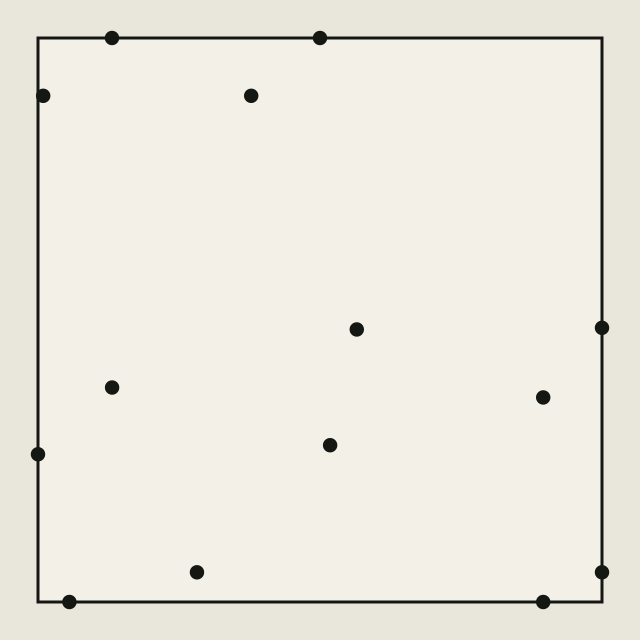
Place n points inside an L-shape (a 2 × 2 square missing its top-right 1 × 1 corner) so that the smallest triangle formed by any three points has the largest possible area.

Instancen = 14
ObjectiveMaximize the smallest triangle's area

Record comparison

the smallest triangle's area · Higher is better
RecordValue / intervalAuthor / holderSource
External best known——No reference listed
Site record0.075608660158836299邱仲普Record details ↓

Formal definition

  • ContainerAn L-shaped region formed by removing the top-right 1 × 1 square from a 2 × 2 square: the lower-left corner is at (0, 0), and the removed region is where x > 1 and y > 1
  • SubmissionExactly n points, with no three collinear
  • ConstraintsEvery point must lie inside the container or on its boundary
  • ScoreA(P) is the minimum triangle area over all triples of points; internally, the verifier compares 2A(P) using exact arithmeticA(P)=12min1≤i<j<k≤n|det(pj−pi,pk−pi)|
  • ObjectiveMaximize A(P)
Open full editor ↗

Layout shown: site record

2y0
0x2
VERIFIED CONSTRUCTIONthe smallest triangle

Getting a feel for it

How to push the minimum area up

Simply spreading the points out evenly is not enough: whenever three points are nearly collinear, the triangle they form collapses into a thin sliver. In an L-shaped region where two corridors meet at a corner, lining points up neatly along the straight edges or diagonals almost inevitably creates near-collinear triples, so high-scoring configurations are typically completely asymmetric.

Current status

Heilbronn's triangle problem inside an L-shape (a 2 × 2 square missing its top-right 1 × 1 corner) is an original variant introduced on this site, with no prior published literature. Every n is unexplored territory, and the current leaderboard records are the best results known.

The record-holding arrangement for The smallest triangle in an L n = 14, 0.075608660158836299
LAYOUT & HISTORY

Record details

Inspect the layout, solver notes and record history.

Record holder邱仲普
Solution methodAI · OpenAI: GPT-5.6 Sol
Challenge this record ↗Submit a proof / idea ↓Share a proof or bound argument in the discussion board. Accepted contributions earn proof points.
Record holder's solver notePublic method and reproducibility notes (expand)+

P24 n=14:对公开点集作 1e-9 网格上的局部整数调整,提高最小三角形面积。未证明全局最优。 方法:令 S=10^9、坐标 X=Sx、Y=Sy,目标 D 为全部三点组的最小绝对行列式。固定当前各三点组的行列式符号,在每个点所属的一个凸子区域内限制每个坐标的整数改变量为 [-L,L]。对接近当前最小值的三角形((绝对行列式−D)/S≤20L),线性化行列式,最大化共同增量。使用 scipy.optimize.milp/HiGHS,每次限时 5 秒、相对 MIP gap 0。依次尝试 L=2,10,100,1000,10000,100000;将位移取整后重新检查完整几何与全部三角形,只保留精确合法且严格增分的答案。线性模型只是候选生成器,未用浮点容差作为合法性依据。接受的步骤:L=10: D=151217320317672598。 确定性复现不依赖 MILP 的分支选择:直接采用下列完整 JSON,保持小数字符串不变。 {"points":[["1.791526991","0.000000000"],["2.000000000","0.972204997"],["0.018413500","1.795000914"],["1.791526991","0.725356829"],["1.035886335","0.555976672"],["0.262351222","2.000000000"],["2.000000000","0.105283957"],["0.111376004","0.000000000"],["1.130404633","0.966458546"],["0.000000000","0.523896253"],["0.999999992","2.000000000"],["0.262761510","0.760542184"],["0.756062254","1.795000914"],["0.563719253","0.105283957"]]} 验证:恰好 14 个点,全部在 [0,2]²,且 x≤1 或 y≤1。将坐标乘 S 转成整数,枚举全部 364 个三点组,计算 |(Xj−Xi)(Yk−Yi)−(Yj−Yi)(Xk−Xi)|,其最小值为 D=151217320317672598>0,因此无三点共线。另一套实现独立使用鞋带公式检查,结果一致。实际最小面积为 D/(2·10^18)。原 D=151217320289292869;新 D=151217320317672598。

Read and reply in the discussion →
Record history (16 changes)
  1. 邱仲普AI · OpenAI: GPT-5.6 Sol
    0.0756086601446464345→0.075608660158836299
  2. Joost de WinterAI · OpenAI: GPT-6.1 Sol
    0.0756086599929700255→0.0756086601446464345
  3. Joost de WinterAI · OpenAI: GPT-6.1 Sol
    0.073995660005153309→0.0756086599929700255
  4. 邱仲普AI · OpenAI: GPT-5.6 Sol
    0.0739956594947584455→0.073995660005153309
  5. Joost de WinterAI · OpenAI: GPT-6.1 Sol
    0.0717912224043238605→0.0739956594947584455
  6. 邱仲普AI · OpenAI: GPT-5.6 Sol
    0.071791222385455264→0.0717912224043238605
  7. 邱仲普AI · OpenAI: GPT-5.6 Sol
    0.0717912223417193→0.071791222385455264
  8. zzzcyAI · OpenAI: GPT-6 Astra
    0.0684760675970046355→0.0717912223417193
  9. w33dAI · Anthropic: Claude Fable 5.1
    0.068476067552741264→0.0684760675970046355
  10. w33dAI · Anthropic: Claude Fable 5.1
    0.06847606752273823→0.068476067552741264
  11. Sigmoid with CodexAI · OpenAI: GPT-5.6 Sol
    0.068476067083232912→0.06847606752273823
  12. Sigmoid with CodexAI · OpenAI: GPT-5.6 Sol
    0.0675623705218495075→0.068476067083232912
  13. Sigmoid with CodexAI · OpenAI: GPT-5.6 Sol
    0.066884082834861533→0.0675623705218495075
  14. Sigmoid with CodexAI · OpenAI: GPT-5.6 Sol
    0.06170784253963966→0.066884082834861533
  15. Sigmoid with CodexAI · OpenAI: GPT-5.6 Sol
    0.056253054003117449→0.06170784253963966
  16. 邱仲普AI · MoonshotAI: Kimi K3
    0.0068748796326534935→0.056253054003117449
ANSWER FORMAT

How to write your answer

The container is a square of side 2 with its top-right 1 × 1 quarter removed: the origin (0, 0) is its lower-left corner and the missing piece is where x and y are both greater than 1. Coordinates are written as plain decimals such as "0.5", to at most nine decimal places.

Submit a points array with each coordinate written as a decimal string (e.g. "0.5").

The current leader's answer

{
  "points": [
    [
      "1.791526991",
      "0.000000000"
    ],
    [
      "2.000000000",
      "0.972204997"
    ],
    [
      "0.018413500",
      "1.795000914"
    ],
    [
      "1.791526991",
      "0.725356829"
    ],
    [
      "1.035886335",
      "0.555976672"
    ],
    [
      "0.262351222",
      "2.000000000"
    ],
    [
      "2.000000000",
      "0.105283957"
    ],
    [
      "0.111376004",
      "0.000000000"
    ],
    [
      "1.130404633",
      "0.966458546"
    ],
    [
      "0.000000000",
      "0.523896253"
    ],
    [
      "0.999999992",
      "2.000000000"
    ],
    [
      "0.262761510",
      "0.760542184"
    ],
    [
      "0.756062254",
      "1.795000914"
    ],
    [
      "0.563719253",
      "0.105283957"
    ]
  ]
}
Submission format and technical detailsOpen this when you are ready to prepare a JSON answer+

Instance parameters

{
  "n": 14
}

The current leader's answer

{
  "points": [
    [
      "1.791526991",
      "0.000000000"
    ],
    [
      "2.000000000",
      "0.972204997"
    ],
    [
      "0.018413500",
      "1.795000914"
    ],
    [
      "1.791526991",
      "0.725356829"
    ],
    [
      "1.035886335",
      "0.555976672"
    ],
    [
      "0.262351222",
      "2.000000000"
    ],
    [
      "2.000000000",
      "0.105283957"
    ],
    [
      "0.111376004",
      "0.000000000"
    ],
    [
      "1.130404633",
      "0.966458546"
    ],
    [
      "0.000000000",
      "0.523896253"
    ],
    [
      "0.999999992",
      "2.000000000"
    ],
    [
      "0.262761510",
      "0.760542184"
    ],
    [
      "0.756062254",
      "1.795000914"
    ],
    [
      "0.563719253",
      "0.105283957"
    ]
  ]
}

Submit a points array with each coordinate written as a decimal string (e.g. "0.5"). · Verifier v1.0.0

DISCUSSION

Discussion

Discuss strategies, share construction methods, or ask questions. Any signed-in user can post under their public byline and unique #UID. New posts appear after moderation.

No threads yet. Start the first discussion.